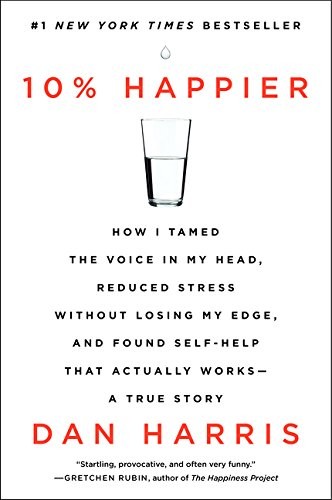
10% Happier by Dan Harris is a 2014 memoir book about meditation, mindfulness, anxiety. Meditation is not a mystical or New Age practice but a trainable cognitive skill with real effects on the relationship between awareness and the automatic thoughts and impulses that drive behavior.
Summary
10% Happier is Dan Harris's account of discovering meditation after a panic attack live on Good Morning America in 2004 forced him to confront an anxiety problem he'd been managing with cocaine and a punishing work schedule. Harris is a television journalist and ABC News anchor, and the book is written in his voice — skeptical, competitive, self-deprecating, and suspicious of anything that smells like self-help. The result is the most effective gateway to meditation for people who consider themselves too hard-edged or rational for it.
The book tracks Harris's path from panic attack to reluctant meditator across encounters with figures from evangelical Christians and new-age gurus to the Dalai Lama, Eckhart Tolle, and eventually Bhante Gunaratana and Mark Epstein. His reporting instinct serves him well: he approaches every teacher as a story, interrogating their claims, looking for the gap between their message and their behavior, and eventually identifying the claims that survive scrutiny. The eventual teacher who cracks him is the psychotherapist and Buddhist practitioner Mark Epstein, who explains meditation in psychological and scientific terms that Harris can engage with without feeling credulous.
The meditation practice Harris arrives at is distinctly practical. He is not seeking enlightenment or spiritual transformation; he wants a tool for managing the voice in his head — the relentless internal narrator that commentates, criticizes, plans, and judges without pause. The meditation he practices (primarily breath-awareness vipassana) gives him the capacity to observe that voice rather than be identified with it. The title's modest claim — ten percent happier — is part of the book's appeal: he promises no miracles, only a modest and real improvement in the relationship with one's own mind.
The book's cultural contribution is significant. Harris reached an audience that books by actual meditation teachers would never have found, and his credible-skeptic stance made meditation discussable in locker rooms, newsrooms, and boardrooms where Kabat-Zinn's clinical framing had limited reach. The 10% Happier app and podcast that grew from the book reflect the same positioning: hard-edged, skeptical, evidence-aware, and focused on practical benefit rather than spiritual aspiration.
Talk to 10% Happier like its author wrote you back.
Get the ideas that fit your life — not generic summaries.
- Chat with the book
- Audiobook-style main ideas
- Adapts to your life and goals
- Helps you take action
Key takeaways
- 1.
Meditation is not a mystical or New Age practice but a trainable cognitive skill with real effects on the relationship between awareness and the automatic thoughts and impulses that drive behavior.
- 2.
The inner narrator — the voice that commentates, criticizes, and plans — is not 'you' but a mental pattern you can observe; that observation, practiced regularly, reduces its automatic power over mood and behavior.
- 3.
The 'price of security' theory Harris develops with his therapist: anxiety that served him well as a driven journalist was the same mechanism that was also making him miserable, and managing it required neither eliminating ambition nor ignoring anxiety.
- 4.
Science increasingly supports meditation's effects: research on attention, emotional regulation, immune function, and neural structure changes with regular practice provides a non-spiritual justification for skeptics.
- 5.
The ten percent framing is honest and appropriate: meditation does not solve life's problems or produce lasting bliss, but it does produce a measurable and real improvement in the quality of one's relationship to experience.
- 6.
Ego depletion — the mental exhaustion from constant self-monitoring and appearance management — is reduced by regular meditation practice, producing a quieter, less reactive baseline.
- 7.
Many people who consider themselves too smart or too busy for meditation are actually describing their ego's resistance to the practice of witnessing themselves objectively.
- 8.
Starting small matters: beginning with five minutes of breath-awareness meditation daily is sufficient to develop the skill, and the compounding effect over months and years is larger than the modest daily investment implies.
Discussion questions
Use these on your own, with a book club, or as chat starters in Superbook. Book club version, ready to copy or print →
- 1.
Harris's entry point to meditation was a panic attack on live television. What would your equivalent forcing event be — the moment when you'd have to take your inner life more seriously?
- 2.
The book is written for skeptics. Did Harris's skeptical framing make meditation more or less appealing to you than more earnest presentations do?
- 3.
He distinguishes between striving and suffering — arguing that ambition is compatible with not making yourself miserable about outcomes. Is that distinction actually achievable in practice?
- 4.
Harris covers his cocaine use as self-medication for anxiety. Do you recognize the pattern of reaching for external stimulation to manage an internal state?
- 5.
The inner narrator is a central figure in the book. When you notice your inner narrator most strongly, what is it usually saying?
- 6.
He argues that the 'price of security' — the anxiety that drove his success — was worth examining but not eliminating. How do you think about the relationship between your productive anxieties and your wellbeing?
- 7.
The book covers multiple teachers and spiritual figures. How do you evaluate teachers whose personal behavior doesn't consistently match their teaching?
- 8.
Harris started meditating reluctantly and found it genuinely useful. Is there a practice you've resisted that you suspect would be beneficial if you gave it a real try?
- 9.
The ten percent framing sets a low bar deliberately. Does that modesty make the practice more appealing or does it seem like underselling something that may be more significant?
- 10.
He covers the neuroscience of meditation briefly — neural changes with practice, reduced amygdala reactivity. How much does scientific validation matter to your willingness to try a contemplative practice?
- 11.
The book became a gateway to meditation for many competitive, driven professionals. What is it about that demographic that makes the mainstream mindfulness framing inadequate for them?
- 12.
If you meditate, what has your experience been? If you don't, what specifically has prevented you from starting?
Themes
Frequently asked questions
-
Do you need to be a skeptic to enjoy 10% Happier?
No, but it's written primarily for people who find conventional mindfulness books too earnest or spiritual. Readers who are already practicing meditators will find the material familiar; those who have resisted meditation because it felt too New Age will find this the most accessible entry point available.
-
Does 10% Happier teach you how to meditate?
Partially — Harris describes the practice he uses and gives enough basic instruction to start. For more detailed instruction, the companion book Meditation for Fidgety Skeptics or a formal app or course would be more useful. The book is primarily about the journey to meditation rather than a meditation manual.
-
What meditation does Harris practice?
Primarily breath-awareness vipassana meditation — attending to the sensations of breathing and gently returning attention when it wanders. He practices this using a technique taught by teachers in the Theravada tradition, as explained by Mark Epstein, Bhante Gunaratana, and others.
-
Is 10% Happier appropriate for people with anxiety disorders?
Yes, though it is not a clinical treatment guide. Harris's own anxiety is the book's subject, and his account of how meditation changed his relationship to anxiety is useful and relatable. For clinical anxiety disorders, professional treatment remains important alongside any meditation practice.
-
What is the 10% Happier app?
An app offering guided meditations, courses, and podcast content aimed at secular practitioners and skeptics. It grew from the book's success and features content from many of the teachers Harris interviewed, as well as a substantial podcast library covering meditation, psychology, and wellbeing from a non-devotional angle.