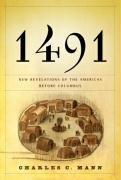
1491: New Revelations of the Americas Before Columbus by Charles C. Mann is a 2005 history book about pre-columbian civilizations, indigenous history, ecology. The pre-Columbian Americas were far more densely populated than the colonial and post-colonial narrative assumed, with some estimates placing the hemisphere's population above Europe's at the time of contact.
Summary
Charles Mann's 1491 sets out to correct a widespread misconception: that the Americas before Columbus were a mostly empty wilderness populated by small, isolated bands of hunter-gatherers living in gentle harmony with an untouched nature. The picture that has emerged from archaeology, genetics, ecology, and epidemiology over the past several decades is radically different. The pre-Columbian Americas were densely populated, deeply engineered, and home to some of the most sophisticated civilizations in the world at the time of contact.
Mann argues on three main fronts. First, the population: estimates of pre-contact indigenous populations have revised sharply upward, with some scholars arguing that the Americas had more people than Europe in 1491. The catastrophic collapse that followed contact — from diseases to which American populations had no immunity — may have killed 90 percent of the hemisphere's inhabitants within a century. Second, the technology: from the terraformed soils of Amazonia (the "dark earths" of the terra preta) to the engineered flood plains of the Maya lowlands, indigenous peoples actively managed their landscapes at a continental scale. The "untouched wilderness" that European settlers encountered was in many cases a recently emptied landscape still showing the scars of demographic collapse. Third, the political and social complexity: the Aztec empire, the Inca road system, and the Haudenosaunee confederacy (which may have influenced American democratic thought) represent levels of political organization that the received story of primitive peoples substantially underestimates.
The book does not romanticize. Mann is careful to present the scientific debates honestly, acknowledging where evidence is contested and where researchers disagree sharply. He is also willing to note that pre-Columbian societies had violence, hierarchy, and environmental impacts of their own. His target is not to replace one mythology with another, but to replace a simplified and largely colonial narrative with the genuinely complex reality.
What makes 1491 unusual is its combination of accessibility and rigor. Mann is a science journalist who spent years reporting this story, and the book reads with the energy of a long magazine feature — specific, peopled with vivid researchers and excavation sites, and alert to the drama of ideas shifting under the weight of new evidence. The result is one of the more important popular histories of the past two decades, one that has measurably changed what general readers know about this subject.
Talk to 1491: New Revelations of the Americas Before Columbus like its author wrote you back.
Get the ideas that fit your life — not generic summaries.
- Chat with the book
- Audiobook-style main ideas
- Adapts to your life and goals
- Helps you take action
Key takeaways
- 1.
The pre-Columbian Americas were far more densely populated than the colonial and post-colonial narrative assumed, with some estimates placing the hemisphere's population above Europe's at the time of contact.
- 2.
European diseases killed up to 90 percent of indigenous populations within a century of contact, creating the 'wilderness' that later settlers encountered — a landscape still recovering from catastrophic depopulation.
- 3.
Amazonia was not pristine wilderness but a densely managed landscape. Terra preta — deliberately engineered dark soils — shows that indigenous peoples transformed the Amazon basin at continental scale.
- 4.
The Maya, Aztec, and Inca civilizations were not aberrations in a world of primitives but participants in a hemispheric network of political and economic complexity comparable to anything in the Old World.
- 5.
The Haudenosaunee (Iroquois) confederacy was a sophisticated political arrangement that some historians argue influenced the American founders' ideas about federation and checks on central power.
- 6.
Pre-Columbian agriculture was not primitive subsistence farming. Maize, potatoes, tomatoes, and other crops developed by indigenous Americans transformed global food systems after contact.
- 7.
The 'natural' landscapes of North America that European settlers experienced were in many cases actively managed by indigenous fire practices, which shaped forests, grasslands, and wildlife populations.
- 8.
Archaeological and genetic evidence continues to revise the story of when and how people arrived in the Americas, with some evidence suggesting human presence far earlier than the conventional Bering land bridge narrative.
Discussion questions
Use these on your own, with a book club, or as chat starters in Superbook. Book club version, ready to copy or print →
- 1.
Mann argues that the 'empty wilderness' narrative was not just wrong but served a colonial purpose. Is that a fair characterization, or does it impose later political concerns onto earlier ignorance?
- 2.
The book relies heavily on debates among specialists that are still unresolved. How should a general reader calibrate confidence when the experts disagree so sharply?
- 3.
What changes in your understanding of North American history if the landscapes that European settlers described as wilderness were actually recently depopulated landscapes?
- 4.
The Haudenosaunee confederacy claim — that it influenced American democratic thought — is contested. Does the political valence of that claim affect how you evaluate the evidence?
- 5.
Mann is careful to note that pre-Columbian societies had violence and environmental impact of their own. How does that acknowledgment change the argument he's making?
- 6.
The scale of the demographic collapse after contact is one of the largest in human history. Why do you think this catastrophe is so little known in mainstream historical memory?
- 7.
How does the terra preta story — deliberately engineered Amazonian soil — change how you think about the boundary between 'natural' and 'managed' ecosystems?
- 8.
What does it mean that much of what we call the 'natural' American landscape is actually a product of indigenous land management? Does it change conservation arguments?
- 9.
Mann revised and updated the book in 2011. What areas of this story do you think have changed most significantly in the years since?
- 10.
Is there an equivalent story in another part of the world — a region whose pre-contact history has been substantially misrepresented by the colonial narrative?
- 11.
The book mixes science journalism with historical argument. Does that hybrid form serve the material, or does it sacrifice depth for accessibility?
- 12.
What responsibility do contemporary Americans have in relation to the history Mann describes, and does better historical knowledge change that responsibility?
Themes
Frequently asked questions
-
Is 1491 worth reading?
Yes, especially if your knowledge of pre-Columbian history comes from school textbooks. The book substantially revises a narrative that most educated people absorbed without questioning, and it does so with specificity and honesty about contested evidence.
-
How long does it take to read 1491?
Around eight to nine hours at average reading pace. At 450 pages, it is substantial, but the writing is accessible and the chapters are organized around specific arguments rather than chronology, which makes it easy to pause and return.
-
How does 1491 relate to 1493?
1491 covers the Americas before European contact. 1493 covers what happened after — the global exchange of plants, animals, diseases, and people that reshaped the entire world's ecology and economy. They are companion volumes and either can be read first.
-
Is 1491 accurate? Are there criticisms?
Mann is a journalist synthesizing active scientific debates, and he acknowledges where evidence is contested. Some specialists argue he gives too much weight to the high-population estimates and the Haudenosaunee influence thesis. The book has held up well overall but should be read as a starting point for the debates it describes, not as settled history.
-
Who should read 1491?
Anyone interested in pre-Columbian history, the history of the Americas, or how colonial narratives shaped historical memory. It is also useful for readers interested in historical ecology — how human populations shaped the landscapes we now call natural.
Similar books
Sapiens: A Brief History of Humankind
Yuval Noah Harari
Guns, Germs, and Steel
Jared Diamond
1493: Uncovering the New World Columbus Created
Charles C. Mann
A Short History of Nearly Everything
Bill Bryson
