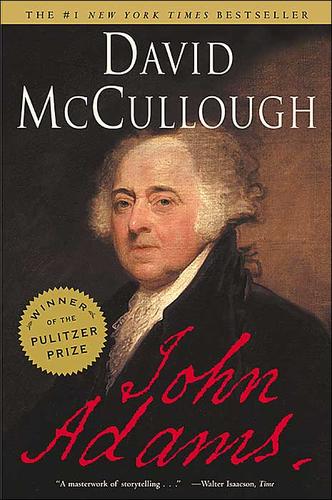
John Adams by David McCullough is a 2001 biography book about founding era, political courage, marriage and partnership. Adams kept the United States out of war with France in 1798-1800, despite Hamilton's opposition and the political cost to his own party. McCullough presents this as his most consequential achievement.
Summary
David McCullough's biography of John Adams, published in 2001, was a commercial phenomenon that spent years on bestseller lists and won the Pulitzer Prize. McCullough draws heavily on the Adams family papers — letters, diaries, and documents held at the Massachusetts Historical Society — to produce a portrait of America's second president that is warmer and more sympathetic than most previous assessments. Adams had long been overshadowed by Washington, Jefferson, and Hamilton in popular history, and McCullough's book was largely responsible for rehabilitating his reputation.
The biography's spine is Adams's long marriage to Abigail Adams, and McCullough uses their extraordinary correspondence — they were separated for years at a time during his diplomatic and political service — to reveal both characters. Abigail emerges as one of the more formidable figures in early American history: intellectually sharp, politically astute, and essential to her husband's equilibrium. The letters between them are among the most intimate documents produced by any American president, and McCullough quotes them extensively.
Adams's career included defending the British soldiers charged after the Boston Massacre — an act of legal courage that cost him politically — serving as America's first ambassador to the Court of St. James's, two terms as Washington's vice president, and a single term as president in which he kept the country out of war with France over the vociferous objections of Hamilton and the war faction of his own party. McCullough frames that decision as one of the most consequential acts of political courage in early American history.
The book's final section covers Adams's retirement in Quincy, his estrangement from and reconciliation with Jefferson, and the extraordinary coincidence of their deaths on the same day — July 4, 1826, the republic's fiftieth anniversary. McCullough is a narrative historian rather than an analytical one, and some critics have argued that his account is too celebratory and too thin on Adams's political failures, including the Alien and Sedition Acts. That objection is fair. But for readers who want to understand Adams as a person and a founding-era presence, McCullough's book is the most compelling available.
Talk to John Adams like its author wrote you back.
Get the ideas that fit your life — not generic summaries.
- Chat with the book
- Audiobook-style main ideas
- Adapts to your life and goals
- Helps you take action
Key takeaways
- 1.
Adams kept the United States out of war with France in 1798-1800, despite Hamilton's opposition and the political cost to his own party. McCullough presents this as his most consequential achievement.
- 2.
His defense of the British soldiers after the Boston Massacre illustrates a commitment to legal principle that made him a poor demagogue but an important constitutionalist.
- 3.
The Adams-Abigail partnership was unusually collaborative for its era. Her letters reveal a political intelligence that informed his decisions across decades.
- 4.
Adams's single presidential term was undermined by his own cabinet, which Hamilton controlled through surrogates, producing a governing crisis that prefigured later conflicts over executive authority.
- 5.
His long estrangement from Jefferson — once a close friend, later a bitter opponent — and their eventual reconciliation in old age illustrate the personal cost of political conflict at the founding level.
- 6.
Adams was suspicious of democracy in ways that made him unpopular but that reflected a consistent classical republican theory about the dangers of faction and the corrupting effects of popularity.
- 7.
The Alien and Sedition Acts, which Adams signed, are the most significant blemish on his record. McCullough treats them too briefly for an account that otherwise claims completeness.
- 8.
Adams and Jefferson both died on July 4, 1826, the republic's fiftieth birthday. The coincidence shaped how their contemporaries understood both men's legacies.
Discussion questions
Use these on your own, with a book club, or as chat starters in Superbook. Book club version, ready to copy or print →
- 1.
McCullough has been criticized for writing too sympathetically. Where in the biography do you feel his admiration shaping what he includes and what he minimizes?
- 2.
Adams kept the country out of war at significant political cost. What does the ability to absorb short-term loss for long-term benefit look like in political leadership today?
- 3.
The Adams-Abigail correspondence is extraordinary. What does it reveal about the relationship between private partnership and public service?
- 4.
How does Adams's defense of the Boston Massacre soldiers connect to his later constitutional thinking?
- 5.
Hamilton effectively controlled Adams's cabinet. What does that episode suggest about executive authority and cabinet loyalty?
- 6.
Adams was genuinely skeptical of popular democracy. Is that skepticism a liability or a useful counterweight in the founding era's arguments about government?
- 7.
The Alien and Sedition Acts allow prosecution of speech critical of the government. How does McCullough's treatment of that episode sit with his generally favorable portrait?
- 8.
What does Adams's vice presidency under Washington — a position he found deeply frustrating — reveal about the original design of that office?
- 9.
Adams and Jefferson reconciled in old age after years of bitterness. What made that reconciliation possible, and what does it say about the political nature of their earlier conflict?
- 10.
McCullough relies heavily on letters. How does reading a biography built around personal correspondence differ from reading one built around public documents and political analysis?
- 11.
Adams is often described as too honest for politics. Is that an admirable trait or a failure of practical judgment?
- 12.
What does this biography tell you about being the second of anything — the second president, the second founding father, the man who came after Washington?
Themes
Frequently asked questions
-
Is John Adams by McCullough worth reading?
Yes, especially if you want to understand the founding era through a personal rather than analytical lens. McCullough's narrative skill is exceptional, and the Adams-Abigail correspondence makes this biography unusually intimate. Readers who want more critical distance should supplement it with academic work on the period.
-
How long does it take to read John Adams?
The book runs to about 650 pages. At average reading pace that is roughly 18-20 hours. McCullough writes fluidly and the narrative moves quickly; most readers can finish it in a few weeks of regular reading.
-
What is McCullough's main argument about Adams?
That Adams has been unfairly neglected and overshadowed by more charismatic founders, and that his decision to keep the country out of war with France was one of the most consequential acts of political courage in early American history.
-
Does the biography cover the Alien and Sedition Acts?
Yes, but briefly. Critics argue McCullough underweights this episode, which involved the prosecution of newspaper editors for criticizing the government. Readers interested in that aspect should look at more critical historical treatments.
-
Who should read John Adams?
Anyone interested in the founding era who wants a personal, character-driven account rather than an institutional or political analysis. The book also appeals to readers interested in marriage and partnership, given how extensively McCullough draws on the Adams correspondence.