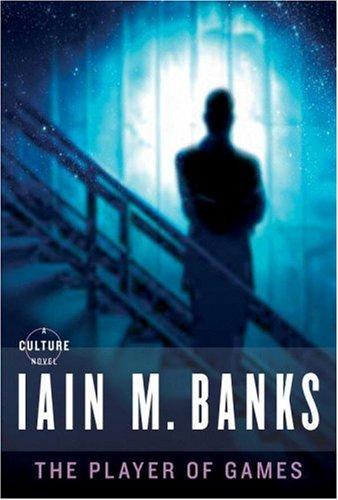
The Player of Games by Iain M. Banks is a 1988 science fiction book about power and empire, identity and performance, manipulation and free will. Azad is the novel's central metaphor: a game so complex it mirrors the civilization that built it, meaning to win the game is to master the civilization's logic — including its brutality.
Summary
Jernau Gurgeh is the greatest game player in the Culture — an interstellar post-scarcity civilization governed by benevolent AIs called Minds. Gurgeh has mastered every game worth mastering and finds himself curiously empty, a condition that makes him vulnerable when Special Circumstances, the Culture's intelligence service, offers him something unprecedented: a chance to travel to the Azadian Empire and play Azad. Azad is not just a game. It is the mechanism by which the Empire determines its Emperor, its power structures, and its entire social order. The best player rules. Gurgeh, who has never played anything but games, is about to discover that some games are the civilization.
Banks is doing several things at once in this compact novel. At the surface level it's a tournament narrative — Gurgeh learning Azad, advancing through rounds, facing increasingly brutal opponents. Below that it's a political allegory: the Azadian Empire is a thinly coded critique of hierarchical, violent, patriarchal civilization, and the game mirrors it perfectly. The game rewards brutality, enforces status, and eliminates mercy. That a Culture citizen who has lived inside a post-scarcity utopia must descend into this world to compete reveals something about how the Culture itself maintains its position.
Banks's real subject, as in most of the Culture novels, is what benevolent power actually costs and whether it can stay clean. Special Circumstances doesn't tell Gurgeh everything. The revelation near the end about what he's actually been doing is one of the sharpest moments in the series: not a twist for its own sake but a logical completion of everything the novel has set up. The Culture's methods are not so different from the Empire's.
This is widely considered the best entry point into the Culture series, more accessible and faster than Consider Phlebas and more self-contained than later entries. It rewards readers who like their science fiction to carry political and moral weight rather than just world-building spectacle. The game-within-empire conceit will appeal to anyone who has thought about how competition structures can encode the values of the societies that create them.
Talk to The Player of Games like its author wrote you back.
Get the ideas that fit your life — not generic summaries.
- Chat with the book
- Audiobook-style main ideas
- Adapts to your life and goals
- Helps you take action
Key takeaways
- 1.
Azad is the novel's central metaphor: a game so complex it mirrors the civilization that built it, meaning to win the game is to master the civilization's logic — including its brutality.
- 2.
Gurgeh's emptiness at the novel's opening is load-bearing. A post-scarcity citizen who has everything and feels nothing is precisely the kind of person who can be recruited for purposes he doesn't fully understand.
- 3.
Special Circumstances operates through manipulation rather than force — it's the Culture's intelligence arm, and its methods are morally different from the Empire's methods only in degree.
- 4.
The Azadian Empire's use of a game to select its ruler is satire of meritocracy: any system that turns selection into competition will encode the existing power structure into the rules.
- 5.
The revelation about Gurgeh's role — what he has actually been doing without knowing it — reframes the entire novel and forces a reassessment of whether the Culture's intervention was ethical.
- 6.
Banks's Minds — the AIs who run the Culture — are presented as genuinely benevolent but their benevolence does not mean they are transparent or that they don't operate in their own interests.
- 7.
The game itself evolves across three boards representing different domains. Banks uses this structure to escalate the moral stakes incrementally, so the novel's ending lands with the weight of everything that came before.
- 8.
The Player of Games is the Culture novel that most directly examines what it means to export your values by force, however indirectly, and whether the result is ever worth the cost.
Discussion questions
Use these on your own, with a book club, or as chat starters in Superbook. Book club version, ready to copy or print →
- 1.
Gurgeh is recruited partly because he is vulnerable — he's done something compromising and Special Circumstances knows about it. Does this make him complicit in what follows, or is he also a victim?
- 2.
The Azadian Empire encodes its values in Azad in a way that makes winning the game identical to embodying those values. Can you think of real-world games, competitions, or systems that work similarly?
- 3.
The Culture is presented as genuinely better than the Empire, but it operates through manipulation. By the novel's logic, is there a meaningful difference between the two civilizations' methods?
- 4.
Gurgeh feels empty and purposeless in the Culture despite having everything. Banks seems to take this seriously rather than dismissing it as ingratitude. What is the novel suggesting about meaning and constraint?
- 5.
The twist near the end — what Gurgeh was actually being used to do — is telegraphed to careful readers earlier in the novel. If you caught it, how did knowing affect your reading of Gurgeh's journey?
- 6.
The Azadian hierarchy involves not just class but embodied violence against lower-status people. Banks doesn't spare the detail. Is that necessary to make the political point, or does it go further than needed?
- 7.
Flere-Imsaho, Gurgeh's drone companion, is evasive throughout. At what point did you realize the extent of the deception, and how did that affect your trust in the Culture more broadly?
- 8.
Compare the Culture to an ideal you've encountered in political philosophy — libertarian, socialist, utilitarian. Which tradition does it most resemble, and where does it deviate?
- 9.
The ending suggests that the Culture's intervention in Azad was strategically successful but morally complicated. Does Banks seem to think the intervention was worth it?
- 10.
Banks wrote the Culture series over several decades. The Player of Games is one of the earliest. How does the Culture of this novel compare to how you imagine a post-scarcity civilization would actually function?
- 11.
Gurgeh is the best player in the Culture but loses early rounds at Azad. How does Banks use those losses to develop Gurgeh's character, and does the novel suggest he becomes a different person by the end?
- 12.
The novel ends with an epitaph of sorts. Given everything that has happened, how do you read that ending line — as irony, celebration, elegy, or something else?
Themes
Frequently asked questions
-
Is The Player of Games a good starting point for the Culture series?
Yes. Most fans consider it the best entry point — more accessible than the series opener Consider Phlebas, with a self-contained story and a protagonist who is introduced to the Culture alongside the reader. It's also the most structurally tight of the early novels.
-
Do I need to have read Consider Phlebas first?
No. The Culture novels are loosely connected and can be read in any order. This one stands entirely alone. Consider Phlebas is the first published but is longer and more demanding; The Player of Games is often recommended as a better introduction.
-
What is the Culture, exactly?
A fictional post-scarcity interstellar civilization managed by enormously intelligent AIs called Minds. Humans and other species live in abundance with minimal coercion. Banks used the Culture as a thought experiment about what a genuinely good society might look like, and what its limits and contradictions would be.
-
Is the game in the novel explained in enough detail to follow?
Yes. Banks doesn't give you enough to play Azad, but he gives you enough to understand the stakes of each round. The game is a conceptual device more than a fully specified system, and the novel works on that level.
-
Who might not enjoy this book?
Readers who find political allegory in science fiction heavy-handed, or who want their space opera to be about wonder and exploration rather than ethics and power. The novel is efficient and rarely wastes a scene, but its pleasures are cerebral more than visceral.