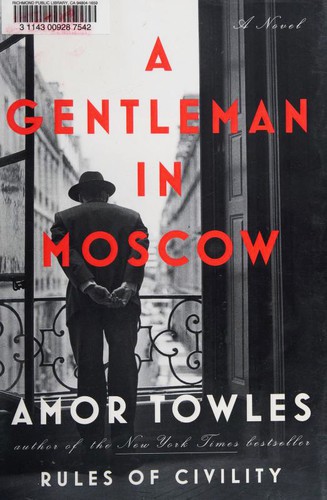
A Gentleman in Moscow by Amor Towles is a 2016 historical fiction book about confinement and freedom, elegance and survival, history and personal dignity. Rostov's response to confinement is not resignation but cultivation — the novel argues that you can build a rich interior life even within severe external limits.
Summary
In 1922, Count Alexander Rostov is sentenced by a Bolshevik tribunal — not to death, but to permanent house arrest in Moscow's Metropol Hotel. He is deemed an unrepentant aristocrat, stripped of his title and his suite, and moved to a small room in the hotel's attic. He will spend the next thirty-two years there, never setting foot outside, while Soviet history unfolds around him. A Gentleman in Moscow is the story of those decades: how a man of intelligence, taste, and self-discipline builds a life that is, against all expectations, a full one.
Towles is interested in a specific question: what does it mean to live well when your external circumstances have been radically constrained? Rostov's answer involves meticulous attention to the pleasures within reach — wine, food, friendship, books, the cultivation of craft. He becomes a head waiter, befriends a young girl named Sofia who grows up in the hotel, develops a profound relationship with a French actress and a cadre of hotel staff. The Metropol becomes a kind of compressed world, and Rostov's navigation of it is rendered with great warmth and considerable wit.
The novel is deliberately, consciously charming — it is one of the most purely enjoyable literary novels of the past decade, which is also one of the easiest criticisms to make of it. Some readers find its elegance evasive: the horrors of Stalinism are present in the background but never interrupt the novel's essential pleasantness. Towles keeps the terror at a remove, filtered through the Count's determined equanimity. Whether that constitutes a failure of moral seriousness or a deliberate artistic choice — an argument that maintaining grace under historical pressure is itself a form of resistance — is the central question the novel poses without fully answering.
Readers who want a warm, witty, beautifully constructed novel will find A Gentleman in Moscow one of the most satisfying reads of recent years. Readers who expect historical fiction to engage more directly with its era's violence and injustice may feel that Towles has written a comfort novel using Soviet Russia as scenery. Both reactions are defensible. The novel is aware of its own escapism and does not apologize for it.
Talk to A Gentleman in Moscow like its author wrote you back.
Get the ideas that fit your life — not generic summaries.
- Chat with the book
- Audiobook-style main ideas
- Adapts to your life and goals
- Helps you take action
Key takeaways
- 1.
Rostov's response to confinement is not resignation but cultivation — the novel argues that you can build a rich interior life even within severe external limits.
- 2.
The Metropol functions as a compressed version of twentieth-century Russia — figures from every political moment pass through, and Rostov observes them all with aristocratic detachment.
- 3.
Towles constructs a hero whose defining quality is equanimity. The novel tests that equanimity and mostly rewards it, which is either reassuring or too easy depending on your tolerance for comfort.
- 4.
Sofia's arc in the second half transforms the novel from a character study into something with more forward momentum — the ending is earned by everything that precedes it.
- 5.
The friendship between Rostov and the chef Emile, and the maitre d' Andrey, is one of the novel's quiet triumphs — a portrait of professional intimacy across decades.
- 6.
Towles handles time beautifully: years compress and expand depending on what happens, and the novel never feels like it's simply checking off historical periods.
- 7.
The novel's wit is not decoration — it is argument. Humor in the face of Soviet bureaucracy is a form of refusal.
- 8.
The question the novel leaves with you: is Rostov's contentment an achievement or a form of self-deception? Towles seems to think it's both, and that both are fine.
Discussion questions
Use these on your own, with a book club, or as chat starters in Superbook. Book club version, ready to copy or print →
- 1.
Rostov chooses to make the best of his confinement rather than raging against it. Is that wisdom or avoidance? Does the novel think there's a difference?
- 2.
The horrors of Stalinism are present in the novel's margins — denunciations, disappearances, famines — but they don't interrupt Rostov's essentially pleasant life. Is that an evasion or a choice that serves the novel's argument?
- 3.
What does Rostov lose by being confined? What, if anything, does he gain that he might not have gained otherwise?
- 4.
Sofia becomes the novel's engine in the second half. How does her arrival change the stakes of Rostov's story?
- 5.
Towles is an American writing about Soviet Russia from a position of emotional warmth toward his subject. Does that outsider perspective enrich the novel or flatten it?
- 6.
The ending is genuinely surprising and satisfying. Did it feel earned? Does the novel prepare for it, or does it arrive somewhat from nowhere?
- 7.
Compare Rostov to other characters confined by circumstance in fiction — the Count of Monte Cristo, say, or a prisoner-of-war novel. What does this novel do differently?
- 8.
The Metropol's staff become Rostov's real family. What does the novel say about friendship and chosen community as substitutes for the world outside?
- 9.
Is A Gentleman in Moscow a political novel? Does it have a position on Bolshevism, on Soviet history, or is it essentially apolitical?
- 10.
Towles writes about pleasure — food, wine, clothes — with unusual specificity and without embarrassment. What does that attention to material elegance accomplish in the novel?
- 11.
The novel became enormously popular. What do you think readers were responding to — the escapism, the warmth, something in the historical setting, the protagonist's character?
- 12.
If Rostov had been imprisoned in a gulag rather than a luxury hotel, would the same story be possible? What does the specific venue of the Metropol do for the novel?
Themes
Frequently asked questions
-
Is A Gentleman in Moscow worth reading?
Yes, if you want a smart, warm, beautifully written novel that is also genuinely fun. It's a rare combination: literary fiction that doesn't feel like homework. If you want historical fiction that engages directly with the horrors of its period, look elsewhere. If you want a novel about how to live with grace under constraint, this is one of the best of its kind.
-
How long does it take to read?
Around six to seven hours at average pace. The chapters are well-structured and the prose moves quickly despite the novel's length. Most readers report it as an unusually easy read for a book of its size and ambition.
-
What is the book about, briefly?
A Russian aristocrat sentenced to permanent house arrest in a Moscow luxury hotel in 1922 builds a full and meaningful life over the next three decades while Soviet history transforms the world outside.
-
Is it historically accurate?
The historical backdrop — the Metropol Hotel, the political events, the period details — is carefully researched. The Metropol was a real hotel and did host various Soviet-era dramas. The Count is fictional but his world is built from accurate period detail.
-
Is there a TV adaptation?
Yes — Paramount+ released a miniseries adaptation in 2024 starring Ewan McGregor as Count Rostov. It was broadly well-received and follows the novel's structure closely.
Similar books
The Splendid and the Vile: A Saga of Churchill, Family, and Defiance During the Blitz
Erik Larson
Sapiens: A Brief History of Humankind
Yuval Noah Harari
The Gulag Archipelago
Aleksandr Solzhenitsyn
The Captive Mind
Czesław Miłosz
