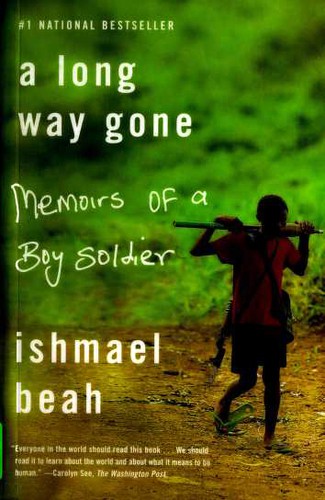
A Long Way Gone: Memoirs of a Boy Soldier by Ishmael Beah is a 2007 memoir book about war, child soldiers, trauma. Children can be shaped by war and systematic conditioning into instruments of violence without losing their underlying capacity for rehabilitation and moral reconstruction.
Summary
Ishmael Beah was twelve years old when the Sierra Leone civil war reached his village and he was separated from his family. A Long Way Gone follows the next several years: first as a refugee moving from village to village, then as a child soldier conscripted into the Sierra Leone Army at thirteen, and finally as a teenager in a UNICEF rehabilitation program trying to understand who he had become and whether he could change.
The account of Beah's time as a soldier is not flinched from. He describes the drugs given to child soldiers — cocaine, marijuana, a brown powder they called "brown brown" — that kept them aggressive and obliterated moral hesitation. He describes killings he committed. The rawness of this is the book's central challenge: Beah is asking readers to understand that children can be shaped by war into something terrible, and that this does not make them irredeemable. The argument is not comfortable, but it is the book's real subject.
The rehabilitation section, centered on a UNICEF program in Freetown, is where the memoir becomes most complicated. Beah and the other boys are hostile, violent, and initially uncooperative. The counselors — particularly a nurse named Esther — persist. Recovery here is not a montage. It's slow, inconsistent, and marked by relapses into rage. Beah eventually finds his way back to language and memory through storytelling, the same capacity that sustains his narrative voice throughout.
Beah was eventually brought to the United States and later addressed the United Nations as a children's rights advocate. A Long Way Gone is specific where it counts, and the specificity is what separates it from both victimhood narrative and war heroism. The book doesn't offer resolution so much as it insists that the capacity for rehabilitation is real — and that ignoring what creates child soldiers in the first place is the more dangerous choice.
Talk to A Long Way Gone: Memoirs of a Boy Soldier like its author wrote you back.
Get the ideas that fit your life — not generic summaries.
- Chat with the book
- Audiobook-style main ideas
- Adapts to your life and goals
- Helps you take action
Key takeaways
- 1.
Children can be shaped by war and systematic conditioning into instruments of violence without losing their underlying capacity for rehabilitation and moral reconstruction.
- 2.
The drugs given to child soldiers were not incidental but structural — part of a deliberate mechanism for overriding the psychological barriers to killing.
- 3.
Rehabilitation from extreme trauma is not linear. Beah and the other boys relapse repeatedly before stabilizing, and the process took years, not weeks.
- 4.
Storytelling and memory are both the wound and the medicine. Being able to narrate what happened to you is itself a form of reintegration.
- 5.
The adults who helped Beah recover — the nurse Esther, the UN advocate — did so through persistent, unhurried presence rather than formal therapeutic technique.
- 6.
Displacement creates its own compounding trauma. Moving through war zones without family or community strips away the social context that gives moral behavior its reference points.
- 7.
The Sierra Leone civil war, like many civil conflicts, used civilians as both targets and recruits, deliberately destroying the distinction between combatant and non-combatant.
- 8.
Beah's eventual role as a UN advocate suggests that survivor testimony has strategic value for policy — not just catharsis — but also places the burden of representation on people who have already endured the most.
Discussion questions
Use these on your own, with a book club, or as chat starters in Superbook. Book club version, ready to copy or print →
- 1.
Beah describes being turned into a soldier through a combination of fear, drugs, and belonging. Which of those three forces seems most powerful in his account?
- 2.
The book asks readers to hold two things simultaneously: understanding how Beah became a killer and not letting that understanding erase moral accountability. Is that balance achievable in practice?
- 3.
How does Beah's use of vivid sensory detail — sounds, smells, images from childhood — function within the narrative? What would be lost without it?
- 4.
The rehabilitation workers at the UNICEF center are largely unsung. What does their approach reveal about what effective care for traumatized children actually requires?
- 5.
Beah does not dwell on self-pity. Is that restraint a strength of the memoir, or does it leave something important unexamined?
- 6.
What does the book suggest about the responsibility of the international community when civil wars recruit children?
- 7.
Beah eventually gets to New York and a relatively safe life. Does the memoir give enough weight to the structural luck involved in that outcome?
- 8.
How do you read the memoir's ending? Is Beah's survival and rehabilitation a hopeful statement or a narrow exception?
- 9.
What would you want to know about Beah's life after the events in the book that he doesn't tell you here?
- 10.
The title, A Long Way Gone, has more than one meaning. What does it refer to by the end of the book?
- 11.
Compare how the book portrays the adults in Beah's life before the war and during it. What happened to the institutions that normally protect children?
- 12.
If you were designing a policy response to child soldier rehabilitation based on what this memoir shows actually works, what would you prioritize?
Themes
Frequently asked questions
-
Is A Long Way Gone a true story?
Yes. Beah has maintained that the events are accurately depicted from memory. Some journalists questioned the precise timeline after publication, but independent reporting confirmed the essential accuracy of his account of both his time as a soldier and his rehabilitation.
-
How long does it take to read A Long Way Gone?
Around four to five hours. The book is 229 pages and written in accessible prose. Some sections are difficult to read emotionally and may warrant slowing down, but the writing is never opaque.
-
What is A Long Way Gone about?
It's a memoir about Ishmael Beah's experience as a child soldier in Sierra Leone's civil war during the 1990s — the circumstances that led him there, what he did and witnessed, and the years-long rehabilitation process that followed.
-
Who should read A Long Way Gone?
Readers interested in conflict zones, children's rights, and the psychology of trauma and recovery. It's widely used in high school and university human rights curricula. The violence is frank, so it is not appropriate for young children, but it is appropriate for teenagers with some context.
-
What is the most important idea in A Long Way Gone?
That children caught in war are simultaneously victims and agents — shaped by forces they didn't choose, capable of terrible acts, and nonetheless recoverable. The book refuses to simplify that into either pure victimhood or pure accountability.
Similar books
Night
Elie Wiesel
Unbroken: A World War II Story of Survival, Resilience, and Redemption
Laura Hillenbrand
Born a Crime: Stories from a South African Childhood
Trevor Noah
Man's Search for Meaning
Viktor E. Frankl
