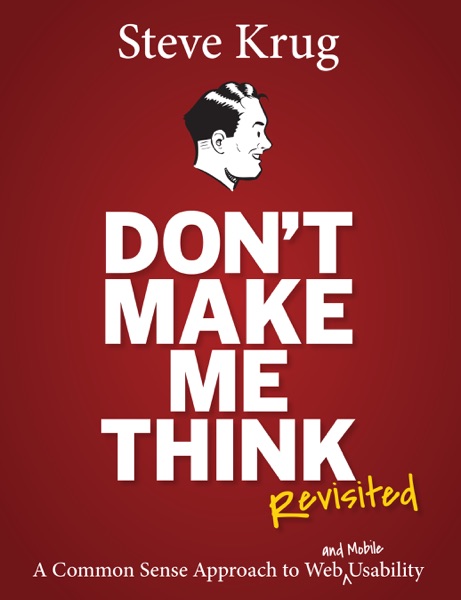
Don't Make Me Think by Steve Krug is a 2000 business book about usability, web design, user behavior. Good usability means the user never has to stop and wonder what something is or how it works. Confusion is always the designer's problem, not the user's.
Summary
Don't Make Me Think is Steve Krug's short, plainspoken guide to web usability. First published in 2000 and revised in 2006 and 2014, it remains the most widely read introduction to the subject, used in design schools and corporate training programs alike. The title is its thesis: good usability means designing so that users never have to wonder what something is or how it works. The moment they have to stop and think, you have already introduced friction that costs you clarity, trust, and conversions.
Krug's central observation is that most web designers and product teams misunderstand how users actually behave online. We design assuming users will read pages carefully, consider all options, and choose deliberately. In reality, users scan, not read. They satisfice — choosing the first option that seems good enough rather than the optimal one. They muddle through without reading instructions. And they don't read error messages. Understanding these behaviors is not cynicism; it's the starting point for design that works.
The book covers navigation (clear, consistent, location-aware), page hierarchy (the most important things must be obvious), link and button design (anything clickable must look clickable), and homepage design (the hardest real estate on the site). Krug is opinionated but not prescriptive — he repeatedly argues that usability principles need to be tested, not just applied from theory, and the book's later chapters cover how to run low-cost guerrilla usability tests with as few as three users.
The third edition added a section on mobile usability, which applies the same principles to the additional constraints of small screens, touch targets, and variable connectivity. Krug's voice throughout is self-deprecating and direct. The book is unusually short for its impact. Designers who have read it extensively cite not its originality but its clarity: it says things that experienced designers know implicitly in language that makes them useful to teach.
Talk to Don't Make Me Think like its author wrote you back.
Get the ideas that fit your life — not generic summaries.
- Chat with the book
- Audiobook-style main ideas
- Adapts to your life and goals
- Helps you take action
Key takeaways
- 1.
Good usability means the user never has to stop and wonder what something is or how it works. Confusion is always the designer's problem, not the user's.
- 2.
Users scan pages rather than read them. They pick the first reasonable option and move on. Design for scanning, not reading.
- 3.
Satisficing is rational under time pressure. Users choose what looks good enough, not what is best. Design must make the right choice look obviously right.
- 4.
Navigation is not just orientation — it's trust. Clear, consistent navigation tells users where they are, where they've been, and where they can go. Remove it and you remove confidence.
- 5.
The home page is the hardest design problem on any site. It must simultaneously establish identity, offer navigation, and not overwhelm the first-time visitor.
- 6.
Arguments about usability are almost never resolved by logic alone. Test with real users. Three sessions of informal guerrilla testing reveal more than months of debate.
- 7.
Accessibility and usability are deeply connected. Designing for users with disabilities typically improves the experience for everyone.
Discussion questions
Use these on your own, with a book club, or as chat starters in Superbook. Book club version, ready to copy or print →
- 1.
Krug argues that users scan rather than read. When was the last time you actually read a webpage from top to bottom, and what made that unusual?
- 2.
Think of a website or app you use regularly that makes you think too much. What specifically is the friction, and what would fixing it require?
- 3.
Krug says the home page is the hardest design problem on any site. What do you think makes it so difficult, and does looking at your own organization's home page support that claim?
- 4.
The book advocates for testing with as few as three users rather than waiting for a large sample. How does this kind of low-cost validation compare to how your team currently makes design decisions?
- 5.
Krug's principles were first articulated for desktop web in 2000. Which of them transfer cleanly to mobile apps, and which need revision?
- 6.
He argues that debates about design should be resolved by user tests, not opinions. In practice, how much of the design disagreement you've witnessed has been resolved this way?
- 7.
Krug is quite harsh about homepage clutter and feature accumulation over time. What forces in your organization make sites or products accumulate complexity they shouldn't have?
- 8.
The book suggests that making something usable and making it accessible to people with disabilities are often the same work. Does your organization treat them that way?
- 9.
What is the 'trunk test' Krug proposes, and can your organization's primary product pass it?
- 10.
Krug's book has been influential for over two decades, but the web it describes has changed dramatically. Which of his core principles feel most timeless and which feel most dated?
- 11.
Don't Make Me Think is famously short — about two hours of reading. What does the book's own brevity model about the advice it gives?
Themes
Frequently asked questions
-
Is Don't Make Me Think still relevant?
Yes, though the specific examples are dated. The third edition added mobile guidance, and the core principles — design for scanning, test with real users, never make the user wonder — apply as forcefully to mobile apps, voice interfaces, and AI products as they did to early websites.
-
How long does Don't Make Me Think take to read?
About two to three hours. It is intentionally short. Krug practices what he preaches: the book is well-organized, scannable, and free of unnecessary length.
-
Who should read this book?
Product managers, designers, developers, and anyone who ships interfaces to users. It's also worth reading for marketers who write content for web — Krug's observations about how people actually read pages apply to copywriting too.
-
Is this a technical book?
No. It requires no coding knowledge. The book deals with design principles and user behavior at a conceptual level accessible to anyone who uses the web.
-
What is the single most useful idea in Don't Make Me Think?
Run guerrilla usability tests. Get three people who are not on your team to try to use your product while thinking aloud. You will find problems in the first session that no amount of internal debate would have revealed.
Similar books
Hooked: How to Build Habit-Forming Products
Nir Eyal
The Mom Test
Rob Fitzpatrick
Inspired: How to Create Tech Products Customers Love
Marty Cagan
Continuous Discovery Habits
Teresa Torres
