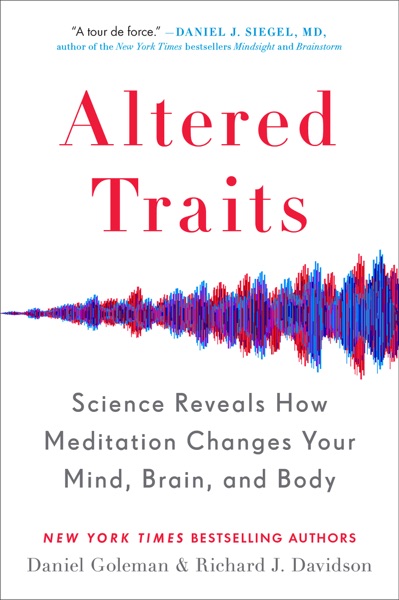
Altered Traits: Science Reveals How Meditation Changes Your Mind, Brain, and Body by Daniel Goleman and Richard J. Davidson is a 2017 science book about meditation, neuroscience, contemplative practice. The distinction between 'altered states' (temporary changes during meditation) and 'altered traits' (durable personality and behavioral changes) is the key diagnostic question in meditation research. Most published research measures states, not traits.
Summary
Altered Traits is a careful assessment of what neuroscience actually knows about meditation, written by two researchers who have spent their careers at the intersection of contemplative practice and empirical science. Daniel Goleman, author of Emotional Intelligence, and Richard Davidson, director of the Center for Healthy Minds at the University of Wisconsin, bring unusual credibility to the project: both have meditated for decades, and both have been involved in the research they are assessing. The book's central mission is to separate genuine findings from the hype that has surrounded meditation science since it went mainstream.
The title captures the argument. Most meditation research shows "altered states" — temporary changes in brain activity during or immediately after practice. Goleman and Davidson are interested in something harder to demonstrate: "altered traits," the durable changes in personality, perception, and behavior that persist beyond any single session. The research on traits is far thinner and more contested than the popular coverage suggests. The authors spend considerable time on what the science does not yet support: most published studies have small samples, no active control group, and measure outcomes that are easy to self-report rather than hard to fake. The book is, in part, a field-clearing exercise.
What the science does appear to support, according to the authors, falls into a rough dose-response relationship. Brief, app-based mindfulness practice produces modest benefits — some reduction in stress reactivity, some improvement in focus. These are real and should not be dismissed, but they are not transformative. Sustained practice — months of regular sitting — produces larger and more reliable changes: reduced amygdala reactivity, measurable changes in attention, some evidence of slowed cellular aging. The deepest changes — fundamental alterations of perception and sense of self described by long-term practitioners — appear in people who have accumulated thousands of hours of practice, often in intensive retreat contexts. Most Western research subjects are nowhere near this threshold.
The book includes a remarkable autobiographical thread: Goleman and Davidson first encountered meditation research at Harvard in the early 1970s, before it was scientifically respectable, and followed the field as it developed. Their accounts of studying with teachers including Anagarika Munindra in India and later meeting the Dalai Lama provide a personal frame for the scientific history. The combination of first-person practice experience and scientific rigor is unusual in this literature. Altered Traits will disappoint readers looking for validation of the meditation app on their phone, but it is essential for anyone who wants to understand what the research actually says.
Talk to Altered Traits: Science Reveals How Meditation Changes Your Mind, Brain, and Body like its author wrote you back.
Get the ideas that fit your life — not generic summaries.
- Chat with the book
- Audiobook-style main ideas
- Adapts to your life and goals
- Helps you take action
Key takeaways
- 1.
The distinction between 'altered states' (temporary changes during meditation) and 'altered traits' (durable personality and behavioral changes) is the key diagnostic question in meditation research. Most published research measures states, not traits.
- 2.
The research shows a dose-response relationship: brief practice produces modest benefits; sustained practice produces measurable neural and behavioral changes; deep long-term practice (thousands of hours) produces changes that appear qualitatively different.
- 3.
Most mainstream meditation research has methodological weaknesses: small samples, no active controls, self-report outcomes, and short follow-up periods. Goleman and Davidson rate studies explicitly by quality.
- 4.
Stress reactivity shows one of the most reliable meditation effects: experienced practitioners show lower amygdala activation in response to disturbing stimuli than non-meditators, and recover faster when activation occurs.
- 5.
Loving-kindness and compassion practices show distinct neural signatures from mindfulness practices. The benefits are different, not just stronger or weaker versions of the same thing.
- 6.
There are genuine risks in intensive meditation that popular coverage tends to ignore, including psychological destabilization in vulnerable individuals. Goleman and Davidson note these without sensationalizing them.
- 7.
The deepest changes described by expert practitioners — fundamental alterations in the sense of self and in emotional reactivity — require levels of practice that very few Western meditators ever reach.
- 8.
The contemplative traditions themselves have detailed maps of practice stages. These maps largely agree with each other and, in the areas that have been studied, correlate reasonably well with neuroscientific findings.
Discussion questions
Use these on your own, with a book club, or as chat starters in Superbook. Book club version, ready to copy or print →
- 1.
Goleman and Davidson separate hype from evidence. Were you surprised by which meditation benefits have solid support and which do not?
- 2.
The dose-response relationship suggests that the casual daily practice most people do is real but modest. Does knowing that change your relationship to your own practice?
- 3.
They argue the deepest changes require thousands of hours of practice, often in intensive retreat contexts. Is that accessible to most people? Should it be?
- 4.
The book is critical of the meditation app industry for overstating effects. Is that critique fair, or is some hype useful if it gets people to practice at all?
- 5.
Both authors have personal meditation practices that inform their scientific work. Does that strengthen or compromise their authority as researchers?
- 6.
They note meditation has risks as well as benefits, particularly for people with certain psychological vulnerabilities. Why is this aspect of the research so rarely discussed publicly?
- 7.
What would change in how you evaluate a meditation intervention if you applied Goleman and Davidson's quality criteria to the research behind it?
- 8.
They describe a progression from occasional practice to deep expertise that parallels mastery in other domains. How does the skill model of meditation change how you think about it?
- 9.
Davidson has spent decades studying the neuroscience of emotion. How does that framing — emotion as trainable — affect what you take from the book?
- 10.
The book describes their early encounters with meditation in India in the 1970s, when it was academically disreputable. What changed that made the research acceptable?
- 11.
Are there changes you have noticed in your own mental habits that you would attribute to meditation? Do the authors' frameworks change how you interpret those?
- 12.
If the deepest benefits require long-term intensive practice, who has access to them? What does that imply about the democratization of contemplative practice?
Themes
Frequently asked questions
-
What is Altered Traits about?
It is a rigorous assessment of what meditation research actually shows, written by two researchers who have studied the field for decades. The book separates temporary state changes from durable trait changes, rates the quality of existing studies, and identifies which meditation benefits have solid empirical support.
-
Is meditation actually good for you, according to this book?
Yes, but the size and type of benefit depends heavily on how much you practice. Brief daily practice has real but modest effects. Sustained practice over months shows more reliable changes in stress reactivity and attention. The transformative changes described in contemplative literature appear to require thousands of hours of practice.
-
Who should read Altered Traits?
Anyone who meditates and wants to understand what the research actually supports, and anyone skeptical of the meditation hype who wants a fair accounting. It is also essential reading for clinicians, therapists, or educators implementing mindfulness-based programs.
-
Is this book accessible to non-scientists?
Yes. Goleman and Davidson write clearly for a general audience and explain neuroscientific concepts as they arise. The personal narrative thread makes it more readable than a straight research review.
-
Does the book recommend specific meditation practices?
It describes the practices that have the most research support and characterizes their distinct effects — mindfulness, loving-kindness, and focused attention practices each produce somewhat different neural signatures and behavioral outcomes. It does not advocate a single approach.
Similar books
Waking Up: A Guide to Spirituality Without Religion
Sam Harris
Why Buddhism Is True
Robert Wright
The Miracle of Mindfulness
Thich Nhat Hanh
The Mindful Way Through Depression
Mark Williams
