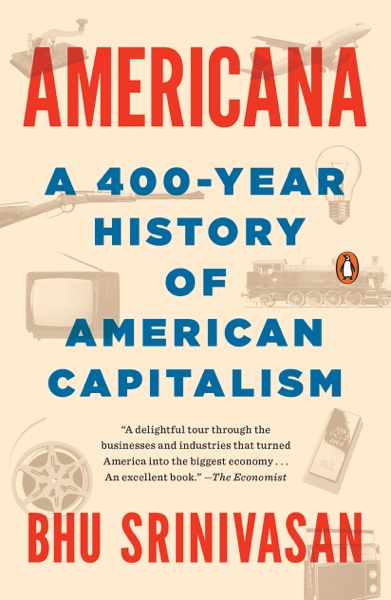
Americana by Bhu Srinivasan is a 2017 history book about capitalism, american history, entrepreneurship. American capitalism has always rested on state support alongside private enterprise: land grants, tariffs, intellectual property protection, and government contracts have been as important as individual initiative.
Summary
Americana is Bhu Srinivasan's attempt to tell the history of American capitalism through its defining industries and the entrepreneurs who built them. The book covers four centuries, from colonial land speculation through railroads, oil, steel, broadcasting, finance, and the internet, treating each era as a new chapter in the same ongoing story: how Americans have organized enterprise, distributed risk, attracted capital, and built fortunes.
Srinivasan is not an academic historian but an entrepreneur and investor, and that perspective shapes the book. He is more interested in the mechanics of wealth creation — how a business model works, how capital is raised, what the regulatory environment looks like — than in social or political criticism. Each chapter is organized around an industry or a defining moment, from John Jacob Astor's fur trade monopoly to Andrew Carnegie's steel integration to the rise of the Hollywood studio system to the venture capital model that funded Silicon Valley.
The book's argument, running implicitly through all the chapters, is that American capitalism has always adapted. The specific industries change, the dominant firms rise and fall, the regulatory and financial frameworks evolve, but the underlying logic — risk taken for private gain, capital organized to exploit new opportunities — persists. Srinivasan documents both the creative and destructive sides of this pattern without moralizing about it.
The limitations are significant. At 500 pages, the book is comprehensive rather than deep; individual chapters necessarily skim what entire volumes have been written about. The treatment of labor, inequality, and the costs borne by workers and communities is thinner than the treatment of capitalists and entrepreneurs. Readers looking for a critical account of American capitalism will find this book frustrating. Those looking for a readable survey of how American business actually worked across four centuries will find it rewarding.
Talk to Americana like its author wrote you back.
Get the ideas that fit your life — not generic summaries.
- Chat with the book
- Audiobook-style main ideas
- Adapts to your life and goals
- Helps you take action
Key takeaways
- 1.
American capitalism has always rested on state support alongside private enterprise: land grants, tariffs, intellectual property protection, and government contracts have been as important as individual initiative.
- 2.
The railroads were the first American industry to require the scale of capital and organizational complexity that characterizes modern corporations — they created the template.
- 3.
Standard Oil's monopoly was built through vertical integration and transportation control, not just economies of scale. Rockefeller didn't just produce oil more cheaply; he controlled the pipelines and railroads that moved it.
- 4.
The Hollywood studio system was a business model innovation as much as a creative one: vertical integration from production through distribution and exhibition created a near-impenetrable competitive position for two decades.
- 5.
The venture capital model transformed Silicon Valley's relationship to failure. Spreading risk across a portfolio of early-stage bets made it rational to fund ideas that had a high probability of failure but an enormous upside.
- 6.
American financial innovation — from the joint-stock company to mortgage-backed securities — has repeatedly enabled new industries by creating mechanisms to distribute risk across many investors.
- 7.
The recurring pattern of American business history is disruption of an incumbent industry by a new entrant with a different cost structure, distribution model, or technology, followed by consolidation and eventual regulation.
- 8.
Immigrant entrepreneurs have been disproportionately important in building American industries, from Carnegie (Scottish) to Astor (German) to the founders of major Silicon Valley firms.
Discussion questions
Use these on your own, with a book club, or as chat starters in Superbook. Book club version, ready to copy or print →
- 1.
Srinivasan covers four centuries in one volume. What are the tradeoffs of that scope, and which chapters did you find most or least satisfying?
- 2.
The book argues American capitalism has always depended on state support alongside private enterprise. How does that framing challenge conventional narratives about American free markets?
- 3.
Standard Oil's monopoly power came partly from controlling infrastructure rather than just production. What contemporary parallels do you see in technology platforms?
- 4.
The venture capital model accepts a high failure rate as the cost of finding outlier successes. Is that an efficient way to allocate society's resources, or does it systematically underfund certain kinds of value?
- 5.
Srinivasan largely treats labor as a cost variable in business models rather than as a social and political force in its own right. Does that emphasis reflect a meaningful limitation in the book?
- 6.
Which of the industries covered in the book do you think involved the most genuine productive innovation, and which involved the most extraction of existing value?
- 7.
How does the history of American capitalism in this book compare with what you were taught in school or believed before reading it?
- 8.
Carnegie and Rockefeller both became major philanthropists after accumulating massive fortunes through practices that caused significant harm. How do you evaluate that pattern?
- 9.
The book ends with the internet era and Silicon Valley. Does the VC-driven, winner-take-all model of that era represent a continuation of earlier American capitalism or a genuine departure?
- 10.
Srinivasan is himself an entrepreneur and investor. Where do you see that perspective shaping what he emphasizes and what he leaves out?
- 11.
The book gives relatively little attention to women and non-white entrepreneurs. What would be different if the book tried to tell the full story of American entrepreneurship?
- 12.
What industry or entrepreneur do you think deserved a chapter that the book didn't give one?
Themes
Frequently asked questions
-
Is Americana worth reading if you already know American history?
Probably yes. The book's value is in its synthetic business-model lens rather than in new historical facts. Even readers with solid knowledge of American history will find Srinivasan's emphasis on capital structure, distribution models, and regulatory context illuminating for industries they thought they understood.
-
How long is Americana?
The book runs about 500 pages and takes roughly nine hours to read at average pace. It's dense in places but the narrative structure keeps it moving.
-
Is this book sympathetic to capitalism?
Broadly yes, in the sense that it treats capitalism as the defining and largely productive feature of American life rather than as a system to be criticized. Srinivasan documents costs and failures but doesn't dwell on them. Readers expecting a critical account will be disappointed.
-
What distinguishes Americana from other American economic histories?
The entrepreneur-investor perspective. Most economic histories are written by academics who focus on systemic forces; Srinivasan focuses on how specific business models worked, why certain strategies succeeded, and how capital was organized. That's a different and genuinely useful angle.
-
Who should read this book?
People in business who want historical perspective on how industries form and evolve, investors interested in patterns across cycles, and general readers curious about how American economic life actually developed. It's less suited to readers primarily interested in labor history, inequality, or political economy.
Similar books
The Innovators: How a Group of Hackers, Geniuses, and Geeks Created the Digital Revolution
Walter Isaacson
Why Nations Fail: The Origins of Power, Prosperity, and Poverty
Daron Acemoglu and James A. Robinson

The Ascent of Money: A Financial History of the World
Niall Ferguson
The Wealth of Nations
Adam Smith
