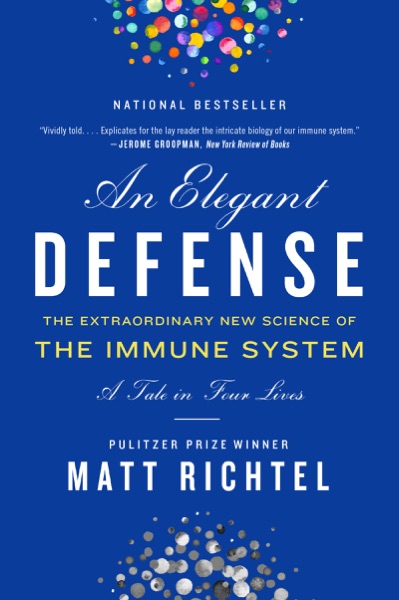
An Elegant Defense by Matt Richtel is a 2019 science book about immunology, medicine, disease. The immune system is a decentralized decision network, not a simple barrier. It has to distinguish self from non-self in real time, and it gets that wrong in both directions: too little response (infection, cancer) and too much (autoimmune disease).
Summary
An Elegant Defense is Matt Richtel's attempt to explain the immune system to a general audience through a combination of narrative science and personal story. Richtel is a Pulitzer Prize-winning journalist at the New York Times, and he centers the book on four people he knows—including his close friend Jason Greenstein, who has Hodgkin's lymphoma—using their medical journeys to make the abstract biology of immune response concrete and human.
The core subject is one of the most complex in biology. The immune system isn't a single organ or a simple defense mechanism; it's a decentralized network of cells, proteins, and signals that has to make real-time decisions about what is self and what is foreign, what to attack and what to tolerate. Richtel traces the scientific history of immunology from the earliest germ-theory experiments through the discovery of T cells and B cells, the development of vaccines, and the recent revolution in immunotherapy—treatments that harness the immune system to fight cancer rather than attacking tumors with toxic chemicals or radiation.
The book is strongest on the immunotherapy revolution, which is recent enough that many readers won't know the story. Checkpoint inhibitors—drugs like Keytruda and Opdivo that essentially remove the brakes the immune system uses to avoid attacking the body's own cells—have produced dramatic remissions in cancers that were previously untreatable. But they also produce serious autoimmune side effects, because removing the brakes also means the immune system sometimes attacks healthy tissue. This tradeoff—liberation versus control—is the book's central tension.
Richtel's journalistic instincts make the science more accessible than a textbook would, though readers with a science background may find the pace slow. The personal narrative around Greenstein is genuinely affecting. Where the book is less convincing is in its occasional tendency to overgeneralize from immune metaphors to social and political claims. Still, for a reader wanting to understand why immunotherapy is considered a genuine paradigm shift in cancer treatment, and why autoimmune disease is so hard to treat, this is an unusually good starting point.
Talk to An Elegant Defense like its author wrote you back.
Get the ideas that fit your life — not generic summaries.
- Chat with the book
- Audiobook-style main ideas
- Adapts to your life and goals
- Helps you take action
Key takeaways
- 1.
The immune system is a decentralized decision network, not a simple barrier. It has to distinguish self from non-self in real time, and it gets that wrong in both directions: too little response (infection, cancer) and too much (autoimmune disease).
- 2.
Immunotherapy works by removing molecular 'checkpoints' that normally prevent the immune system from attacking the body's own cells. This can produce remarkable cancer remissions but also serious autoimmune side effects.
- 3.
The history of immunology is a history of scientists getting things wrong spectacularly and usefully. Early researchers thought the immune system would simply kill everything foreign; the tolerance problem took decades to understand.
- 4.
Autoimmune diseases—rheumatoid arthritis, lupus, multiple sclerosis—are essentially the immune system misidentifying self as foreign. They're extremely difficult to treat because you can't simply suppress the system without leaving the patient vulnerable to infection.
- 5.
Cancer can evade the immune system by mimicking self-signals or by actively suppressing the immune response nearby. Checkpoint inhibitors disrupt that evasion.
- 6.
The gut microbiome plays a significant and still poorly understood role in immune regulation. The relationship between what we eat, our microbial populations, and immune function is an active research frontier.
- 7.
Vaccines work by training the adaptive immune system to recognize a pathogen without causing a full infection. They're among the most cost-effective interventions in medical history.
- 8.
The balance between immune activation and immune tolerance is the central problem in modern immunology. Too much activation causes autoimmunity; too little allows cancer and infection.
Discussion questions
Use these on your own, with a book club, or as chat starters in Superbook. Book club version, ready to copy or print →
- 1.
Richtel frames the immune system as making 'elegant defense' decisions. Does the biological reality match that metaphor, or is it messier than elegance implies?
- 2.
The checkpoint inhibitor story is presented as a medical revolution. How do you evaluate the tradeoff between dramatic remissions and serious autoimmune side effects?
- 3.
Richtel uses personal narrative to make science accessible. Does that approach change how you read and retain the science, or does it distract from it?
- 4.
Autoimmune disease affects a significant and growing share of the population. What does the book's account suggest about why that might be happening?
- 5.
What surprised you most about how the immune system actually works versus what you assumed going in?
- 6.
The book argues that the immune system needs to be in a constant state of calibrated balance. What disrupts that balance in modern life, and what restores it?
- 7.
How does the immune system's logic apply to how we think about other defensive systems—political, institutional, ecological?
- 8.
Jason Greenstein's story runs through the book. What does his case illustrate about the state of cancer treatment that statistics alone couldn't convey?
- 9.
The immune system's ability to distinguish self from non-self is imperfect and context-dependent. What does that say about the concept of immunity as protection?
- 10.
What would it mean for you personally to understand your immune system better? Would it change anything about how you think about your health?
- 11.
Richtel occasionally extends immune metaphors to social phenomena. Do you find those extensions illuminating or strained?
Themes
Frequently asked questions
-
What is An Elegant Defense about?
The immune system: how it works, how it goes wrong in autoimmune disease and cancer, and how the recent revolution in immunotherapy—using the immune system to fight cancer—came about. Richtel tells the science through four personal stories, including his friend's cancer treatment.
-
Do I need a science background to read An Elegant Defense?
No. Richtel writes for a general audience and explains concepts as he introduces them. Readers with biology backgrounds may find some sections slower than necessary, but the book doesn't require prior knowledge.
-
What is the most important idea in An Elegant Defense?
That the immune system's defining challenge is calibration: enough response to kill pathogens and cancer cells, not so much that it attacks healthy tissue. Checkpoint inhibitors are revolutionary because they shift that balance deliberately — at the cost of making the calibration problem harder.
-
How long is An Elegant Defense?
Around 400 pages. At average reading pace, roughly seven to eight hours. The narrative structure makes it read faster than its length suggests.
-
Who should read An Elegant Defense?
Anyone dealing with an immune-related condition, anyone interested in cancer treatment, and any reader who wants a solid foundational understanding of immunology without a textbook. It's also worth reading for the immunotherapy story alone, which is one of the more remarkable chapters in recent medicine.
Similar books

The Emperor of All Maladies: A Biography of Cancer
Siddhartha Mukherjee
The Gene: An Intimate History
Siddhartha Mukherjee
Behave: The Biology of Humans at Our Best and Worst
Robert M. Sapolsky

The Immortal Life of Henrietta Lacks
Rebecca Skloot
