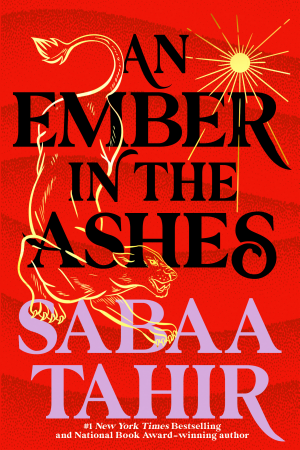
An Ember in the Ashes by Sabaa Tahir is a 2015 fantasy book about oppression and resistance, duty versus freedom, identity under empire. Laia and Elias see the same empire from opposite positions — Tahir uses the dual POV not for balance but to show how a system sustains itself through everyone's participation.
Summary
An Ember in the Ashes is set in a Roman Empire-inspired world where the Martial empire has conquered and brutalized the Scholar people for centuries. The novel follows two perspectives: Laia, a Scholar girl who becomes an informant for the underground resistance after her brother is arrested; and Elias, a Mask — an elite soldier of the empire — who is training at the brutal academy Blackcliff and who increasingly questions everything he's been forged to be. The two are drawn into each other's orbits through the machinery of an imperial selection process that determines who rules next.
The book is fundamentally about what people do under conditions of total power imbalance — how they survive, compromise, resist, and sometimes collaborate in their own oppression. Laia begins the novel without agency and spends most of it learning to act despite fear; Elias has power but finds it corroding. Tahir uses their alternating perspectives to explore the same system from opposite sides without resolving into easy heroism. Laia is not instantly brave. Elias is not simply good. Both are complicit in ways the novel takes seriously.
The world-building draws heavily on Roman military culture and North African and South Asian aesthetics, and the result is a fantasy world with a specific texture rather than the default northern-European medieval. The Augurs — ancient supernatural figures who shape events — add a fatalistic dimension: the characters navigate prophecy and predetermined outcomes while trying to exercise genuine choice, which creates a productive tension throughout.
An Ember in the Ashes was published as YA and has a YA emotional register — first loves, urgent loyalties, the intensity of adolescent crisis. Readers who primarily read adult fantasy may find the romantic subplots more prominent than they'd prefer. Readers who are comfortable with, or who enjoy, that register will find a well-built world, thoughtful politics, and two protagonists whose divergent experiences illuminate the same oppressive system from different angles.
Talk to An Ember in the Ashes like its author wrote you back.
Get the ideas that fit your life — not generic summaries.
- Chat with the book
- Audiobook-style main ideas
- Adapts to your life and goals
- Helps you take action
Key takeaways
- 1.
Laia and Elias see the same empire from opposite positions — Tahir uses the dual POV not for balance but to show how a system sustains itself through everyone's participation.
- 2.
The Martial empire's brutality is systematic, not personal; the horror is that most of the people enforcing it are not monsters but trained soldiers following logic.
- 3.
Survival under occupation requires compromise that the novel doesn't moralize away — Laia's choices are sometimes ugly and Tahir doesn't pretend otherwise.
- 4.
Elias's arc is about the cost of exiting a system you were made by — the identity crisis of the defector who is neither fully insider nor fully out.
- 5.
The Augurs and their prophecies introduce a theological politics: fate as a tool of power, not divine providence.
- 6.
The world-building's Roman-with-North-African-and-South-Asian-aesthetics texture gives the fantasy world a specific cultural identity rather than a generic medieval one.
- 7.
The romantic tension is central to the YA register of the book — it is a feature of the genre the novel operates in, not an accident.
- 8.
Blackcliff Academy is a distilled version of empire: the system that turns children into soldiers, and the question of what, if anything, survives that process.
Discussion questions
Use these on your own, with a book club, or as chat starters in Superbook. Book club version, ready to copy or print →
- 1.
The novel uses dual perspectives from an oppressor and an oppressed person in the same world. Did Tahir give them equal weight, or did you find one narrative more compelling?
- 2.
Laia makes choices under duress that she is not proud of. Does the novel ask you to judge her for them, or does it ask you to understand them?
- 3.
Elias was raised by Blackcliff but increasingly rejects what it made him. Is his arc a story about individual conscience, or does the novel suggest that conscience alone isn't enough to dismantle a system?
- 4.
The Augurs know the outcome of events and manipulate people toward them. Does the novel treat this as villainy, as divine order, or as something more ambiguous?
- 5.
The romantic subplot between Laia and Elias is substantial. Did it feel integral to the story's themes or more like a genre requirement?
- 6.
The empire in the novel is brutal but not one-dimensional — some characters inside it are sympathetic. Does that complexity make it more or less effective as a critique of oppressive systems?
- 7.
Helene, Elias's close friend and fellow Mask, chooses duty where Elias chooses conscience. Does the novel treat her choice as wrong, or does it respect the internal logic of it?
- 8.
The world draws on Roman and North African aesthetic influences. Did the specificity of the setting help you locate the story, or did the historical references feel more like wallpaper?
- 9.
Blackcliff is designed to break people down and rebuild them as soldiers. What does the novel suggest about whether that process can be survived with identity intact?
- 10.
Laia's informant work requires her to be near the Commandant, one of the novel's most frightening figures. How does that proximity change Laia over the course of the book?
- 11.
The series continues across multiple volumes. Does An Ember in the Ashes work as a standalone story, or does it feel structurally like a first act?
- 12.
YA fantasy is sometimes dismissed by adult readers as too emotional or too focused on romance. Did An Ember in the Ashes challenge or confirm that view for you?
Themes
Frequently asked questions
-
Is An Ember in the Ashes YA?
Yes. It was published as YA and has a YA emotional register — intense first relationships, urgent adolescent stakes, and a focus on personal identity as well as political conflict. Adult fantasy readers comfortable with that register will find it engaging; readers who want more distance from the romantic material may find it prominent.
-
Is there a lot of violence?
Yes. The novel depicts torture, slavery, execution, and military brutality without heavy sanitizing. It is graphic enough that some parents of younger teens have found it surprising for a YA label. It is not as extreme as adult grimdark, but it doesn't shy from depicting the consequences of the world it's built.
-
Do I need to read the sequels?
An Ember in the Ashes has a reasonably contained arc, but the larger story continues across A Torch Against the Night, A Reaper at the Gates, and A Sky Beyond the Storm. The series is best read as a unit.
-
What makes the world-building distinctive?
The Roman military structure combined with North African and South Asian aesthetics produces a world that doesn't feel like default-medieval European fantasy. The Martials have a specific culture, the Scholars have a specific history, and the geography and visual details are drawn from a wider range of influences than most Western fantasy.
-
Who shouldn't read An Ember in the Ashes?
Readers who find YA romantic dynamics tiresome, or who want self-contained epic fantasy that doesn't require committing to a series. Also readers sensitive to depictions of slavery and systematic violence.