Atlas of the Heart by Brené Brown is a 2021 psychology book about emotions, vulnerability, connection. Most people use fewer than three words to describe their emotional states. Expanding emotional vocabulary is not just about precision — it directly improves the ability to regulate emotions and connect with others.
Summary
Atlas of the Heart is Brené Brown's attempt to map eighty-seven distinct human emotions and experiences — not as a clinical taxonomy but as a practical vocabulary for people who want to communicate more precisely about what they feel. Brown's premise, backed by her qualitative research with thousands of participants, is that most people use a handful of words (sad, anxious, angry, fine) to describe an enormous range of internal states, and that this poverty of language limits their ability to understand themselves and connect with others.
The book is organized around clusters of related emotions that are frequently confused: envy and jealousy, for example, or awe and wonder, or grief and sadness. For each cluster, Brown gives a definition, distinguishes between the concepts, and draws on research and her own clinical experience to illustrate where the confusion leads us astray. The section on shame and guilt alone has changed how many readers think about their own responses to failure — shame is about identity ("I am bad") while guilt is about behavior ("I did something bad"), and the distinction turns out to matter enormously for how people recover.
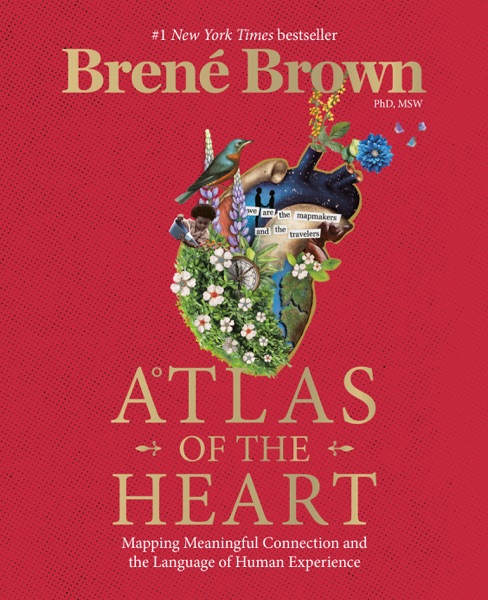
This is an unusually visual Brown book: the hardcover and audiobook companion were designed to be read together, with photographs, illustrations, and graphic layouts that reinforce the emotional texture of each section. The writing is warmer and more personal than her research-heavy earlier books, drawing on stories from her own life and her work with therapy clients. The ambition is high — cataloguing human emotional experience risks being either too clinical or too vague — but Brown's approach of staying close to specific situations and quoted language keeps it grounded.
Whether the book changes behavior depends on how much a reader is willing to practice the vocabulary. Knowing the difference between foreboding joy and anxiety, or between comparative suffering and empathy, is only useful if you apply it when it matters. Some critics note that the sheer number of emotions covered can feel overwhelming, and that the book is better read section by section than cover to cover. But as a reference work for emotional life — something to return to when stuck on what you're actually feeling — it has few rivals.
Talk to Atlas of the Heart like its author wrote you back.
Get the ideas that fit your life — not generic summaries.
- Chat with the book
- Audiobook-style main ideas
- Adapts to your life and goals
- Helps you take action
Key takeaways
- 1.
Most people use fewer than three words to describe their emotional states. Expanding emotional vocabulary is not just about precision — it directly improves the ability to regulate emotions and connect with others.
- 2.
Shame and guilt are not interchangeable. Shame says 'I am bad'; guilt says 'I did something bad.' Shame corrodes connection; guilt, if handled well, can restore it.
- 3.
Envy is about wanting what someone else has; jealousy is about fear of losing something you already have to someone else. The distinction changes how you should respond.
- 4.
Awe is not the same as wonder. Wonder is curious and open; awe overwhelms the self. Both are valuable, but confusing them leads to missing what each is actually offering.
- 5.
Comparative suffering — telling yourself your pain doesn't count because someone else has it worse — is a form of empathy failure directed at yourself.
- 6.
Foreboding joy is the anticipatory dread that undercuts happy moments. Brown argues that practicing gratitude in those moments is the antidote, not optimism.
- 7.
Belonging and fitting in are opposites. Fitting in requires changing yourself to be accepted; belonging requires being accepted as you are.
- 8.
Emotional granularity — the ability to make fine distinctions between your feeling states — is associated with better mental health, more adaptive coping, and stronger relationships.
Discussion questions
Use these on your own, with a book club, or as chat starters in Superbook. Book club version, ready to copy or print →
- 1.
Brown argues that most people operate with a vocabulary of fewer than three emotions. What does your default emotional vocabulary look like, and where do you notice its limits?
- 2.
Has learning the distinction between shame and guilt changed how you think about a past experience? What would you do differently now?
- 3.
Think of a situation where you confused envy for another feeling — admiration, resentment, sadness. What did that confusion cost you?
- 4.
The book claims that foreboding joy — the dread that cuts into happy moments — is extremely common. Do you recognize it? What triggers it for you?
- 5.
Brown distinguishes belonging from fitting in. Where in your life have you been fitting in when you wanted to belong? What's the difference in experience?
- 6.
Comparative suffering is the habit of invalidating your own pain because others have it worse. Have you done this to yourself or seen it done to others? What does it actually accomplish?
- 7.
Awe requires an overwhelm of the self. When did you last feel genuine awe? What produced it, and how long did it last?
- 8.
The book says emotional granularity — being able to distinguish your feeling states precisely — is associated with better wellbeing. Is that something you can practice, or does it feel like a fixed trait?
- 9.
Brown argues that grief and sadness are different: sadness has a cause we can often name; grief is more diffuse and less resolvable. Does that distinction match your experience?
- 10.
The atlas covers emotions like boredom, nostalgia, and ennui that we often dismiss as minor. Have any of these played a larger role in your life than you gave them credit for?
- 11.
If you could add one word to your daily emotional vocabulary — one distinction you don't currently make that would be useful — what would it be?
- 12.
Is there a relationship in your life where a shared emotional vocabulary has made communication significantly easier? And one where the absence of shared vocabulary creates friction?
Themes
Frequently asked questions
-
What is Atlas of the Heart about?
It's a guide to 87 human emotions and experiences, organized to help readers name what they feel more precisely. Brown's argument is that emotional vocabulary directly shapes emotional experience — the better you can identify what you're feeling, the better you can understand and communicate it.
-
Is Atlas of the Heart worth reading if I've read Brown's earlier books?
Yes, though it's different in structure. Her earlier books build arguments around research findings; this one is more reference-oriented — organized around emotion clusters rather than a through-line thesis. The two formats complement each other.
-
How long does it take to read?
Around five to six hours, though many readers find it works better as a slow reference than a cover-to-cover read. The emotion sections are self-contained enough to dip into when a specific feeling comes up in your life.
-
Is this a self-help book or a psychology book?
Both. The research base is real — Brown draws on a decade of qualitative data — but the application is practical and personal rather than clinical. It's written for general readers who want to understand themselves and others better.
-
What's the most actionable idea in the book?
The shame-versus-guilt distinction. Understanding that shame attacks identity while guilt addresses behavior changes how you handle your own mistakes and how you respond when others hurt you. It's one of those concepts that, once you have it, you see it everywhere.