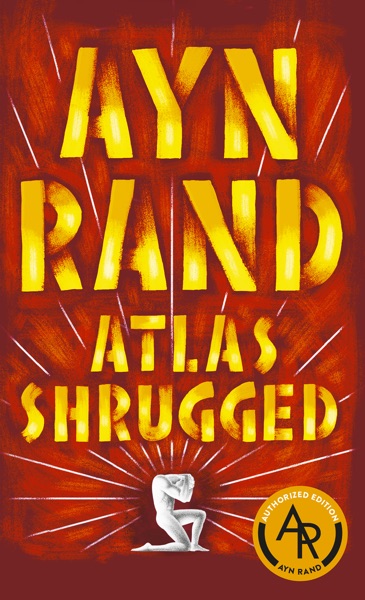
Atlas Shrugged by Ayn Rand is a 1957 philosophy book about rational self-interest, individualism, capitalism. Rand's central argument is that productive achievement is the highest human value and that the productive mind, not collective effort or redistribution, is the source of civilizational progress.
Summary
Atlas Shrugged is Ayn Rand's philosophical novel and the fullest expression of her system, Objectivism. Published in 1957, it follows Dagny Taggart, vice president of Taggart Transcontinental railroad, and Hank Rearden, a steel magnate who has invented a superior alloy, as they struggle to keep their industries running while the United States government progressively restricts, regulates, and expropriates productive enterprise in the name of equality and social need. The central mystery of the plot is a question: who is John Galt? The answer arrives in the third act and anchors the novel's philosophical climax.
The novel's argument is that the productive minds — the engineers, entrepreneurs, and industrialists who create material value — are the true motors of civilization, and that when those minds are punished, constrained, and plundered rather than rewarded, they will eventually withdraw. The "strike of the mind" that John Galt organizes is Rand's thought experiment: what happens when the people who actually build things decide to stop? The collapse she depicts is meant to demonstrate that productive achievement, not collective welfare or self-sacrifice, is the foundation that holds civilization upright.
Rand's prose is intentionally larger than life. The heroes are almost superhumanly competent; the villains are cartoons of mediocrity and manipulation. This is deliberate — she is writing a philosophical fable as much as a realistic novel, and the characters are vehicles for ideas as much as portraits of actual human beings. The love triangle between Dagny, Rearden, and Galt serves a philosophical purpose: it illustrates Rand's claim that romantic love should be a response to values and achievement, not sentiment or duty.
Atlas Shrugged remains one of the most widely read American novels of the twentieth century and probably the most influential book produced by a philosopher who was never taken seriously by academic philosophy. Its influence on business culture, libertarian politics, and tech entrepreneurship is substantial and often underestimated. It also provokes intense resistance. Critics point to the one-dimensionality of its characters, the implausibility of its economics, and the cold social ethics that Rand draws from her premises. Both reactions are legitimate. Reading it means engaging seriously with a coherent but demanding worldview — not one to accept wholesale or dismiss without thought.
Talk to Atlas Shrugged like its author wrote you back.
Get the ideas that fit your life — not generic summaries.
- Chat with the book
- Audiobook-style main ideas
- Adapts to your life and goals
- Helps you take action
Key takeaways
- 1.
Rand's central argument is that productive achievement is the highest human value and that the productive mind, not collective effort or redistribution, is the source of civilizational progress.
- 2.
The 'strike of the mind' thought experiment asks: what would happen if the creators and producers withdrew? Rand uses it to argue that the exploitation of the productive by the parasitic is self-defeating.
- 3.
Objectivism holds that rational self-interest is the proper ethical guide — not selfishness in the sense of cruelty, but the principled pursuit of one's own values and goals as the foundation of moral life.
- 4.
The novel is highly critical of altruism as Rand defines it: the belief that sacrifice for others is inherently moral, and that production for personal gain is inherently suspect. She inverts this entirely.
- 5.
Mixed economy is portrayed as inherently unstable — government intervention to protect the weak from the strong produces cycles of political favoritism and progressive decline, not stability or justice.
- 6.
The heroes of the novel are defined by their competence and their refusal to compromise their judgment to social pressure or collective guilt. Integrity, in Rand's sense, means consistency between values and actions.
- 7.
Rand's epistemology is built on reason as the only reliable guide to reality. Mysticism, faith, and collective consensus are all rejected as sources of knowledge or moral guidance.
- 8.
The book functions as a political argument, a philosophical treatise, and a Romantic novel simultaneously. Its admirers and critics often react to different layers of the same work.
Discussion questions
Use these on your own, with a book club, or as chat starters in Superbook. Book club version, ready to copy or print →
- 1.
Rand argues that productive achievement is the foundation of civilization. Do you find this claim convincing? What does it leave out?
- 2.
The novel's heroes refuse to compromise with people they regard as parasites or second-handers. Is there a version of this principle that applies to your own life without the coldness Rand attaches to it?
- 3.
Rand's critique of altruism as self-destruction is unusual — most ethical systems treat self-sacrifice as virtuous. How do you situate her argument against other frameworks you find compelling?
- 4.
The villains of Atlas Shrugged are mainly motivated by resentment and the desire to destroy what they can't create. How accurately does this characterize the political and economic forces Rand is critiquing?
- 5.
The 'strike of the mind' is a thought experiment, not a realistic scenario. What does its hypothetical character tell us about the limits and the utility of the novel as philosophy?
- 6.
Rand draws a sharp line between producers and parasites. Is this distinction as clean in reality as she depicts it, or does it break down when you look at actual economic life?
- 7.
The novel has had enormous influence on Silicon Valley and libertarian political thought. Why do you think it resonates so strongly in those communities specifically?
- 8.
Rand's romantic heroes love each other for their values and achievements, not their vulnerabilities or needs. Does this conception of love strike you as admirable, unrealistic, or both?
- 9.
Atlas Shrugged was published in 1957. How well does its picture of the relationship between government and business hold up sixty-plus years later?
- 10.
What is the strongest argument you can make against Rand's position? What would she say in reply?
- 11.
The novel is more than 1,000 pages. Did its length serve the argument, or did you find the repetition a weakness? What would be lost in a shorter version?
- 12.
Rand rejected the academic philosophical establishment and they largely rejected her. How do you evaluate a philosophical system that sits outside the mainstream of the discipline it claims to address?
Themes
Frequently asked questions
-
Is Atlas Shrugged worth reading?
Worth engaging with seriously, yes — even if you disagree with Rand's conclusions. It articulates a coherent and influential worldview that shapes significant parts of contemporary business and political culture. Understanding it is useful whether you end up convinced, partially convinced, or firmly opposed.
-
How long does Atlas Shrugged take to read?
It's over 1,000 pages — one of the longest novels in the American canon. At an average reading pace, expect 35 to 40 hours. The famous radio speech by John Galt in Part Three runs around 60 pages and is itself a test of the reader's patience and interest.
-
What is the main idea of Atlas Shrugged?
That the productive mind is the source of all civilization and that any system — whether altruistic ethics or collectivist politics — that penalizes production and rewards dependency is both morally wrong and practically self-defeating.
-
Who should not read Atlas Shrugged?
Readers looking for psychologically complex or realistic characters will be frustrated. The novel is a philosophical argument in fictional form, and the characters serve that argument. Readers who need prose naturalism or moral nuance will find it a slog.
-
What's the most actionable idea in Atlas Shrugged?
The principle of refusing to apologize for productive achievement — what Rand calls 'productive pride.' The business application: design your work around creating genuine value, resist the guilt-trip framing that says success requires excusing yourself, and be honest about what you're actually building and why.