Basic Economics: A Common Sense Guide to the Economy by Thomas Sowell is a 2000 economics book about price mechanisms, unintended consequences, market incentives. Economics is about scarce resources allocated among competing uses. The central question is always: compared to what alternative?
Summary
Thomas Sowell published the first edition of Basic Economics in 2000 and has since revised and expanded it through five editions. The book has no graphs, no equations, and no technical apparatus — its explicit aim is to teach economic reasoning to readers who have no economics background, and to do so through relentless application of a single principle: that economics is the study of how scarce resources are allocated among competing uses, and that to evaluate any policy you must look at incentives and consequences rather than intentions.
Sowell structures the book around the price system. Prices, he argues, transmit information and coordinate economic activity across millions of actors more efficiently than any centralized alternative. When prices are artificially constrained — through rent control, minimum wages, price ceilings, or tariffs — they disrupt this coordination function, often producing the opposite of the intended result. Rent control reduces housing supply over time. Price controls on medicine distort pharmaceutical investment toward treatments with controlled profits. This framework, applied chapter by chapter to wages, profits, international trade, housing, and healthcare, is both pedagogically effective and consistent.
The book is genuinely useful as an introduction to economic thinking. Sowell writes clearly, uses concrete historical examples, and is good at exposing the gap between stated intentions and actual consequences in policy. His treatment of comparative advantage and international trade is particularly clear, and his analysis of why prices ration resources better than administrative allocation is well argued.
What readers should weigh is that Sowell applies his framework consistently but not always evenhandedly. The analysis tends to highlight government failures and market successes while being somewhat quicker to dismiss the cases for intervention — market power, externalities, public goods, and distributional justice receive less systematic treatment than inefficiencies in government programs. The book is less a neutral introduction to economics than a particular and coherent free-market interpretation of economics, and it is more useful if read alongside other introductory texts that give equal weight to market failures.
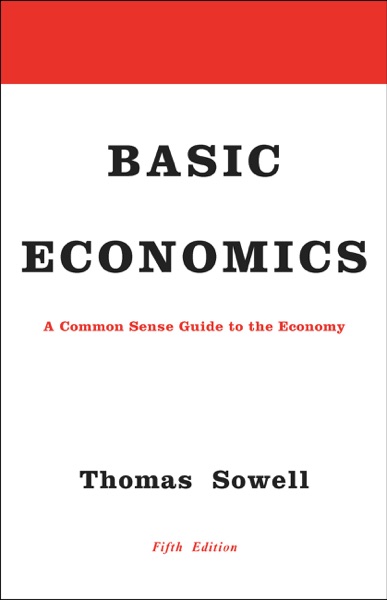
Talk to Basic Economics: A Common Sense Guide to the Economy like its author wrote you back.
Get the ideas that fit your life — not generic summaries.
- Chat with the book
- Audiobook-style main ideas
- Adapts to your life and goals
- Helps you take action
Key takeaways
- 1.
Economics is about scarce resources allocated among competing uses. The central question is always: compared to what alternative?
- 2.
Prices are not arbitrary; they transmit information about scarcity and coordinate the behavior of millions of people who have no direct contact with each other.
- 3.
Rent control reliably reduces housing supply over time because it removes the incentive to build or maintain rental property, harming the people it was meant to help.
- 4.
Wages are prices for labor. Minimum wages set above the market-clearing rate create unemployment among the workers they are designed to protect.
- 5.
Comparative advantage makes trade beneficial even when one country is more productive at everything: specialization raises total output for all parties.
- 6.
Profits are signals that resources are being used in ways that consumers value; losses are signals to redirect those resources. Suppressing profits suppresses those signals.
- 7.
Intentions and incentives are different things. Policies with good intentions routinely produce bad outcomes when they disrupt incentive structures.
- 8.
Political decision-makers face different incentives than market actors; they respond to voters, donors, and interest groups rather than to price signals and consumer behavior.
Discussion questions
Use these on your own, with a book club, or as chat starters in Superbook. Book club version, ready to copy or print →
- 1.
Sowell's core move is asking 'compared to what?' Apply that question to a policy debate you care about. What is the realistic alternative you are comparing the policy to?
- 2.
The rent control analysis is one of the clearest in the book. Are there cases where the long-run supply reduction is an acceptable tradeoff for short-run affordability?
- 3.
Sowell is skeptical of minimum wage increases. What does the empirical evidence on minimum wages over the past twenty years suggest about his analysis?
- 4.
The book argues prices carry more information than administrators can. Where do you think that argument is strongest, and where does it break down?
- 5.
How does Sowell treat externalities — costs or benefits that fall on parties outside a transaction? Does that treatment feel adequate?
- 6.
The book largely avoids graphs and equations. Does that make it more accessible, or does it also make it harder to challenge the arguments with data?
- 7.
Sowell draws on historical examples from across the world. Which examples did you find most compelling, and which felt most like cherry-picking?
- 8.
The book's framework handles scarcity and allocation well. How does it handle questions of distribution — not just efficiency but fairness in who gets what?
- 9.
Comparative advantage is the core argument for free trade. What does it assume about workers' ability to move between industries, and how realistic is that assumption?
- 10.
Sowell argues political incentives systematically distort economic policy. Is there a version of political economy that could align those incentives better?
- 11.
Which of the book's applications to specific policy areas — healthcare, housing, education, trade — did you find most persuasive or least persuasive?
- 12.
Does knowing Sowell's broader political views affect how you read the book? Should it?
Themes
Frequently asked questions
-
Do you need any economics background to read Basic Economics?
No. Sowell wrote explicitly for readers with no prior economics training. The book contains no graphs or equations and builds its arguments from first principles and historical examples. It is probably the most accessible introduction to market economics currently in print.
-
Is Basic Economics worth reading?
Yes, especially as an introduction to economic reasoning. Its strength is teaching you to ask the right questions about policy. Read it alongside a book that gives more weight to market failures and distributional concerns for a more complete picture.
-
How long is Basic Economics?
The fifth edition runs to around 700 pages, making it one of the longer popular economics books. At average reading pace that is around seven to eight hours. The chapters are relatively self-contained so readers often focus on the sections most relevant to their interests.
-
What is the main idea of Basic Economics?
That prices transmit information and coordinate economic activity in ways no central authority can replicate, and that policies designed to override prices — rent control, price caps, tariffs — consistently produce unintended consequences by disrupting that coordination.
-
What are the main criticisms of Basic Economics?
That it applies its framework unevenly, emphasizing government failures while giving less systematic attention to market failures like monopoly power, externalities, and public goods. Some readers also note that the empirical evidence on topics like minimum wages is more mixed than Sowell presents.
Similar books
Economics in One Lesson
Henry Hazlitt
Freakonomics
Steven D. Levitt and Stephen J. Dubner
Thinking, Fast and Slow
Daniel Kahneman
Why Nations Fail: The Origins of Power, Prosperity, and Poverty
Daron Acemoglu and James A. Robinson
