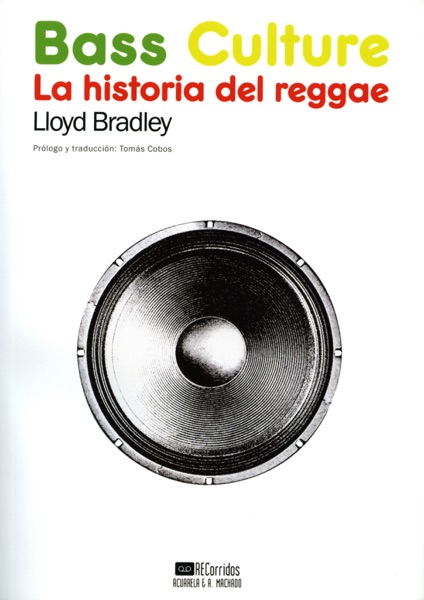
Bass Culture: When Reggae Was King by Lloyd Bradley is a 1999 history book about music history, jamaica, rastafari. Sound system culture — rival operators competing through exclusive records and engineering quality — was the institutional foundation from which the entire Jamaican music industry grew.
Summary
Lloyd Bradley's Bass Culture is the definitive popular history of Jamaican music from the late 1940s through the 1990s, tracing the full arc from mento and ska through rocksteady, reggae, dancehall, and ragga. At over six hundred pages, it is both comprehensive and genuinely readable — a rare combination in genre music history. Bradley, a British music journalist who has spent decades documenting Jamaican and its diaspora in the UK, brings an insider's ear and an outsider's analytical clarity.
The book opens with the social and economic conditions that produced the music: the grinding poverty of Kingston's West End, the sound system culture that emerged as communities unable to afford live music built their own entertainment infrastructure, and the complex relationship between Jamaica's Black majority, its political class, and a colonial musical establishment that initially patronized and then attempted to commercialize what it didn't fully understand. Sound system battles — where rival operators competed by finding exclusive recordings — are presented as both entertainment and social ritual, the crucible from which producers, singers, and eventually an entire industry emerged.
The Bob Marley arc dominates the middle of the book, but Bradley is careful to embed it in its proper context. Marley's international success was built on the work of dozens of singers, musicians, producers, and sound system operators whose names are less famous, and Bradley gives them space. Clement "Coxsone" Dodd, Duke Reid, Lee "Scratch" Perry, King Tubby — the producers and studio architects who shaped the sound are treated as central figures, not background characters. Dub, which Bradley covers in necessary depth, emerges as one of the most radical innovations in twentieth-century music: a genre built around absence, bass, and the manipulation of recorded sound as raw material.
The later chapters on dancehall and the transition from Rastafarian spiritual content to sound system hedonism are among the most analytically sharp in the book. Bradley does not moralize but does observe the shift clearly: a music that had once been explicitly about liberation became, in certain forms, explicitly about dominance. The book is consistently affectionate toward its subject without becoming uncritical, which is harder than it sounds.
Talk to Bass Culture: When Reggae Was King like its author wrote you back.
Get the ideas that fit your life — not generic summaries.
- Chat with the book
- Audiobook-style main ideas
- Adapts to your life and goals
- Helps you take action
Key takeaways
- 1.
Sound system culture — rival operators competing through exclusive records and engineering quality — was the institutional foundation from which the entire Jamaican music industry grew.
- 2.
Dub music inverted conventional music production. By treating the recorded track as raw material to be stripped, delayed, and echoed, King Tubby and Lee Perry invented a new relationship between producer and listener.
- 3.
Bob Marley's international success required a translation of Rastafarian themes into a register that white rock audiences could receive. The translation was necessary and costly in terms of cultural specificity.
- 4.
Reggae's political content was not incidental but structural: the Rastafarian theology of Babylon (worldly oppression) gave the music a consistent framework for social critique across decades.
- 5.
The shift from roots reggae to dancehall in the 1980s was partly a generational shift, partly economic, and partly a genuine change in what Jamaican youth wanted from music.
- 6.
The Jamaican music industry was plagued by exploitation. Artists frequently signed away rights they didn't understand, and producers who built entire careers on their sound often received almost nothing in royalties.
- 7.
British reggae, emerging from second-generation Caribbean immigrants, developed its own dialect and themes — more explicitly about police racism and urban alienation than its Jamaican counterpart.
- 8.
The bass in Jamaican music is not ornamental but structural. The evolution of sound system technology was driven by the pursuit of deeper, more physical low frequencies, which required constant engineering innovation.
Discussion questions
Use these on your own, with a book club, or as chat starters in Superbook. Book club version, ready to copy or print →
- 1.
Bradley argues that sound system culture was both entertainment and social institution. What institutions in your own community serve a comparable function — communal entertainment as social infrastructure?
- 2.
Dub music created a genre out of absence and manipulation. Where else do you see creative innovation that comes from removing or subtracting rather than adding?
- 3.
Marley's international success required translating specific cultural content for a different audience. Is that translation always a betrayal, or can it be a genuine act of cultural exchange?
- 4.
Rastafarian theology gave reggae a coherent politics. What other musical movements have had an equivalent ideological framework, and what happens to the music when the movement loses momentum?
- 5.
Bradley documents systematic exploitation of Jamaican artists. How much has changed in the music industry's treatment of artists from economically marginalized backgrounds?
- 6.
The shift to dancehall was partly about Jamaican youth rejecting the previous generation's politics. Do you see an equivalent generational rejection happening in a music genre you follow?
- 7.
The book gives substantial attention to producers and engineers alongside performers. Who are the equivalent invisible creators in a creative field you know?
- 8.
Bass Culture covers fifty years of music. What gets lost in a history this comprehensive, and what is only visible at this scale?
- 9.
The book was published in 1999. What has happened to Jamaican music since then that the book couldn't have anticipated?
- 10.
Bradley writes about music that comes from specific economic and social conditions — poverty, colonial history, migration. How does that context change how you listen to it?
- 11.
Which figure in the book, other than Marley, do you think deserves more international recognition, and why?
Themes
Frequently asked questions
-
Do I need to know reggae to read Bass Culture?
No, though you'll get more from it if you are listening as you read. Bradley writes for a general audience and explains context that specialists might skip. Readers who know nothing about Jamaican music can follow the argument; those who know it well will find depth they haven't encountered elsewhere.
-
Is Bass Culture a complete history of reggae?
It is the most comprehensive single-volume history available in English and covers the period up to the late 1990s. It does not cover developments since its 1999 publication and has less depth on Jamaican music outside the Kingston mainstream.
-
How long is it?
Over 600 pages in most editions. It is a long book but not a slow one — Bradley writes propulsively and the chapters are organized around clear narrative threads. Most readers who start it finish it.
-
What's the best entry point if I want to listen while reading?
Start with Studio One compilations for the ska and early reggae period, then Lee Perry's production work and King Tubby's dub mixes for the mid-1970s, then Bob Marley's Island Records albums for the international crossover years. Bradley's narrative follows roughly the same arc.
-
Is this book written for a British or Jamaican audience?
Both, with awareness of neither as default. Bradley addresses the music's Jamaican origins, its British diaspora, and its American reception with roughly equal care. American readers may need slightly more context for the British material and vice versa.
Similar books

Chronicles: Volume One
Bob Dylan

Just Kids
Patti Smith
Kitchen Confidential: Adventures in the Culinary Underbelly
Anthony Bourdain
Born a Crime: Stories from a South African Childhood
Trevor Noah
