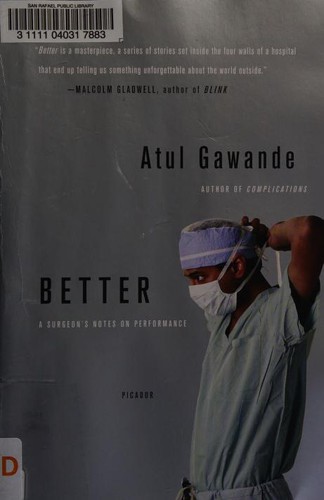
Better by Atul Gawande is a 2007 health book about medical performance, improvement, ethics. Performance in medicine varies far more than patients realize, and much of that variation is preventable rather than inevitable.
Summary
Better is Atul Gawande's examination of what it means to perform well in medicine, a field where the stakes are as high as they get and where the gap between ordinary and excellent care routinely determines who lives and who dies. Gawande is a surgeon and a journalist, and the book reads like both — precise clinical observation combined with a reporter's eye for the telling detail and the structural problem that most people miss.
The book is organized around three qualities Gawande argues define the best medical practitioners: diligence, doing right, and ingenuity. Through a series of linked essays he traces these qualities across wildly different contexts — a hand-washing campaign that hospitals couldn't get doctors to follow, the military medical corps working in Iraq, the ethics of physicians who administer lethal injections, the improbable improvements in cystic fibrosis outcomes at one Cincinnati hospital. Each essay makes a specific, grounded argument rather than gesturing toward inspiration.
One of the book's central cases is the cystic fibrosis story. Gawande went looking for why outcomes at different CF centers varied so dramatically — and found that the best center's success came down to one physician who was relentlessly systematic and insistent on tracking every number. The lesson isn't that this doctor was heroic; it's that measurement and accountability, applied with discipline, move the needle when intuition and effort alone don't. That's a harder truth than most medicine-adjacent books want to deliver.
The final essay, a kind of coda, gives five pieces of advice for doing better under any circumstances: ask an unscripted question, don't complain, count something, write something, change something. It's advice calibrated for people working inside imperfect systems rather than dreaming about perfect ones. Gawande's recurring argument is that improvement doesn't come from inspiration but from the slow, unglamorous work of measurement, iteration, and the willingness to be held accountable.
Talk to Better like its author wrote you back.
Get the ideas that fit your life — not generic summaries.
- Chat with the book
- Audiobook-style main ideas
- Adapts to your life and goals
- Helps you take action
Key takeaways
- 1.
Performance in medicine varies far more than patients realize, and much of that variation is preventable rather than inevitable.
- 2.
Diligence — following through on what you already know to do — is underrated. Hand-washing compliance is mundane; its absence kills people.
- 3.
Measurement is a prerequisite for improvement. The best CF center succeeded not because of superior talent but because of meticulous tracking and accountability.
- 4.
Doing right in medicine involves real moral ambiguity. Gawande examines physicians who participate in executions and finds no clean answer, only a case for confronting hard questions honestly.
- 5.
Ingenuity under constraint is often more important than resources. Wartime military medicine improved outcomes through systematic problem-solving, not just heroism.
- 6.
Asking the right questions distinguishes excellent practitioners. A few genuine questions per patient interaction changes what you see and what you learn.
- 7.
Improvement is unglamorous. It comes from tracking data, noticing patterns, and being willing to change a practice that isn't working.
- 8.
Writing about your work — reflecting on what happened and why — accelerates learning in ways that experience alone does not.
Discussion questions
Use these on your own, with a book club, or as chat starters in Superbook. Book club version, ready to copy or print →
- 1.
Gawande argues that diligence is underappreciated as a medical virtue. In your own field, where does diligence matter more than talent?
- 2.
The hand-washing example shows that knowing what to do and actually doing it are completely different problems. Where do you see that gap in your own work or life?
- 3.
What do you make of Gawande's treatment of physicians who assist in executions? Does his argument that doctors should engage rather than disengage hold up?
- 4.
The CF center story turns on one doctor's obsessive measurement. Is that kind of accountability culture replicable, or does it depend on a specific personality?
- 5.
Gawande argues that medicine needs to get better at admitting failure and tracking what goes wrong. What prevents institutions in other fields from doing the same?
- 6.
His five pieces of advice — ask questions, don't complain, count something, write something, change something — are unusually concrete. Which feels most achievable for you right now?
- 7.
Does knowing that medical outcomes vary so widely between hospitals change how you think about your own healthcare decisions?
- 8.
What's an area in your own work where you could start measuring something you currently only have intuitions about?
- 9.
Gawande describes ingenuity as making the most of what you have rather than waiting for better resources. Where have you seen this work in practice?
- 10.
The Iraq military medical corps improved survival rates dramatically through iteration. What conditions made that kind of rapid learning possible there that might be absent elsewhere?
- 11.
Gawande admits his own failures and gaps throughout the book. How does that self-disclosure affect your trust in his arguments?
- 12.
What's the hardest feedback you've ever had to integrate about your own performance? What made you actually change?
Themes
Frequently asked questions
-
Is Better by Atul Gawande worth reading?
Yes, particularly if you're interested in how complex systems fail and improve. Gawande writes as both a practitioner and a journalist, which gives the book a rare combination of technical specificity and narrative drive. It's more rigorous and less sentimental than most popular medicine writing.
-
What is Better by Atul Gawande about?
It examines what separates excellent medical performance from ordinary practice, through essays on diligence, ethics, and ingenuity. Gawande argues that improvement in medicine comes from accountability and measurement rather than heroism or inspiration.
-
How does Better compare to Gawande's other books?
Better is more structurally loose than The Checklist Manifesto, which makes a single focused argument, and less emotionally intense than Being Mortal. It works best as a series of linked essays on professional performance rather than as a continuous argument.
-
Who should read Better?
Anyone in a high-stakes professional field — medicine, law, education, engineering — who wants to think carefully about performance and accountability. The specific examples are medical but the underlying questions about how institutions improve apply broadly.
-
What's the most actionable idea in Better?
Count something. Pick one variable in your work that currently goes untracked and start measuring it. Gawande's argument is that measurement alone changes behavior, because it forces you to confront the gap between what you intend and what actually happens.
Similar books
Being Mortal: Medicine and What Matters in the End
Atul Gawande
The Checklist Manifesto
Atul Gawande
The Emperor of All Maladies: A Biography of Cancer
Siddhartha Mukherjee
Mountains Beyond Mountains
Tracy Kidder
