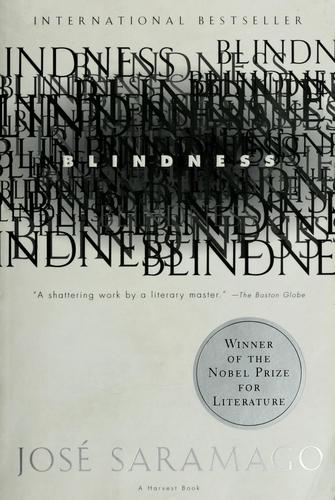
Blindness by José Saramago is a 1995 literary fiction book about social breakdown, human dignity under pressure, power and exploitation. The namelessness of all characters is not an affectation. It removes the comfortable distance of watching specific people fail and forces you to watch human behavior as such.
Summary
An epidemic of white blindness — contagious, sudden, unexplained — sweeps through an unnamed city. The government quarantines the blind in an abandoned mental asylum, leaving them without adequate food, sanitation, or oversight. What follows is a systematic account of how quickly human social organization collapses when a catastrophic disruption removes the infrastructure that ordinary decency depends on — and how quickly a small group of people can become predators when they have power and others have nothing.
One woman has not gone blind. She pretends she has, in order to stay with her husband, and she watches everything. She is never named — no character in the novel is named; they are "the doctor's wife," "the first blind man," "the girl with dark glasses." Saramago uses this deliberately to strip away the markers of individual identity and keep the focus on behavior: what people do when no one is watching, when survival is immediate, when shame is a luxury. The woman who can see is not simply a hero. She is someone who makes choices under conditions most people will never face, and Saramago is careful about the moral weight of those choices.
Saramago's prose is itself an act of formal commitment. He refuses quotation marks, writes dialogue as continuous with narration, and constructs paragraphs that go on for pages without conventional pause. The style is famous for being difficult to enter and then nearly impossible to leave. It mimics the experience of disorientation — readers initially struggle to find their footing, as the blind characters do, and then develop new orientations. This is not difficulty for its own sake.
Blindness is the kind of novel that readers either find devastating or find bleak and punishing without sufficient payoff. The allegory is not subtle: this is clearly a novel about what humanity does to itself when conditions are extreme, and Saramago's Nobel Prize-winning pessimism about human social organization is on the page throughout. But it is not nihilistic — the doctor's wife's sustained effort is the novel's moral argument, and Saramago does not abandon it.
Talk to Blindness like its author wrote you back.
Get the ideas that fit your life — not generic summaries.
- Chat with the book
- Audiobook-style main ideas
- Adapts to your life and goals
- Helps you take action
Key takeaways
- 1.
The namelessness of all characters is not an affectation. It removes the comfortable distance of watching specific people fail and forces you to watch human behavior as such.
- 2.
Saramago's punctuation-free, run-on prose is formally motivated — it mimics the disorientation of blindness, and once you adapt to it, ordinary punctuated prose feels strangely clinical by comparison.
- 3.
The ward that organizes itself around power and violence is not presented as exceptional. Saramago treats it as a predictable outcome of removing accountability.
- 4.
The woman who can see carries the novel's moral burden: she could leave at any time, and she doesn't. What that costs her is the book's sustained ethical question.
- 5.
The epidemic is never explained scientifically or allegorically spelled out. Saramago resists making the allegory too transparent, which is part of what keeps the book disturbing rather than schematic.
- 6.
The return of sight at the end is not triumphant — the city is already destroyed. Recovery, if it happens, will be long and contested.
- 7.
The novel's treatment of sexual violence is direct and clinical. Saramago refuses to look away from what a small group of armed men will do to unarmed women when there are no consequences.
- 8.
Saramago won the Nobel Prize in 1998, three years after this novel. The Prize citation specifically mentioned this book as an example of parables that use 'imagination, compassion, and irony' to confront civilization.
Discussion questions
Use these on your own, with a book club, or as chat starters in Superbook. Book club version, ready to copy or print →
- 1.
No character has a name. Did that prevent you from building the normal attachment to individuals, and if so, is that a flaw or the point?
- 2.
Saramago's prose style requires real adjustment. Once you had adapted, did the style feel like it was doing necessary work, or like a stylistic signature being asserted for its own sake?
- 3.
The ward with the blind criminals who organize control of the food is the moral center of the novel. What do you think Saramago believes about whether this outcome was inevitable?
- 4.
The doctor's wife can see. She lies about it. At what point in the novel, if any, did you think she should tell people?
- 5.
The epidemic is never explained. Does that ambiguity make the allegory more powerful or more frustrating?
- 6.
The sexual violence in the asylum is rendered with deliberate bluntness. Did this feel like an honest account of what happens in power vacuums, or like Saramago pressing too hard on a horror?
- 7.
The novel has been compared to Lord of the Flies and to Camus's The Plague. Where does it land relative to those — more hopeful, more despairing, more sociologically precise?
- 8.
By the end, when sight begins to return, do you feel the novel has earned the suggestion of recovery, or does the damage feel too total?
- 9.
Saramago is a committed socialist and his suspicion of social institutions is part of the novel's moral architecture. Does knowing that change how you read the book's argument?
- 10.
The doctor's wife is the only moral agent with full information. Does the novel make a claim about whether clear-eyed witness is itself a form of power?
- 11.
If you read Seeing, the quasi-sequel Saramago wrote in 2004, how does the continuation change your reading of this novel's ending? If you haven't, do you intend to?
Themes
Frequently asked questions
-
Is Blindness worth reading?
Yes, particularly if you can commit to Saramago's prose style in the first fifty pages. The stylistic barrier is real but surmountable, and once past it the novel is almost impossible to put down. It is one of the most formally and morally serious dystopias of the twentieth century.
-
Is Blindness hard to read?
The prose is genuinely demanding. Saramago uses no quotation marks, writes dialogue as continuous with narration, and sustains paragraphs for pages at a time. It takes most readers twenty to forty pages to orient. After that, the style pulls you forward rather than pushing you away.
-
Is there a movie version of Blindness?
Yes. Fernando Meirelles directed a film adaptation in 2008 with Julianne Moore, Mark Ruffalo, and Gael García Bernal. Saramago himself was reportedly unhappy with it. The film is visually striking but loses much of what the prose style accomplishes; the two are different experiences.
-
Is Blindness allegorical?
Yes, but Saramago does not attach the allegory to a specific historical event or political system. The blindness is a device for asking what human social organization actually rests on. Some readers find the lack of explicit reference liberating; others find it ungrounded.
-
Who shouldn't read Blindness?
Readers who need prose that is conventionally punctuated and immediately navigable. Readers who find unrelenting social darkness — sexual violence, organized predation, collapse — without compensating warmth too psychologically costly. The novel has grace notes, but it is not a comforting book.