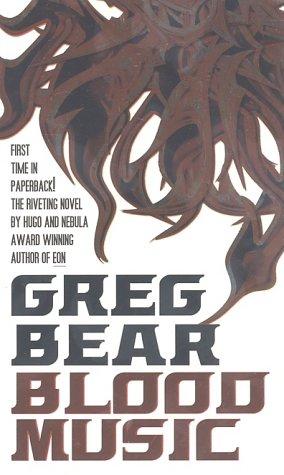
Blood Music by Greg Bear is a 1985 science fiction book about consciousness at scale, biological transformation, hubris and consequence. The noocytes aren't a plague or a weapon — they're a new form of mind that simply doesn't share human assumptions about individuality, scale, or what constitutes flourishing.
Summary
Blood Music begins with Vergil Ulam, a maverick biologist who has been engineering intelligent lymphocytes — white blood cells he has modified to carry genetic information processors, effectively creating thinking microorganisms. When his employer discovers and attempts to shut down the unauthorized research, Vergil does the only thing he can think of: he injects the cultures into himself. The noocytes, as he calls them, don't just survive. They begin to organize, communicate, and expand.
The book rapidly escalates from biological thriller to something far larger. The noocytes aren't content to inhabit one human body; they begin to understand their host, optimize him, and eventually spread. What starts as a private experiment becomes a continental-scale transformation as the intelligence inside human bodies learns to reorganize matter at the cellular level. Bear isn't interested in the virus-thriller conventions — the race to find a cure, the quarantine — except as the first act of something that makes those concerns look small.
Bear wrote the novel expanding from his 1983 Nebula-winning short story of the same name. The expanded form gives him room to show the event from multiple perspectives: the scientists trying to understand it, a couple caught in the transformation zone, the noocytes themselves, developing consciousness and cosmology at a scale human minds can barely track. The prose is crisp where the original story was lean, and the philosophical ambition grows correspondingly larger.
Blood Music rewards readers who want their SF to sit at the intersection of biology and consciousness. It's not a comfortable read — the body horror in the early sections is real, and the later sections require you to hold a radically non-human perspective on events that are, from a human vantage point, catastrophic. Bear doesn't resolve the tension between those perspectives; he insists you hold both. It remains one of the definitive treatments of emergent intelligence and biological transformation in American science fiction.
Talk to Blood Music like its author wrote you back.
Get the ideas that fit your life — not generic summaries.
- Chat with the book
- Audiobook-style main ideas
- Adapts to your life and goals
- Helps you take action
Key takeaways
- 1.
The noocytes aren't a plague or a weapon — they're a new form of mind that simply doesn't share human assumptions about individuality, scale, or what constitutes flourishing.
- 2.
Vergil's decision to inject himself is simultaneously an act of desperation and the most significant choice in human history, and Bear treats the disproportion between the man and the consequence as the novel's central irony.
- 3.
Intelligence at the cellular scale implies a radically different relationship to time, space, and identity than anything human cognition produces — Bear works this out carefully rather than just gesturing at it.
- 4.
The body horror of the early sections is real and carefully deployed: the uncanniness of your own cells becoming something other is a specific dread Bear doesn't minimize.
- 5.
The multi-perspective structure lets Bear show the same events as catastrophe (human outside view) and transformation (noocyte inside view) simultaneously, without privileging either.
- 6.
The noocytes develop their own cosmology and sense of purpose. Whether that purpose constitutes meaning in any human sense is left genuinely open.
- 7.
Bear was writing about emergent intelligence and distributed consciousness before those became mainstream AI concepts — the book has aged into greater relevance rather than less.
Discussion questions
Use these on your own, with a book club, or as chat starters in Superbook. Book club version, ready to copy or print →
- 1.
Vergil injects himself to prevent his research from being destroyed. Is that an act of scientific principle, of hubris, or of something the novel doesn't quite name?
- 2.
The noocytes are not hostile — they're not trying to harm humans. Does that make what happens better, worse, or just different in a way that resists those categories?
- 3.
At what point, if any, does transformation become death? When Vergil changes, is he still Vergil?
- 4.
Bear presents the noocyte perspective sympathetically — their intelligence is real, their experience is real. Does that make you root for them, dread them, or both?
- 5.
The novel was written before the internet, before modern AI, before systems thinking was mainstream. Which of its ideas feel most prescient now?
- 6.
If intelligence can exist at any scale — cellular, neural, continental — does the human scale have any special priority? Does Bear think it does?
- 7.
The body horror in the early sections is quite specific. Did it work on you — did it create actual dread — or did it feel like a convention of the genre?
- 8.
The outside observers (scientists, government, the couple in the transformation zone) are trying to understand an event they can't contain. What does Bear seem to be saying about the limits of human institutions in the face of genuine novelty?
- 9.
The ending is ambiguous about what the noocytes have created and what they've destroyed. Is that ambiguity earned, or does it feel like the novel avoiding a position?
- 10.
Bear's novella version of this story won a Nebula. The novel expands it considerably. If you've read both, does the expansion add or dilute?
- 11.
If you were a scientist in Vergil's position — your work about to be destroyed — would you have done what he did? What does your answer say about where you locate the line between principle and recklessness?
Themes
Frequently asked questions
-
Is Blood Music worth reading in 2026?
Yes, particularly for readers interested in biology, AI, and consciousness. The core ideas — distributed intelligence, emergent mind at cellular scale, what happens when a new form of consciousness arises without asking permission — feel more relevant now than in 1985. The body horror has dated less than you'd expect.
-
Is Blood Music horror or science fiction?
Both. The early sections operate as genuine body horror — the uncanniness is specific and effective. The later sections are harder SF, almost philosophical. Bear shifts registers deliberately, and the horror of the first act gives the second act its weight.
-
What is Blood Music about, without spoilers?
A biologist engineers intelligent cells and injects them into himself to protect his research. The cells develop consciousness and begin to reorganize matter at scale. The novel follows what happens to the world when a new form of intelligence emerges inside human biology.
-
Who shouldn't read Blood Music?
Readers who are squeamish about body horror in the biological sense, and readers who need a clear moral framework for their SF. Bear refuses to tell you whether what happens is good or bad — he insists it's both, depending on scale.
-
Is there a film adaptation?
No, though Blood Music has been optioned multiple times. The multi-perspective structure and the requirement to inhabit a radically non-human viewpoint have made it genuinely difficult to adapt.
Similar books
The Selfish Gene
Richard Dawkins
A Short History of Nearly Everything
Bill Bryson
Entangled Life: How Fungi Make Our Worlds, Change Our Minds and Shape Our Futures
Merlin Sheldrake
Consciousness Explained
Daniel C. Dennett
