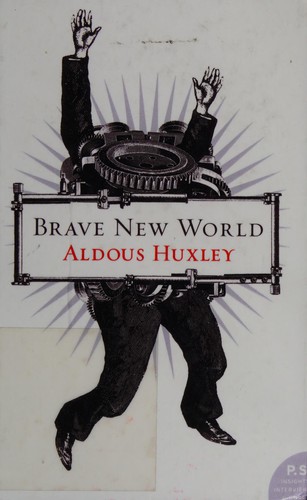
Brave New World by Aldous Huxley is a 1932 literary fiction book about consumerism and control, freedom and happiness, science and humanity. Huxley's dystopia is achieved through pleasure, not pain. Soma, sex, and entertainment replace coercion — which makes resistance almost impossible because nobody is obviously suffering.
Summary
In the World State of 632 A.F. (After Ford), human beings are manufactured in hatcheries, conditioned from infancy to love their assigned roles, and kept content by unlimited sex, the drug soma, and an endless flow of entertainment. Nobody suffers. Nobody asks hard questions. Stability is the supreme value, and it has been achieved so completely that the word "mother" is now obscene. Brave New World, published in 1932, was Huxley's vision of a dystopia built not on brutality but on comfort — the opposite approach from the one Orwell would take seventeen years later.
The book follows Bernard Marx, an Alpha-Plus who feels vaguely out of step with the conditioning everyone else embraced perfectly, and later John — a man born naturally on a Savage Reservation in New Mexico — who arrives in London carrying Shakespeare and romantic ideals the World State has engineered away. The collision between John's hunger for authenticity, suffering, and transcendence and the World State's cheerful abolition of all three is the novel's central drama. Huxley doesn't make John simply right; the novel is more honest than that. The Savage wants to suffer. He wants complexity. And the World State's Resident Controller, Mustapha Mond, can explain exactly why society chose otherwise, and he sounds reasonable.
Huxley was working in the tradition of the satirical essay as much as the novel. The expository sections — Mond's lectures, the long opening description of the hatchery — are intellectually dense and deliberately didactic. The characters are less psychologically rich than symbolic. This gives the book more staying power as a thought experiment than as fiction: you finish it with an argument in your head, not characters you miss.
Brave New World has been read for nearly a century as a warning, but Huxley himself saw it as a prediction, not a prescription — and late in life he thought we were moving faster toward it than he'd imagined. The question it leaves open is whether a world without war, poverty, or loneliness, in which people are genuinely happy but have engineered away everything that makes happiness meaningful, is a dystopia or a solution. Most readers pick dystopia immediately. The book is most useful when it slows you down on that answer.
Talk to Brave New World like its author wrote you back.
Get the ideas that fit your life — not generic summaries.
- Chat with the book
- Audiobook-style main ideas
- Adapts to your life and goals
- Helps you take action
Key takeaways
- 1.
Huxley's dystopia is achieved through pleasure, not pain. Soma, sex, and entertainment replace coercion — which makes resistance almost impossible because nobody is obviously suffering.
- 2.
The World State sacrifices art, religion, science, and love for stability. Mustapha Mond's argument is that people accepted the trade freely, more or less. The novel doesn't fully refute him.
- 3.
Conditioning shapes desire, not just behavior. The citizens of the World State don't just obey — they want what they've been programmed to want, which is a more efficient form of control.
- 4.
John the Savage is not presented as straightforwardly right. His attachment to suffering and Shakespearean romanticism is partly self-destructive. Huxley complicates the obvious hero.
- 5.
Bernard Marx's dissatisfaction is partly principled and partly wounded ego — he's unhappy because his conditioning didn't quite take, not because he's genuinely more conscious.
- 6.
Helmholtz Watson, who wants to create art that matters but has nothing to say, is the more interesting rebel: he feels the emptiness of his craft without knowing what to put in it.
- 7.
The Bokanovsky Process — one fertilized egg budgeted into ninety-six identical workers — is Huxley's image of industrial logic applied to human beings at the source.
- 8.
The final chapter's tragedy is not that John is destroyed by the World State's cruelty but that he can't survive its benign indifference. The State doesn't need to punish him. It just watches.
Discussion questions
Use these on your own, with a book club, or as chat starters in Superbook. Book club version, ready to copy or print →
- 1.
Mustapha Mond argues that the World State made a fair trade: art, religion, and authentic love for stability and universal contentment. Do you find his argument more persuasive than you expected?
- 2.
John the Savage insists on his right to be unhappy. Is that a coherent claim? Does suffering have value, or does John romanticize it?
- 3.
The citizens of the World State are genuinely happy by any observable measure. Is Brave New World actually a dystopia, or does it require the reader to smuggle in assumptions about what happiness is worth?
- 4.
Bernard Marx's rebellion is partly driven by vanity and wounded status, not principle. Does that make his critique of the system less valid?
- 5.
Helmholtz Watson feels that his writing is empty but can't identify what it's missing. What has the conditioning taken from him that a Shakespeare could supply?
- 6.
The novel was written in 1932. Which of its predictions have come closest to being accurate, and which look most dated?
- 7.
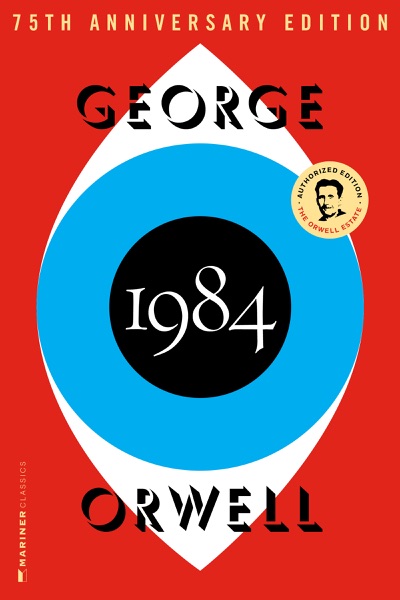
Compared to 1984, where control is brutal and explicit, Brave New World's control is pleasurable. Which form of totalitarianism do you find more frightening, and why?
- 8.
The word 'mother' is obscene in the World State. Why does Huxley make family the thing the utopia most thoroughly destroys?
- 9.
Lenina Crowne is cheerful, kind, and incapable of anything deeper than she's been conditioned to feel. Is she a victim, a villain, or just a product of her world?
- 10.
Huxley later wrote Brave New World Revisited arguing the world was arriving faster than he'd predicted. Looking at contemporary culture, what would he point to as evidence?
- 11.
What would you personally give up — or not — to live in the World State? Where is your line?
- 12.
The Savage Reservation is preserved as a tourist attraction. What does it mean that the World State keeps the alternative visible rather than destroying it?
Themes
Frequently asked questions
-
What is Brave New World about, briefly?
A future society that maintains perfect stability by manufacturing and conditioning humans for predetermined roles, suppressing genuine emotion with drugs and entertainment, and eliminating art, religion, and family. The story follows outsiders who encounter the system's costs.
-
Is Brave New World hard to read?
Not particularly. The prose is clear and the opening chapters explaining the World State are deliberately expository. The middle section can feel slow. The ideas are more demanding than the sentences.
-
How does Brave New World compare to 1984?
Where 1984 depicts totalitarianism through fear, surveillance, and torture, Brave New World achieves control through pleasure — conditioning, drugs, and comfort. Huxley's nightmare is that people choose their cage. Neil Postman famously argued that Huxley's was the more accurate prophecy.
-
Is Brave New World still relevant?
More than ever, most readers find. The combination of engineered contentment, entertainment as pacification, pharmaceutical mood management, and the engineering away of discomfort maps uncomfortably well onto contemporary life.
-
Who shouldn't read Brave New World?
Readers who need character-driven emotional investment may struggle. The people in the novel are largely symbolic, and the scenes between them are vehicles for ideas rather than developed human relationships.