Science · Book club
Breath: The New Science of a Lost Art book club questions
Here are 12 book club questions for Breath: The New Science of a Lost Art by James Nestor, ordered to open easily and end somewhere worth arguing about. Copy them, print them, or bring them up one at a time.
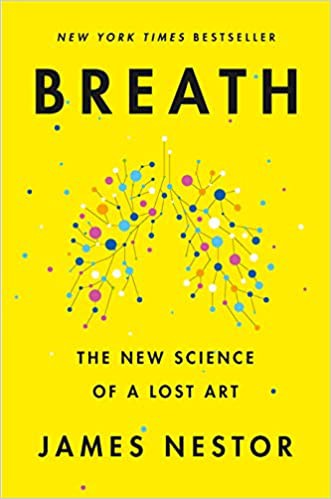
Breath is James Nestor's investigation into one of the most basic and overlooked aspects of human health: how we inhale and exhale.
James Nestor · 2020 · 4h 45m
Full summary and key takeaways →The 12 questions
- 1.
Nestor argues that breathing is something most people do wrong their entire lives without knowing it. Did reading the book change how you paid attention to your own breath during the day?
- 2.
The Stanford nose-plugging experiment was extreme, but it produced dramatic results in ten days. What does that suggest about how sensitive the body is to changes in breathing pattern?
- 3.
Nestor traces jaw shrinkage and airway narrowing to modern diets. If this is accurate, what does it imply for how we think about 'normal' health baselines — are we comparing to a degraded average?
- 4.
The book gives a lot of space to self-experimentation. How much weight do you give to Nestor's personal experience versus the clinical studies he cites?
- 5.
Several of the breathing techniques in the book come from spiritual or religious traditions. Does their origin affect whether you'd try them? Should it?
- 6.
Nestor describes breathing researchers who work outside mainstream medicine and have faced institutional skepticism for decades. How do you decide when a marginalized idea deserves more attention versus when skepticism is warranted?
- 7.
The core prescription — slower, nasal, fewer breaths — is simple enough to test at no cost. Have you tried it, and if so, what did you notice?
- 8.
Mouth-breathing during sleep is associated with snoring, sleep apnea, and poor sleep quality. If you or someone you know has these problems, does the book change how you think about the cause?
- 9.
Nestor argues that anxiety and breath are bidirectionally linked — that changing the breath changes the emotional state. Is that a physiological claim, a psychological one, or both?
- 10.
The Buteyko method has clinical trials supporting it for asthma, yet it remains almost unknown to most patients. What does that gap suggest about how medical knowledge spreads?
- 11.
Which of the breathing techniques Nestor describes would you most want to try, and which would you dismiss? What criteria are you using?
- 12.
Breath sits at the intersection of ancient practice and modern science. Do you find that framing persuasive, or does it blur an important line between the two?
How to run the discussion
- Pick six to eight, not all of them. An hour of real discussion covers fewer questions than anyone expects, and racing the list is what makes a book club feel like homework.
- Open with what people noticed, not what they concluded. Asking for a verdict first hardens opinions before anyone has heard each other.
- Let the disagreement run. The questions below that split a room are the ones worth the time; the ones everyone answers the same way can be skipped.
- Ask the quiet person a specific question. A direct, narrow question is far easier to answer than an open invitation to contribute.
Themes worth steering toward
If the conversation stalls, these are the threads that usually restart it.
Common questions
What are good book club questions for Breath: The New Science of a Lost Art?
Here are 12 book club questions for Breath: The New Science of a Lost Art by James Nestor, ordered to open easily and end somewhere worth arguing about. The strongest openers ask what each reader noticed rather than what they concluded, and the discussion usually turns on breathing, human physiology, health optimization.
How long should a book club discussion of Breath: The New Science of a Lost Art last?
Most groups run 60 to 90 minutes of actual discussion. That is roughly six to eight questions, not all of them, so pick the ones that suit your group rather than working down the list in order.
What are the main themes in Breath: The New Science of a Lost Art?
Breathing, Human physiology, Health optimization, Ancient practices, Biology. Those are the threads most likely to divide a room, which makes them the useful places to steer a discussion that has gone quiet.
Picking the next one? See books like Breath: The New Science of a Lost Art or questions for other book club picks.
