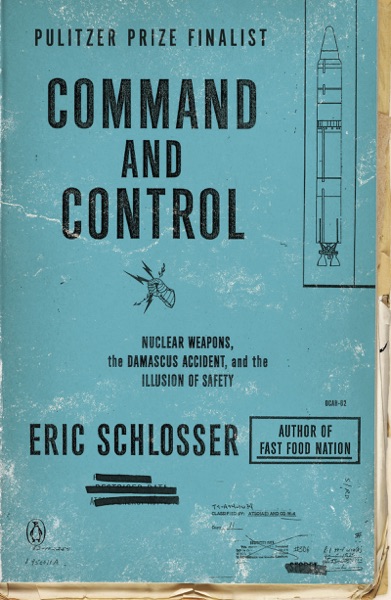
Command and Control: Nuclear Weapons, the Damascus Accident, and the Illusion of Safety by Eric Schlosser is a 2013 history book about nuclear weapons, bureaucracy and safety, cold war. The United States experienced dozens of nuclear weapons accidents during the Cold War, most of which were never publicly disclosed. Several came extremely close to detonation.
Summary
Command and Control is Eric Schlosser's investigation into the hidden history of nuclear weapons accidents and the organizations that tried to prevent them from detonating by accident. The book runs two tracks simultaneously: a detailed account of the 1980 Damascus, Arkansas missile explosion — in which a Titan II intercontinental ballistic missile caught fire and blew up in its silo, scattering a nine-megaton warhead across the Arkansas countryside — and a broader history of how the United States came to possess thousands of nuclear weapons it struggled to control safely.
Schlosser spent six years on the research and uncovered documents showing that near-catastrophes were far more common than the government ever acknowledged. A B-52 broke apart over North Carolina in 1961 and dropped two hydrogen bombs; investigators later found that a single low-voltage switch was all that stood between a detonation and survival. A Titan II in Kansas accidentally released a warhead that fell thirty feet before stopping just short of the ground. Schlosser catalogs dozens of similar events — collectively known as "broken arrows" — and traces the bureaucratic dynamics that allowed each one to be covered up or downplayed.
The organizational analysis is as important as the accident history. Schlosser draws on the work of sociologist Charles Perrow, whose "normal accidents" theory holds that complex, tightly coupled systems will inevitably fail in unexpected ways regardless of how careful the operators are. The Air Force's culture of maintaining operational readiness at all costs repeatedly overrode the safety concerns of engineers and weapon designers, with near-catastrophic results. The people who built the bombs often had a much clearer understanding of the dangers than the generals who commanded them.
Schlosser is not arguing that we should be surprised nuclear accidents happened; he is arguing that we should be amazed none of the accidents led to a detonation. The Damascus explosion left its warhead mostly intact not because of careful engineering but because of luck. For anyone interested in institutional failure, risk management, or the hidden costs of deterrence, Command and Control is essential reading.
Talk to Command and Control: Nuclear Weapons, the Damascus Accident, and the Illusion of Safety like its author wrote you back.
Get the ideas that fit your life — not generic summaries.
- Chat with the book
- Audiobook-style main ideas
- Adapts to your life and goals
- Helps you take action
Key takeaways
- 1.
The United States experienced dozens of nuclear weapons accidents during the Cold War, most of which were never publicly disclosed. Several came extremely close to detonation.
- 2.
The 1961 Goldsboro B-52 crash dropped two hydrogen bombs over North Carolina. One bomb armed and deployed its parachute. A single low-voltage switch prevented detonation.
- 3.
The 1980 Damascus explosion destroyed a Titan II silo and scattered a nine-megaton warhead across Arkansas. The warhead's conventional explosives detonated but the nuclear stage did not — due largely to luck.
- 4.
Bureaucratic cultures that prioritize operational readiness create pressure to overlook safety concerns. The Air Force repeatedly resisted design changes that would have made warheads safer but slower to deploy.
- 5.
Complex, tightly coupled systems — like nuclear arsenals — are subject to 'normal accidents': failures that emerge unpredictably from interactions between components, not from individual errors.
- 6.
The people who designed nuclear warheads often understood the dangers far better than the generals who commanded them. The divide between scientists and the military chain of command was a persistent source of risk.
- 7.
The command-and-control systems designed to prevent accidental or unauthorized launches were often in tension with the systems designed to ensure the weapons would always be available if ordered to launch.
- 8.
The full history of nuclear near-misses suggests that surviving the Cold War without a nuclear detonation by accident involved a significant element of luck, not just competent management.
Discussion questions
Use these on your own, with a book club, or as chat starters in Superbook. Book club version, ready to copy or print →
- 1.
Schlosser argues that near-accidents were far more common than the government acknowledged. Does this change how you think about nuclear deterrence as a stable policy?
- 2.
The Air Force culture favored readiness over safety. What organizational pressures created that culture, and do similar pressures exist in other high-stakes industries?
- 3.
How does Charles Perrow's 'normal accidents' theory apply beyond nuclear weapons? What other complex systems might be subject to the same inevitable failure modes?
- 4.
The engineers who built the warheads often knew about safety risks that were being ignored. What responsibility did they have to push harder, and what constraints limited them?
- 5.
The Damascus accident was caused by a dropped wrench socket. How does the mundaneness of the initial failure affect how you think about catastrophic risk?
- 6.
Schlosser shows that much of this history was deliberately classified. What is the public's legitimate interest in knowing about near-disasters involving nuclear weapons?
- 7.
The book profiles workers at the Damascus site who risked their lives trying to save a weapon that might have killed them. What does it say about institutional culture that they felt compelled to try?
- 8.
Does the long stretch of Cold War without an accidental detonation prove that the system worked, or does it merely prove that we got lucky? How would you distinguish between these two interpretations?
- 9.
Many safety improvements were resisted because they added cost or reduced capability. How should governments balance operational capability against safety in systems with catastrophic failure modes?
- 10.
How does Schlosser's portrait of the military-industrial complex compare to popular images of cold, calculating deterrence strategy?
- 11.
The book was written in 2013. How do the risks it describes change as nuclear arsenals age and new countries acquire weapons?
- 12.
Which specific accident in the book alarmed you most, and why?
Themes
Frequently asked questions
-
Is Command and Control worth reading?
Yes, especially if you have any interest in institutional risk, Cold War history, or the gap between public reassurance and private reality. Schlosser is a skilled reporter and the Damascus accident narrative is genuinely gripping. The policy implications are also more current than the Cold War setting suggests.
-
How long does it take to read Command and Control?
The book is around 620 pages plus extensive notes. Expect nine to eleven hours at average pace. The dual narrative — Damascus and the broader history — keeps the pace moving despite the density of detail.
-
What happened in the Damascus accident?
In September 1980, an Air Force technician dropped a socket wrench in a Titan II missile silo in Arkansas. The falling tool punctured the missile's fuel tank. The resulting fire and explosion destroyed the silo and killed one airman, scattering the nine-megaton warhead. The nuclear stage did not detonate, but it was a close call.
-
Who should read this book?
Anyone interested in nuclear history, organizational safety, or how large institutions manage catastrophic risk. It pairs well with books on the Challenger disaster, Chernobyl, and other technological failures. Readers looking for a good narrative alongside the policy analysis will find both.
-
Does Schlosser argue that nuclear weapons should be abolished?
He is careful not to make that explicit argument, but the cumulative weight of the evidence points in that direction. His stated goal is transparency: the public cannot evaluate nuclear policy when the government systematically conceals how dangerous the weapons are in practice.
Similar books
The Making of the Atomic Bomb
Richard Rhodes

American Prometheus
Kai Bird and Martin J. Sherwin

The Rise and Fall of the Third Reich
William L. Shirer

Sapiens: A Brief History of Humankind
Yuval Noah Harari
