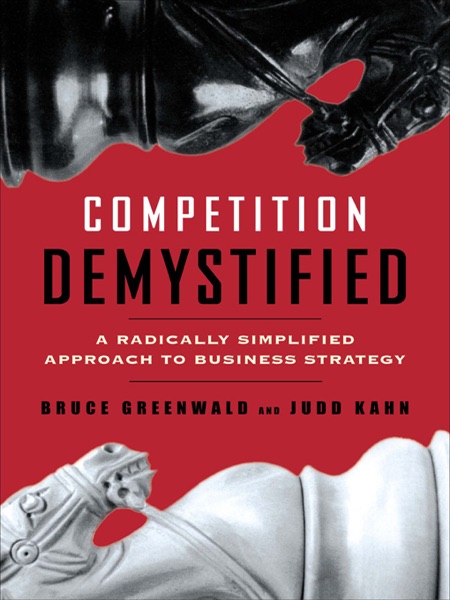
Competition Demystified by Bruce Greenwald and Judd Kahn is a 2005 business book about competitive strategy, competitive advantage, entry barriers. The only truly durable competitive advantage is a barrier to entry. Without one, competition will eventually reduce returns to the cost of capital, regardless of management quality.
Summary
Competition Demystified is Bruce Greenwald and Judd Kahn's deliberate simplification of competitive strategy — a counterweight to the complexity of the Porter Five Forces framework, which they argue gives strategists too many variables and not enough analytical clarity. The central claim is that the only thing that truly matters in competitive strategy is whether a company has barriers to entry. If it does, it has competitive advantage. If it does not, competition will erode profits to the cost of capital no matter what else management does.
Greenwald, a Columbia Business School professor associated with the value investing tradition of Benjamin Graham and Warren Buffett, applies this lens to a series of extended case studies — Walmart, Intel, Coke, Apple, local newspapers — to show how entry barriers analysis explains observed competitive outcomes better than more complex frameworks. The case studies are the book's primary vehicle, and they work. Reading the Intel analysis or the local newspaper analysis will change how you think about those businesses.
The three types of barriers to entry Greenwald identifies are: supply-side advantages (proprietary technology, processes, or assets), demand-side advantages (captive customers or strong brand loyalty that effectively locks out competitors), and economies of scale in a market too small for multiple competitors to coexist. He argues that most businesses lack all three, and that strategy in competitive markets should not be about winning competition but about restructuring the competitive environment or choosing markets where barriers can be built.
The book is shorter and more focused than most strategy texts, which is partly a virtue and partly a limitation — the framework is sharp but some cases would benefit from more detail. Greenwald and Kahn are honest about what their framework does not address: competitive dynamics within industries where no one has a durable advantage, and the question of how to build an advantage rather than just how to identify one. Competition Demystified works best as a complement to rather than a replacement for broader strategy education.
Talk to Competition Demystified like its author wrote you back.
Get the ideas that fit your life — not generic summaries.
- Chat with the book
- Audiobook-style main ideas
- Adapts to your life and goals
- Helps you take action
Key takeaways
- 1.
The only truly durable competitive advantage is a barrier to entry. Without one, competition will eventually reduce returns to the cost of capital, regardless of management quality.
- 2.
Porter's Five Forces framework is often used incorrectly as a descriptive tool rather than a normative one. Greenwald argues the relevant question is always specifically about barriers to entry, not the full five-variable analysis.
- 3.
Supply-side barriers include proprietary technology, unique production processes, and captive raw materials. They are relatively rare and often erode over time as technology diffuses.
- 4.
Demand-side barriers — customer captivity through habit, switching costs, or search costs — are often more durable than supply-side barriers because they are embedded in customer behavior rather than technology.
- 5.
Economies of scale create barriers only in markets small enough that a new entrant could not achieve efficient scale. In large markets, scale alone is not a durable barrier.
- 6.
Competitive advantage is local. A company may have enormous advantages in its home market and none in adjacent markets. Geographic or segment expansion that leaves the advantage behind creates value destruction, not growth.
- 7.
In competitively advantaged industries, management matters less than the structural position. In competitive industries, management matters enormously — but not enough to overcome the absence of barriers.
- 8.
Most strategic planning activity in firms without durable competitive advantages is wasted. The priority for those firms should be market selection and advantage creation, not operational optimization.
Discussion questions
Use these on your own, with a book club, or as chat starters in Superbook. Book club version, ready to copy or print →
- 1.
Greenwald argues that most strategic planning is irrelevant for companies without barriers to entry. Is that claim too strong, or does it match what you have observed in organizations you know?
- 2.
The case study on local newspapers shows how barriers that seemed durable — captive local advertiser relationships — were destroyed by the internet. What current barriers do you think are more vulnerable to technological disruption than they appear?
- 3.
Supply-side versus demand-side barriers behave differently over time. Which type do you think is more durable in the industries you know best?
- 4.
Greenwald argues that competitive advantage is inherently local. How does that play out in technology platforms that achieve global scale? Do network effects create a different kind of barrier than the three categories he identifies?
- 5.
The book uses Intel as a central case study. In retrospect, given what happened to Intel in the 2010s and 2020s, does the Intel analysis hold up or does it reveal limitations in the framework?
- 6.
Greenwald and Kahn argue that management quality matters less than competitive position. How does that claim fit with the evidence from companies like Apple under Jobs versus without him?
- 7.
If you applied the barrier-to-entry analysis to a company you currently work for or invest in, which category best describes its position? Does that analysis change how you think about the business?
- 8.
The framework is deliberately simpler than Porter's Five Forces. What does simplicity gain and what does it cost in terms of analytical accuracy?
- 9.
The book argues that companies without barriers should focus on market selection rather than trying to win in competitive markets. What does that prescription look like in practice?
- 10.
Greenwald comes from a value investing tradition that looks for companies with durable advantages at reasonable prices. How does the competitive analysis framework in this book connect to the stock selection framework in value investing?
- 11.
The case study on Walmart shows how scale created a durable advantage in retail. Does that analysis explain why Amazon has been able to challenge Walmart in a way that other retailers could not?
- 12.
What is the most important insight from Competition Demystified that you would apply immediately to a business decision you currently face?
Themes
Frequently asked questions
-
Is Competition Demystified better than Porter's Competitive Strategy?
They serve different purposes. Porter's framework is broader and more descriptive — a map of competitive forces across an industry. Greenwald's framework is narrower and more normative — a tool for evaluating whether a specific company has a durable advantage. Both are worth reading; Competition Demystified is more useful for investors, Porter is more useful for industry-wide strategic planning.
-
Do I need a business or finance background to read this book?
Some familiarity with financial statements and basic business concepts helps, but the book is written accessibly enough for motivated general readers. The case studies are more useful if you can read a simplified income statement, but the core argument does not require technical expertise.
-
How does Competition Demystified relate to Warren Buffett's investment framework?
Closely. Buffett's concept of the economic moat is essentially the same as Greenwald's barrier to entry — a durable structural advantage that protects returns from competition. The book provides the analytical framework for identifying and evaluating the moats Buffett looks for. Greenwald taught in the Graham and Dodd tradition and has lectured alongside Buffett.
-
What is the most actionable insight in Competition Demystified for a practitioner?
The emphasis on customer captivity as a demand-side barrier. Most practitioners focus on technology and scale, but the most durable competitive advantages are often embedded in customer habits, switching costs, and search costs — and those are more easily built, and more easily assessed, than technological superiority.
-
Is Competition Demystified still relevant given changes in technology markets since 2005?
Largely yes. The framework predates platform businesses and network effects, which require some extension of the analysis — network effects are effectively a form of demand-side barrier that Greenwald's framework partially captures. The core insight that barriers to entry determine long-term profitability has not been challenged by subsequent market developments.
Similar books
Competitive Strategy
Michael E. Porter
Good Strategy Bad Strategy
Richard Rumelt
The Outsiders: Eight Unconventional CEOs and Their Radically Rational Blueprint for Success
William N. Thorndike
The Intelligent Investor
Benjamin Graham
