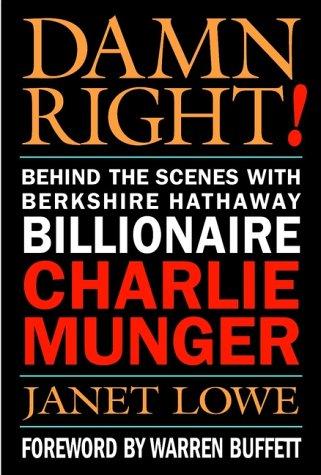
Damn Right! Behind the Scenes with Berkshire Hathaway Billionaire Charlie Munger by Janet Lowe is a 2000 biography book about investing, biography, mental models. Munger's early career as a real estate attorney instilled the habit of rigorous documentation, adversarial testing of arguments, and systematic checking of claims — analytical habits that transferred directly to investing.
Summary
Damn Right! is Janet Lowe's authorized biography of Charles T. Munger, the vice-chairman of Berkshire Hathaway and Warren Buffett's long-term partner. Published in 2000, it remains the most detailed biographical account of Munger's life available, tracing his upbringing in Omaha during the Depression, his wartime service as a meteorologist, his Harvard Law degree, his early career as a real estate attorney, and his eventual transition to full-time investing through the partnership that became Wesco Financial.
Lowe had cooperation from Munger, Buffett, and the Berkshire inner circle, which gives the book unusual access but also a degree of advocacy for its subject. The picture of Munger that emerges is consistent: relentlessly curious, deeply read across disciplines, intellectually honest to the point of bluntness, and personally frugal despite enormous wealth. Lowe traces how Munger's legal career shaped his analytical rigor — his habit of checking every claim against the evidence, his distrust of conventional wisdom — and how his friendship with Buffett evolved from occasional business overlap to a decades-long intellectual partnership.
The core of the book, for readers interested in investment philosophy, is Lowe's account of Munger's development of what he calls the lattice of mental models — the practice of drawing on ideas from multiple disciplines (psychology, biology, physics, mathematics, economics) rather than relying on the specialized toolkit of any one field. Munger's argument, developed over decades of speeches and annual meeting commentary, is that most investment mistakes are not failures of financial analysis but failures of thinking: confirmation bias, incentive distortion, social proof, first-conclusion bias. Understanding these mechanisms, he argues, is more valuable than any specific valuation model.
Lowe's writing is thorough rather than elegant, and the book reads more like a careful documentation than a narrative drive. Readers looking for page-turning biography will find it slow in places. But as a record of Munger's intellectual development, his investment track record, and the way his partnership with Buffett actually functioned, Damn Right! remains essential. There is no other source that covers Munger's pre-Berkshire years in as much depth.
Talk to Damn Right! Behind the Scenes with Berkshire Hathaway Billionaire Charlie Munger like its author wrote you back.
Get the ideas that fit your life — not generic summaries.
- Chat with the book
- Audiobook-style main ideas
- Adapts to your life and goals
- Helps you take action
Key takeaways
- 1.
Munger's early career as a real estate attorney instilled the habit of rigorous documentation, adversarial testing of arguments, and systematic checking of claims — analytical habits that transferred directly to investing.
- 2.
The lattice of mental models is Munger's core intellectual framework: effective decisions require insights from psychology, biology, physics, economics, and history applied in combination, not in isolation.
- 3.
Munger's investing approach differs from pure Graham-Buffett value investing in one key way: he pushed Buffett toward paying fair prices for wonderful businesses rather than buying mediocre businesses cheaply.
- 4.
Human psychological biases — particularly incentive bias, social proof, commitment and consistency, and availability bias — cause predictable investment errors that can be understood, named, and partially mitigated.
- 5.
Munger's frugality was not poverty mentality but a principled preference for simplicity that predated and survived his wealth. He drove modest cars and avoided displays of status throughout his billionaire years.
- 6.
The Berkshire Hathaway partnership between Munger and Buffett worked because each brought a different intellectual style that corrected for the other's tendencies. Buffett was the synthesizer; Munger was the skeptic.
- 7.
Wesco Financial, which Munger ran independently for years before its merger into Berkshire, provides a less-analyzed record of his investment approach in isolation from Buffett's that reveals his individual priorities.
Discussion questions
Use these on your own, with a book club, or as chat starters in Superbook. Book club version, ready to copy or print →
- 1.
Lowe had Munger's cooperation in writing this biography. How does authorized access change what gets told, and what might be underemphasized as a result?
- 2.
Munger's legal background is presented as a formative influence on his analytical habits. How does professional training in one discipline shape intellectual style in ways that persist long after leaving that field?
- 3.
The book describes Munger pushing Buffett toward quality businesses at fair prices rather than cheap businesses at bargain prices. This seems obvious now. Why was it not obvious to Buffett in the early days?
- 4.
Munger identifies roughly twenty-five cognitive biases that lead to investment errors. Which of the ones he describes do you think operates most powerfully in your own decision-making?
- 5.
Lowe documents Munger's frugality — modest cars, simple lifestyle — despite enormous wealth. Is this admirable, or does it suggest something more complicated about his relationship with money and status?
- 6.
The lattice of mental models requires sustained reading across many disciplines. How practical is this as a prescription for most working professionals? Is there a more efficient version of the same insight?
- 7.
Munger is consistently skeptical of conventional wisdom and resistant to consensus. How do you distinguish healthy skepticism from contrarianism for its own sake?
- 8.
He spent years running Wesco Financial independently before its merger into Berkshire. Does the Wesco record, separate from Buffett's influence, reveal anything different about Munger's investment priorities?
- 9.
The book was published in 2000, when both Munger and Buffett were in their 70s. Did reading it change your sense of the Berkshire story you already knew, or mostly confirm it?
- 10.
Munger is famously candid about human psychological biases, including his own. Do you think self-awareness about cognitive bias actually reduces its effect, or does knowing about a bias and correcting for it require different things?
- 11.
Lowe's writing is described by critics as thorough rather than elegant. For biographical subjects as intellectually dense as Munger, does prose style matter less than it would for a more accessible subject?
Themes
Frequently asked questions
-
Is this the best book about Charlie Munger?
For biography — yes. Poor Charlie's Almanack provides more of Munger's actual speeches and thinking, but Damn Right! provides the biographical context: the Depression childhood, the legal career, the early investments. The two books complement each other well.
-
Do I need to know about investing to read this?
Basic familiarity helps. The book assumes you know who Berkshire Hathaway is and what value investing means. The investment philosophy sections are accessible but not introductory. Non-investors can still read the biographical and philosophical material profitably.
-
How does it compare to The Snowball about Warren Buffett?
Alice Schroeder's Buffett biography is longer, more narrative, and less cooperative — Buffett later expressed regret about his level of disclosure. Lowe's book is shorter and more sympathetic. Both are essential for understanding the Berkshire partnership from different angles.
-
Is the book dated?
The biography covers Munger's life through 2000, which means it misses the subsequent twenty-plus years of Berkshire's growth and Munger's public commentary. But the formative years and intellectual framework are all documented here, and later events don't change the earlier analysis.
-
What's the most useful section?
The chapters on cognitive biases and the lattice of mental models — Munger's 'Psychology of Human Misjudgment' lecture is discussed in depth. That material alone justifies reading the book.
Similar books
The Tao of Charlie Munger
David Clark
Thinking, Fast and Slow
Daniel Kahneman
A Man for All Markets
Edward O. Thorp
Thinking in Bets: Making Smarter Decisions When You Don't Have All the Facts
Annie Duke
