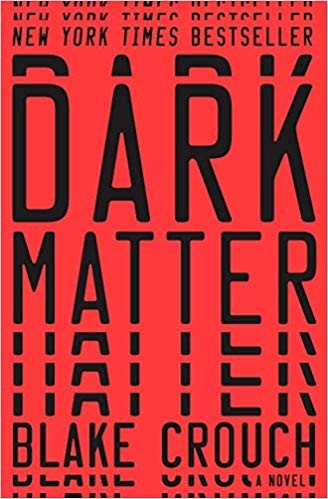
Dark Matter by Blake Crouch is a 2016 science fiction book about identity and selfhood, alternate lives, quantum reality. The novel uses quantum branching to ask a genuinely interesting question: if you made different choices, you would be a different person — so what exactly is the 'you' that persists across those branches?
Summary
Jason Dessen is a physics professor in Chicago, content with his career, his marriage to Daniela, and his teenage son. One evening he's abducted, injected with something, and wakes up in a laboratory where he is apparently a celebrated scientist who made a breakthrough he doesn't remember making — and where his wife and son don't exist. The novel is a chase story and a puzzle: how did Jason get here, how does he get back, and who did this to him?
The quantum mechanics framework is real, if simplified. Crouch builds his multiverse around the many-worlds interpretation of quantum physics — the idea that every quantum event spawns divergent realities. Jason navigates between these realities using a device that allows the observer's mental state to determine which branch of reality is entered. The emotional core of this apparatus is the question of what constitutes your identity across versions of yourself: if you chose differently at every major fork, is the result still you?
What makes Dark Matter work as a thriller — and it is primarily a thriller — is that Crouch keeps escalating the stakes through the novel's final third in a way that the premise genuinely supports. The problem Jason faces in the last act is not artificial; it follows logically from the multiverse concept and is more philosophically uncomfortable than anything in the setup. The prose is stripped-down and fast, designed for momentum rather than depth.
This is an airport thriller that is smarter than it has to be, not a literary novel that happens to move quickly. Readers who want to think about the multiverse as a philosophical problem will find the novel a useful primer but not a rigorous examination. Readers who want a fast, confident science fiction thriller with a genuine emotional engine will find it close to ideal. The ending is hopeful in a way that may feel earned or may feel convenient depending on your tolerance for genre resolutions.
Talk to Dark Matter like its author wrote you back.
Get the ideas that fit your life — not generic summaries.
- Chat with the book
- Audiobook-style main ideas
- Adapts to your life and goals
- Helps you take action
Key takeaways
- 1.
The novel uses quantum branching to ask a genuinely interesting question: if you made different choices, you would be a different person — so what exactly is the 'you' that persists across those branches?
- 2.
The device works by the observer's emotional state selecting the reality they enter, which makes the science simultaneously about physics and about the quality of attention you bring to your life.
- 3.
Crouch's multiverse is not a parallel-worlds tourism story — the divergent realities are terrifying rather than romantic, mostly because they remind you of what you've lost or never had.
- 4.
The antagonist isn't a villain in the conventional sense; the threat comes from someone who is, in a meaningful way, the protagonist himself — which makes the conflict both more interesting and more disturbing.
- 5.
The novel implicitly argues for the life you have: its emotional thesis is that contentment isn't a consolation prize for ambition but a genuine achievement with its own value.
- 6.
The final third's escalation works because the premise's logic is followed honestly — the problem Jason faces is inherent in the multiverse concept, not imposed externally.
- 7.
Dark Matter is more interested in loyalty and love as concrete acts — what you actually do when tested — than in them as abstract values.
Discussion questions
Use these on your own, with a book club, or as chat starters in Superbook. Book club version, ready to copy or print →
- 1.
Jason's contentment with his life is established early as something he has to defend to himself and others. Is the novel endorsing contentment, or just presenting it as a defensible choice?
- 2.
The multiverse means that a version of Jason made different choices and became someone successful in the ways Jason's version isn't. Which version, if any, do you think is living better?
- 3.
The mechanism for navigating between realities depends on the observer's mental clarity and emotional focus. What does that suggest about the relationship between consciousness and physical reality?
- 4.
By the end of the novel there are many versions of Jason converging on the same goal. That scenario is played as horror. Is the horror about identity, scarcity, or something else?
- 5.
Daniela has to make a choice near the end about which Jason is 'hers.' How does the novel set up that choice, and does her decision feel earned?
- 6.
The antagonist is technically Jason — another version of him who made different choices. Does knowing that change how you read the antagonist's motivations?
- 7.
Crouch simplifies the quantum mechanics significantly — the device works in ways that real many-worlds physics doesn't support. Does the scientific hand-waving bother you, or does it not matter for the story he's telling?
- 8.
The novel suggests that the path not taken is haunting specifically because you can imagine it. Would the novel work as well without the multiverse premise — could the same themes be explored through, say, a straight thriller?
- 9.
Dark Matter is consciously a thriller first. Does treating the multiverse concept as a genre device rather than a philosophical inquiry waste the premise, or is that the right call?
- 10.
Jason's son Charlie is present in the story but not fully developed as a character. Does his relative thinness as a character undercut the emotional stakes of what Jason is fighting for?
- 11.
The ending gestures toward hope and a kind of resolution. Does that feel like the right ending for what the book has been doing, or does it let the reader off the hook too easily?
- 12.
If you had access to the box and could observe a version of your own life where you made different choices, would you want to? What does your answer say about your relationship to regret?
Themes
Frequently asked questions
-
Is Dark Matter worth reading?
Yes, if you want a fast, smart thriller with genuine ideas underneath. It's not rigorous science fiction — the physics is simplified and the emotional resolution is genre-comfortable — but it's better than most thrillers at using its premise to generate real stakes.
-
Is Dark Matter scientifically accurate?
The many-worlds interpretation of quantum mechanics is a real and respected scientific hypothesis. The device Crouch invents to navigate between realities is not. He simplifies and speculates freely. If scientific rigor matters to you, approach it as a thought experiment, not a science lesson.
-
How long does it take to read Dark Matter?
Six to seven hours. The pacing is fast — it's designed to be read in large sittings. Many readers finish it in a day or two. The chapters are short and end with momentum.
-
Is there a TV adaptation?
Yes. Apple TV+ released a Dark Matter series in 2024, with Joel Edgerton playing Jason. Crouch was involved in the adaptation. The series expands some storylines but follows the novel's basic structure.
-
Who shouldn't read Dark Matter?
Readers who want their science fiction to take the science seriously, or who want literary depth over plot momentum, will find it thin. It's a thriller that borrows from science fiction, not science fiction that happens to be thrilling. Know which you're looking for.
Similar books
The Alchemist
Paulo Coelho
Thinking in Bets: Making Smarter Decisions When You Don't Have All the Facts
Annie Duke
Algorithms to Live By: The Computer Science of Human Decisions
Brian Christian and Tom Griffiths
