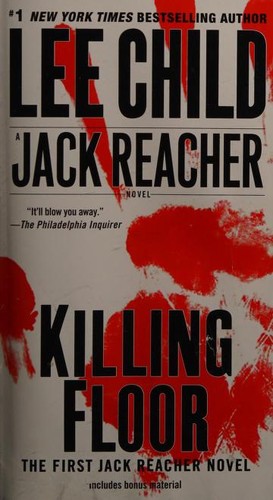
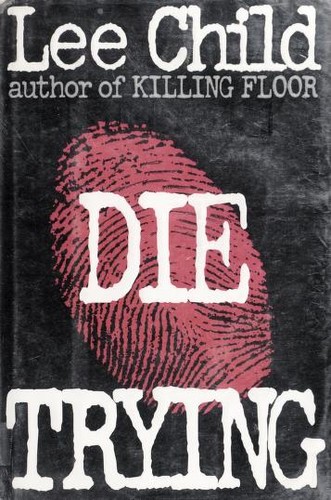
Die Trying by Lee Child is a 1998 thriller book about captivity and survival, militia ideology and extremism, loyalty and duty. Captivity as a narrative constraint forces the novel to live inside Reacher's tactical thinking rather than his movement through space — a different mode that Child handles well.
Summary
Jack Reacher is in the wrong place at the wrong time in Chicago — helping a woman with dry cleaning when she is snatched off the street. He is taken with her, and by the time the van reaches the highway he understands that this is not a random kidnapping. Holly Johnson turns out to be an FBI agent and the daughter of the Chairman of the Joint Chiefs. The man who took her is running a militia compound in the Montana wilderness, and his plans are considerably larger than one woman.
Die Trying is structurally different from Killing Floor: instead of Reacher investigating from the outside, he is a captive for most of the novel. Child uses that constraint interestingly — the novel tracks Reacher's tactical thinking in real time as he assesses his captors, maintains his cover as a helpless civilian, and waits for the right moment. The militia setting allows Child to engage with 1990s American political extremism, the specific ideology of antigovernment separatists, and the psychology of a charismatic leader who has convinced several hundred people to follow him into the wilderness and wait for a war.
The Beau Borken character — the militia leader — is one of Child's more psychologically developed antagonists. He is not simply crazy; he has a coherent system of beliefs, a real grievance history, and the organizational intelligence to build a functioning paramilitary community. That specificity makes him more frightening than a random violent offender, and the novel's engagement with his worldview, while not sympathetic, is serious rather than dismissive.
Die Trying confirmed the Reacher series as a viable long-running franchise and showed Child's willingness to vary the structural formula while preserving the essential character. It is slightly slower in the middle third than Killing Floor, but the Montana standoff builds to a climax that is among the more satisfying in the series. A solid second entry; can be read without the first.
Talk to Die Trying like its author wrote you back.
Get the ideas that fit your life — not generic summaries.
- Chat with the book
- Audiobook-style main ideas
- Adapts to your life and goals
- Helps you take action
Key takeaways
- 1.
Captivity as a narrative constraint forces the novel to live inside Reacher's tactical thinking rather than his movement through space — a different mode that Child handles well.
- 2.
Beau Borken is a study in the organizational logic of extremism: how charisma, grievance, and ideology produce a community that functions according to its own internal rules.
- 3.
The novel engages with 1990s militia movements with more seriousness than most thrillers of that period — it understands the ideological framework rather than simply positioning it as 'crazy.'
- 4.
Holly Johnson's FBI background means she is not a passive hostage, and the dynamic between her agency and her captivity is one of the more interesting things Child does structurally.
- 5.
Reacher's patience under captivity — his ability to wait, assess, and not act before the moment is right — is as important a quality as his capacity for violence.
- 6.
The federal response to the militia — bureaucratic, slow, and partly wrong — is a counterpoint to Reacher's individual effectiveness, and the novel is honest about the limits of both.
- 7.
The Montana landscape functions as a character: the isolation, the scale, and the self-sufficiency it demands are what makes Borken's project physically possible.
- 8.
Die Trying is a novel about what happens when American ideals — freedom, self-determination, the right to resist tyranny — are stripped of context and taken to their logical extreme.
Discussion questions
Use these on your own, with a book club, or as chat starters in Superbook. Book club version, ready to copy or print →
- 1.
Borken's ideology is presented with enough internal coherence that you can follow his reasoning even while finding it monstrous. Does that presentation feel dangerous or necessary?
- 2.
Holly is a trained federal agent who is also a political liability as a hostage. How does the novel handle the tension between her competence and her vulnerability?
- 3.
Reacher's approach as a captive is to appear compliant while planning. At what point does tactical patience shade into moral compromise?
- 4.
The federal government's response is depicted as slow, institutional, and partly counterproductive. Is that a political statement, a practical observation, or both?
- 5.
Borken has convinced hundreds of people to leave their lives and come to Montana. What does the novel suggest about what makes that offer compelling to those specific people?
- 6.
Die Trying was published in 1998, a few years after the Oklahoma City bombing and the Montana Freemen standoff. How does that historical context inflect the novel's militia storyline?
- 7.
Compared to Killing Floor, where Reacher is free to act — how does constraint change the character? Is captive-Reacher more or less interesting than operational-Reacher?
- 8.
The novel ends in large-scale violence. Does that violence feel proportionate to the threat, excessive, or exactly what the genre requires?
- 9.
Holly and Reacher develop a relationship over the course of the novel. Is that relationship earned, or does it feel like genre convention?
- 10.
The militia's compound is self-sufficient and functional. How does Child use the organizational competence of Borken's people to make the threat feel real rather than cartoonish?
- 11.
Reacher decides early on that he will stay with Holly even when escape without her is possible. What does that decision reveal about his code?
- 12.
The ending dispatches the primary threat conclusively. Is that resolution satisfying in a way the novel earns, or does it resolve too neatly?
Themes
Frequently asked questions
-
Can I read Die Trying without reading Killing Floor first?
Yes. Child provides enough context about Reacher's background that Die Trying works as a standalone. Killing Floor is the better introduction to the character, but the novels are not sequentially dependent.
-
Is Die Trying better or worse than Killing Floor?
Different rather than better or worse. Killing Floor is faster and more emotionally direct. Die Trying is structurally more ambitious — captive Reacher is an interesting constraint. Most readers rank Killing Floor higher but Die Trying is a strong second.
-
Is the militia storyline realistic?
Child researched the Montana militia and American patriot movements of the mid-1990s and the details of the ideology are reasonably accurate. The operational scale of Borken's organization is somewhat fantastical, but the ideological framework is not.
-
Who shouldn't read Die Trying?
Readers who want fast-moving, free-agent Reacher from page one. The middle section is slower, and the captive dynamic requires patience. Also readers who find militia-movement ideology too distressing to engage with as fiction.
-
Does Die Trying have political messages?
It engages seriously with antigovernment extremism without endorsing it. The federal government is depicted as slow and institutional; Borken's grievances are presented as real even when his methods are monstrous. Child is not writing a polemic in either direction.