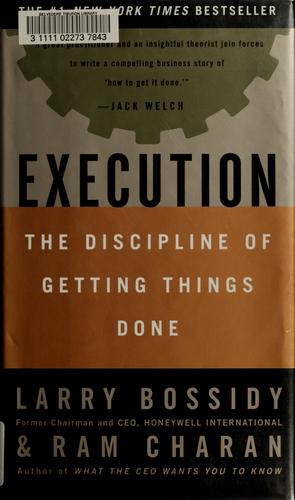
Execution by Larry Bossidy and Ram Charan is a 2002 business book about execution, leadership, strategy implementation. Execution is not a tactical detail but a discipline that senior leaders must personally own. Delegating it entirely is how strategies fail.
Summary
Execution is Larry Bossidy and Ram Charan's argument that the biggest gap in business is not strategy but implementation. Most strategies fail not because they are wrong but because the organization lacks the discipline, processes, and leaders to carry them out. Bossidy, the former CEO of AlliedSignal and Honeywell, provides the operational experience; Charan provides the analytical framework.
The book's central claim is that execution is a discipline, not a detail — and that senior leaders who treat it as beneath them are the primary cause of their organization's underperformance. The authors identify three core processes: the people process (who fills which roles), the strategy process (which choices guide resource allocation), and the operations process (how performance is managed quarterly). They argue that the people process is the most important and the most neglected: leaders who get the right people into the right roles before deciding strategy will outperform those who do it in the conventional order.
Bossidy's voice dominates the book's most engaging sections — direct, occasionally blunt accounts of how he ran operating reviews at AlliedSignal. The operating review as described is substantive: not a presentation of how things are going but an honest conversation about what is and isn't working, who is and isn't performing, and what needs to change. The authors argue that leaders who avoid these conversations in the name of collegiality are actually being unkind, because they leave underperformers in roles where they will fail.
The book is rooted in large industrial companies of the 1990s and early 2000s, and some of its specific practices show that age. But the underlying argument — that execution requires sustained personal attention from senior leaders, honest assessment of people and plans, and consistent follow-through — has not dated. Where it is most useful is in naming the behaviors that separate leaders who get results from those who generate thoughtful strategies that quietly die.
Talk to Execution like its author wrote you back.
Get the ideas that fit your life — not generic summaries.
- Chat with the book
- Audiobook-style main ideas
- Adapts to your life and goals
- Helps you take action
Key takeaways
- 1.
Execution is not a tactical detail but a discipline that senior leaders must personally own. Delegating it entirely is how strategies fail.
- 2.
The people process is more important than the strategy process. The right people in the right roles will fix a flawed strategy; the wrong people will ruin a good one.
- 3.
Most organizations promote people based on past performance rather than future potential. Evaluating people for execution requires asking what they do when the plan meets reality.
- 4.
Operating reviews should be honest conversations about what is and isn't working, not ceremonial presentations that confirm the existing story.
- 5.
Leaders who avoid difficult conversations about underperformance believe they are being kind. They are actually being cowardly, and the people around the underperformer pay the price.
- 6.
Strategy must be grounded in what the organization is actually capable of doing. An elegant strategy the organization cannot execute is worse than a modest strategy it can.
- 7.
Follow-through is the discipline of closing the loop: if you said you would do something, doing it, and if you couldn't, explaining why and what changed.
- 8.
The gap between strategy and results is almost always explained by culture, capability, and leadership behavior — not by external conditions or bad luck.
Discussion questions
Use these on your own, with a book club, or as chat starters in Superbook. Book club version, ready to copy or print →
- 1.
Bossidy argues that execution is a senior leader's job, not something that can be delegated. In your experience, where does execution accountability actually sit?
- 2.
The authors say the people process should come before strategy. What would change about how your organization makes decisions if it took that sequence seriously?
- 3.
Think of a strategy in your organization that failed or stalled. Was the failure in the strategy itself or in the execution? How do you know?
- 4.
Operating reviews as described here are fundamentally honest performance conversations. What makes that kind of honesty difficult in most organizations, and what would have to change to enable it?
- 5.
Bossidy is direct about confronting underperformance. What norms in your organization make that difficult, and are those norms serving the people involved?
- 6.
The book treats culture as something leaders create through behavior, not through declarations. What behaviors in your current context are shaping culture in ways that help or hurt execution?
- 7.
Charan and Bossidy argue that most strategies are too optimistic about organizational capability. How does your organization currently test whether its strategy is executable?
- 8.
The concept of follow-through seems simple but the authors treat it as rare. What prevents leaders from closing the loops they open?
- 9.
The book is largely about large industrial companies in the early 2000s. Which parts of the execution framework transfer to knowledge work, and which don't?
- 10.
If you were promoted tomorrow to run your current organization, what would be the first execution problem you'd tackle, and what would the first 90 days look like?
- 11.
The authors argue that leaders who avoid difficult conversations believe they're being kind. Is there a case where avoiding a difficult conversation is actually the right call?
- 12.
The book implies that most strategic plans fail because organizations overestimate their own capability. How do you honestly assess execution capability before committing to a plan?
Themes
Frequently asked questions
-
Is Execution worth reading?
Yes, particularly if you are in a leadership role and have felt the gap between a good strategy and actual results. The book names behaviors that most organizations recognize but rarely discuss directly. Some of the specific practices feel dated, but the underlying argument holds.
-
What is the main idea of Execution?
That execution is a discipline senior leaders must personally own, built on three interlocking processes: people, strategy, and operations. The people process is foundational: without the right people in the right roles, strategy and operations processes cannot work.
-
Who should read Execution?
Senior leaders and those aspiring to general management roles who want to understand what separates organizations that deliver from those that produce thoughtful plans that stall. Less directly useful for individual contributors or functional specialists.
-
How does Execution differ from other management books?
It is more operational and more personal than most. Bossidy writes from experience running large companies and is willing to be blunt about what failure looks like and who caused it. It is less theoretical than Charan's other work.
-
What is the most useful idea in the book?
The operating review as an honest performance conversation, not a presentation. The discipline of asking directly what is working, what isn't, and who is and isn't delivering — and then doing something about it rather than moving to the next agenda item.