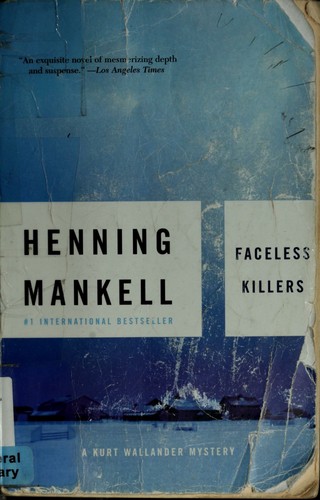
Faceless Killers by Henning Mankell is a 1991 mystery book about immigration and xenophobia, rural isolation, institutional decay. A single word — 'foreign' — is enough to channel collective anxiety into violence. Mankell demonstrates how little it takes to arm a prejudice.
Summary
Faceless Killers is the first Kurt Wallander novel, published in Swedish in 1991 and translated to English in 1997. On a bitter January night in the Swedish countryside, two elderly farmers are murdered in their isolated home. One of the victims, before she dies, utters a single word: "foreign." From that detail, a media firestorm ignites, and Wallander finds himself running not only a murder investigation but a race against vigilante violence against Sweden's immigrant communities.
The book's central tension is between the procedural and the political. Mankell is not subtle about his intentions: the murders serve as a lens on Sweden's changing demographics, its deep rural conservatism, and the ease with which fear can be shaped into hatred. Wallander investigates doggedly — following leads, making mistakes, waiting for breakthroughs — while outside the police station, politicians and newspapers feed the narrative the single word started. The killer's identity, when revealed, is a pointed rebuke to that narrative.
What distinguishes Wallander from most detective series protagonists is that he is not particularly compelling in the traditional sense. He is middle-aged, newly separated, mostly eating badly, frequently unsure of himself. The cases don't light him up — they grind him down. Mankell's prose is spare and cold, like the Swedish winter it keeps returning to. The pacing is deliberate. There are long stretches of failed leads and bureaucratic friction that most crime writers would cut. Mankell leaves them in because that is what police work actually is.
Readers looking for wit, charisma, and banter should look elsewhere. Readers who want a detective novel that takes its social context seriously and treats police work as fundamentally unglamorous will find Faceless Killers an exceptional start to one of the most sustained crime series in European literature.
Talk to Faceless Killers like its author wrote you back.
Get the ideas that fit your life — not generic summaries.
- Chat with the book
- Audiobook-style main ideas
- Adapts to your life and goals
- Helps you take action
Key takeaways
- 1.
A single word — 'foreign' — is enough to channel collective anxiety into violence. Mankell demonstrates how little it takes to arm a prejudice.
- 2.
Wallander's depression is not a quirk or a flavor element. It is a coherent response to the work he does and the world he inhabits.
- 3.
The Ystad setting is almost a character: provincial, flat, cold, far from the Sweden of international imagination.
- 4.
Procedural accuracy is one of Mankell's methods. The investigation takes months, hits dead ends, requires administrative patience — none of which is exciting, all of which is true.
- 5.
The murder of elderly people in their own home — a space that should represent safety — is the book's specific horror. It isn't random; it is a violation of the social contract.
- 6.
The political subplot is not background. The anti-immigrant backlash and the media's role in amplifying it are as central as the investigation itself.
- 7.
Wallander's relationship with his father is the emotional spine of the series. Faceless Killers establishes it clearly: estrangement, unspoken love, mutual incomprehension.
- 8.
The resolution doesn't feel triumphant because the conditions that created the crime haven't changed. Mankell refuses the reassurance most genre fiction offers.
Discussion questions
Use these on your own, with a book club, or as chat starters in Superbook. Book club version, ready to copy or print →
- 1.
The dying woman says 'foreign' — possibly as a description, possibly as an accusation, possibly without intent. How does the novel trace what happens when an ambiguous statement becomes certain in the public mind?
- 2.
Wallander fails repeatedly in this investigation. How does Mankell make failure feel realistic rather than frustrating?
- 3.
The anti-immigrant vigilantism in the novel was published in 1991. How does it read now? Has the cultural context changed, or has it just relocated?
- 4.
Wallander's personal life is a wreck — the divorce, the drinking, the ruptured relationship with his daughter. Does knowing his private situation change how you evaluate his professional decisions?
- 5.
Compared to Kurt Wallander, a detective like Sherlock Holmes is essentially asocial by design. What does it mean for the genre that Mankell makes his detective ordinary and legible?
- 6.
The killer's identity is structured as a rebuke to the 'foreign' narrative. Did that feel earned by the investigation, or more like authorial argument?
- 7.
How does the Ystad setting — the landscape, the weather, the distance from Stockholm — shape the mood and meaning of the book?
- 8.
Mankell includes scenes of Wallander making basic procedural errors. Do you read this as realism, or as Mankell critiquing the Swedish police more broadly?
- 9.
The novel's ending provides a resolution to the murders but not to the social conditions that enabled the backlash. Was that the right choice?
- 10.
Wallander's father paints the same landscape over and over. What do you make of that detail in the context of a book about people unable to change their patterns?
- 11.
Faceless Killers is often credited with launching Nordic noir as a genre. What specifically about its approach do you think other crime writers borrowed?
- 12.
Who in the novel has the most power to prevent the vigilante violence, and who chooses not to use it?
Themes
Frequently asked questions
-
Is Faceless Killers the best Wallander book?
Opinion is divided. Many readers consider The Dogs of Riga or Sidetracked stronger, but Faceless Killers establishes the template and the social seriousness that defines the whole series. Starting here is the right choice for most readers.
-
What is the Wallander series about beyond the mysteries?
It is fundamentally about a man aging in a country he no longer quite recognizes, doing a job that costs him more each year. The social commentary — immigration, welfare state erosion, rural isolation — is consistent across all ten books.
-
Is Faceless Killers hard to read?
The prose is spare and the pacing is slow by genre standards. It is not difficult language, but readers used to propulsive, plot-driven thrillers may find the deliberate rhythm frustrating at first. That said, the slow accumulation is part of the point.
-
Who shouldn't read Faceless Killers?
Anyone looking for a clever, charming, fast-moving detective hero. Wallander is none of those things. If your threshold for crime fiction requires either glamour or wit, this series will disappoint you.
-
Is there a TV adaptation?
Yes — two. A Swedish television series ran from 2005 to 2010 with Krister Henriksson as Wallander. A British adaptation starring Kenneth Branagh ran from 2008 to 2016 on BBC One and was internationally distributed. Both are well-regarded.
Similar books
In Cold Blood
Truman Capote
Crime and Punishment
Fyodor Dostoevsky

The Devil in the White City
Erik Larson
The Spy and the Traitor: The Greatest Espionage Story of the Cold War
Ben Macintyre
