Thanks for the Feedback by Douglas Stone and Sheila Heen is a 2014 business book about feedback, self-awareness, learning. The leverage in the feedback system is in the receiver, not the giver. You can't always get good feedback, but you can always improve how you use what you receive.
Summary
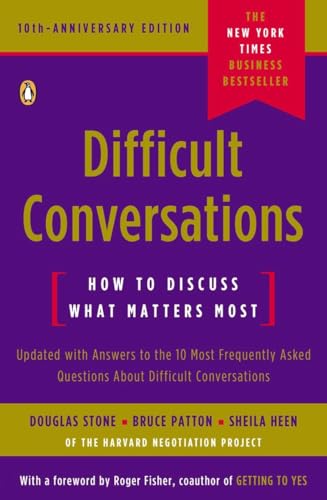
Thanks for the Feedback is Douglas Stone and Sheila Heen's follow-up to Difficult Conversations, this time focused on the receiving end of feedback rather than the giving end. The counterintuitive premise is that most feedback literature addresses the wrong problem: it tries to help people give feedback better, while the real leverage is in helping people receive it — because receivers can't control the quality of feedback they get, but they can control how they use it.
Stone and Heen identify three types of feedback: appreciation (thank you for your work), coaching (here's how to improve), and evaluation (here's where you stand). Most feedback conflicts happen when the giver and receiver have different ideas about which type is happening. Someone who wants appreciation receives coaching and feels criticized. Someone who needs evaluation receives encouragement and is misled about their actual standing.
The book describes three "triggers" that block effective reception of feedback. Truth triggers fire when the feedback seems wrong — we dismiss it rather than examine whether there's any signal in it. Relationship triggers fire when we don't trust the source — the message gets lost in our assessment of the messenger. Identity triggers fire when the feedback threatens our self-image — we destabilize rather than learn.
The second half is practical: how to distinguish the type of feedback you're getting, how to separate the signal from the noise when the delivery is poor, how to navigate relationship issues that contaminate feedback without letting them prevent learning, and how to build a personal system for getting good feedback consistently. The central argument is that being a good feedback receiver is a learnable skill that dramatically improves your development trajectory — and that most people leave enormous learning on the table by being poor receivers.

Talk to Thanks for the Feedback like its author wrote you back.
Get the ideas that fit your life — not generic summaries.
- Chat with the book
- Audiobook-style main ideas
- Adapts to your life and goals
- Helps you take action
Key takeaways
- 1.
The leverage in the feedback system is in the receiver, not the giver. You can't always get good feedback, but you can always improve how you use what you receive.
- 2.
Three types of feedback — appreciation, coaching, and evaluation — serve different needs. Mismatches between what's given and what's needed cause most feedback conflicts.
- 3.
Three triggers block feedback reception: truth triggers (this seems wrong), relationship triggers (I don't trust you), and identity triggers (this threatens who I am).
- 4.
When a truth trigger fires, the first question to ask is not 'are they right?' but 'is there a grain of truth worth examining?' The useful signal is often buried under poor delivery.
- 5.
Relationship triggers mean you're evaluating the giver rather than the feedback. Separating the message from the messenger is hard but essential for learning.
- 6.
Identity triggers are the hardest to manage because they activate physiological stress responses. Having a more complex self-story — one that can hold 'and I failed at this' without catastrophizing — is the core skill.
- 7.
Asking for specific feedback is far more useful than inviting general commentary. 'What's one thing I could do differently in my next presentation?' gets better data than 'How am I doing?'
- 8.
A switchtracking conversation happens when you respond to feedback with feedback. The conversation becomes a two-person monologue rather than an exchange — and nothing gets learned.
Discussion questions
Use these on your own, with a book club, or as chat starters in Superbook. Book club version, ready to copy or print →
- 1.
Think about feedback you've received that you dismissed. In retrospect, was there a grain of truth in it you missed at the time? What would you do differently now?
- 2.
Which of the three triggers — truth, relationship, identity — is most likely to block your reception of feedback? Can you name a recent example?
- 3.
Stone and Heen argue that the quality of your feedback reception matters more than the quality of feedback you receive. Do you agree? What's your evidence from your own development?
- 4.
Have you ever been in a situation where you needed evaluation but received coaching instead — or vice versa? What was the cost of the mismatch?
- 5.
What's your current system for getting feedback on your most important work? Is it working? What would you change?
- 6.
Relationship triggers mean the giver's relationship with you contaminates how you hear what they say. Who gives you feedback that you systematically under-weight because of how you feel about them?
- 7.
The switchtrack pattern — responding to feedback with counter-feedback — is extremely common. Have you done this recently? What was the effect?
- 8.
Identity triggers fire when feedback threatens a core self-belief. What's a belief about yourself as a professional that would be hardest to hear challenged? Is that area where you're most resistant to feedback?
- 9.
How do you distinguish between feedback that's genuinely wrong and feedback that's right but uncomfortable? What's your heuristic?
- 10.
Stone and Heen say most people leave enormous learning on the table through poor feedback reception. What's the learning you've been leaving on the table?
- 11.
What's the most useful feedback you've ever received, and what conditions made you able to use it well?
- 12.
How do you create conditions in your team for honest feedback to flow — both upward and sideways, not just downward?
Themes
Frequently asked questions
-
Is Thanks for the Feedback worth reading if I've already read Difficult Conversations?
Yes. Difficult Conversations covers how to have hard conversations from the initiator's perspective. Thanks for the Feedback covers how to receive feedback — a different and arguably more consequential skill. The books share a framework but don't overlap significantly in content.
-
How long does it take to read Thanks for the Feedback?
Around five hours for the 348-page book. It's more practical than theoretical and reads quickly, especially for people who have experienced the triggers it describes.
-
Who should read Thanks for the Feedback?
Anyone who wants to accelerate their professional development, managers who want to understand why feedback doesn't seem to stick with some of their team members, and people who find it hard to use criticism constructively.
-
What's a switchtrack and how do you avoid it?
A switchtrack happens when you respond to feedback with a counter-complaint: 'You say I'm not meeting deadlines, but you never give me what I need on time either.' The feedback conversation becomes a grievance exchange and nothing gets resolved. The fix is to hear the first feedback completely before raising any of your own, or to explicitly agree to have two separate conversations.
-
What's the most actionable idea in Thanks for the Feedback?
Asking for specific, narrow feedback rather than general commentary. 'What's one thing I could do differently in my presentations?' generates useful data that 'How am I doing?' rarely does. The more specific the question, the more useful the answer.