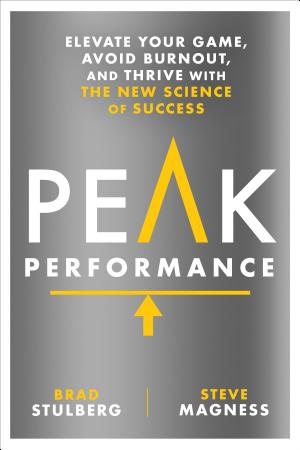
Peak Performance by Brad Stulberg is a 2017 health book about performance, stress and recovery, purpose. The fundamental formula for growth is stress plus rest. Apply a challenging stimulus, recover fully, and emerge stronger. This applies equally to muscles, skills, and creative capacity.
Summary
Peak Performance is Brad Stulberg and Steve Magness's synthesis of performance science across domains — athletics, science, art, and business. The book's unifying formula is simple: stress plus rest equals growth. Every adaptation the body and mind make — whether in muscle fiber, cognitive skill, or creative capacity — follows the same pattern of applying a challenge, recovering fully, and emerging stronger. The authors argue that most people misapply this insight in both directions: they apply chronic stress without sufficient recovery, or they avoid discomfort to the point of never generating the stimulus for growth.
The book covers several interconnected themes. Priming describes how physical and cognitive warmup routines affect performance quality. The minimum effective dose of stress is explored — enough to trigger adaptation, not so much that it causes breakdown. The authors discuss the difference between good and bad stress, the science of recovery (sleep, rest, doing nothing), and the role of purpose in sustaining effort over time. Research on elite performers in multiple fields shows consistent patterns: they practice in focused blocks, rest deliberately, and connect their work to something beyond personal achievement.
One of the book's stronger chapters covers purpose and its relationship to performance. Stulberg and Magness draw on studies showing that people who frame challenging tasks around contribution to others outperform those focused purely on personal outcomes. The section on ego depletion and identity is similarly compelling: performers who tie their entire identity to their performance become fragile, while those who hold performance as one part of a larger self tend to recover from failure more effectively.
Peak Performance reads quickly and integrates research from sports science, psychology, and neuroscience without becoming academic. The main limitation is that the synthesis sometimes sacrifices depth for breadth — readers familiar with the individual topics (deliberate practice, stress physiology, purpose research) may find the coverage thin. As an entry point for someone new to performance science, it is efficient. As a complete treatment of any single idea, it falls short.
Talk to Peak Performance like its author wrote you back.
Get the ideas that fit your life — not generic summaries.
- Chat with the book
- Audiobook-style main ideas
- Adapts to your life and goals
- Helps you take action
Key takeaways
- 1.
The fundamental formula for growth is stress plus rest. Apply a challenging stimulus, recover fully, and emerge stronger. This applies equally to muscles, skills, and creative capacity.
- 2.
Most people either apply chronic stress without adequate recovery, or avoid discomfort entirely. Both strategies prevent growth.
- 3.
Purpose amplifies performance. People who connect difficult work to something larger than personal achievement show measurably greater endurance and output quality.
- 4.
Identity should be broader than performance. Athletes and performers who define themselves entirely by results are more fragile than those who hold performance as one part of a larger self.
- 5.
Recovery is not the absence of work — it is active preparation for the next performance. Sleep, deliberate rest, and doing nothing are not optional extras.
- 6.
Priming routines — physical and cognitive rituals before demanding work — consistently improve performance quality by preparing the nervous system and focusing attention.
- 7.
The minimum effective dose of stress is the right target. More is not better. Elite performers often do less total volume than amateurs but make each session matter more.
- 8.
Ego fatigue is real. Decision-making and willpower draw on the same cognitive resource, and depleting it on minor decisions leaves less available for important ones.
Discussion questions
Use these on your own, with a book club, or as chat starters in Superbook. Book club version, ready to copy or print →
- 1.
The book's core formula is stress plus rest equals growth. Where in your life are you applying stress without adequate rest, and where are you resting without applying sufficient stress?
- 2.
Stulberg and Magness argue purpose amplifies performance. What purpose motivates the most effortful work you currently do?
- 3.
Which of your current goals is purely self-focused, and which connects to something beyond yourself? Does that distinction affect your commitment?
- 4.
Think about a skill you want to develop. Are you applying deliberate stress to it, or going through motions that are comfortable but not actually challenging?
- 5.
The authors argue that identity tied too tightly to performance creates fragility. How broadly or narrowly do you define yourself in the domain you care most about?
- 6.
What does genuine recovery look like for you? Is the recovery you currently practice actually restorative, or is it just distraction?
- 7.
Where in your daily routine could you add a priming ritual before your most important work?
- 8.
The minimum effective dose concept suggests doing less but making it count. What in your current practice could you do less of without losing results?
- 9.
Elite performers studied in the book typically work in focused blocks of no more than four hours per day. How does that compare to your own high-output periods?
- 10.
Have you ever over-trained, over-worked, or pushed through insufficient recovery and paid a price? What did you learn from it?
- 11.
The book covers performers across sports, science, and art. Which examples were most relevant to the domain you care about?
- 12.
If your primary performance goal serves only your own achievement, is that sufficient motivation for sustained long-term effort?
Themes
Frequently asked questions
-
What is Peak Performance about?
It argues that all growth — physical, cognitive, creative — follows the same cycle of stress plus rest, and applies that framework to the habits of elite performers across sports, science, and business.
-
Is Peak Performance worth reading?
Yes, as an accessible synthesis. It integrates research across multiple fields coherently and is well written. Readers who have already read deeply in sports science or performance psychology may find it covers familiar ground at a surface level.
-
Who should read Peak Performance?
High-achievers in any domain who are burning out, people curious about the science behind elite performance, and readers who want a framework for growth that applies beyond athletics.
-
How long does it take to read Peak Performance?
Around four to four and a half hours at average reading pace for the roughly 240-page book. The chapters are short and the writing is clear, making it easy to read in focused sessions.
-
What is the most actionable idea in Peak Performance?
Connect your most challenging work to a purpose beyond personal achievement. The research on purpose and performance is among the strongest in the book, and reframing a goal from personal to contributive is something anyone can try immediately.