Germinal by Émile Zola is a 1885 classics book about class war, labor and survival, collective action. Zola's naturalist method treats the mining community as an ecosystem rather than a collection of individuals — heredity, environment, and economic structure are the real protagonists.
Summary
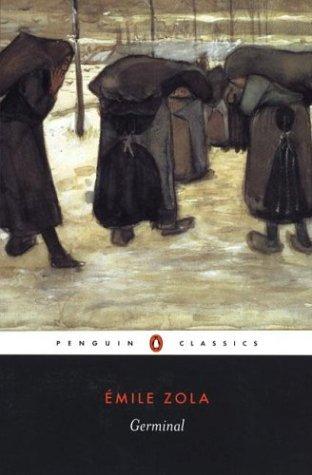
Germinal is the thirteenth novel in Zola's Rougon-Macquart series, and the one most readers consider his masterpiece. It follows Étienne Lantier, a young worker who arrives at a northern French coal mining community and, over the course of one terrible winter, becomes radicalized — organizing a strike that spirals into violence, starvation, and catastrophe. Published in 1885, it drew on Zola's own research visits to mining regions and became one of the foundational texts of labor literature worldwide.
The novel operates on two levels simultaneously. On the surface it is a plot-driven story of people in desperate circumstances making increasingly desperate choices. Underneath it is a naturalist study of an entire community understood as an organism — the mine itself is often described in terms that make it sound like a living thing, breathing, eating, consuming the people who feed it. Zola's research shows in the specificity of the conditions: the darkness, the gas, the physical degradation, the diet, the way the company store keeps workers permanently indebted. This is not background color; it is the argument. The system is designed this way, Zola says, and individual choice has almost nothing to do with how it ends.
The naturalist framework can feel fatalistic in a way that makes the novel uncomfortable from multiple directions at once. The workers are not saints — they commit violence, betray one another, surrender to despair. The owners are not cartoons — Zola gives them complexity and some private decency that coexists seamlessly with their structural indifference. Étienne himself is capable of self-deception and rhetorical vanity. The novel refuses the comfort of clear heroes. What it does offer instead is one of the most visceral depictions in literary history of what it costs to live at the bottom of a class system — not just economically but physically, psychologically, generationally.
Readers who want a politically satisfying labor narrative may find this too bleak — the strike does not win, and the costs are severe. Readers who want moral clarity will find the ambiguity frustrating. What the novel delivers instead is truth of a different kind: the particular weight of lives lived under conditions not of their choosing, and the flicker of hope at the end that gives the book its title and refuses to let it simply be a tragedy.
Talk to Germinal like its author wrote you back.
Get the ideas that fit your life — not generic summaries.
- Chat with the book
- Audiobook-style main ideas
- Adapts to your life and goals
- Helps you take action
Key takeaways
- 1.
Zola's naturalist method treats the mining community as an ecosystem rather than a collection of individuals — heredity, environment, and economic structure are the real protagonists.
- 2.
The mine in the novel is rendered almost as a living predator: breathing, groaning, consuming workers across generations. This isn't metaphor but a precise description of what extraction looks like from below.
- 3.
Étienne's radicalization is portrayed with sympathy but not without critique — Zola shows how ideology can become a form of self-aggrandizement even in people with genuine grievances.
- 4.
The company store system — keeping workers permanently indebted to their employer — is shown as more structurally important than any individual cruelty; the system extracts without needing villains.
- 5.
Class solidarity in the novel is real but fragile: it holds for a while and then breaks under the pressure of hunger, fear, and competing interests. Zola doesn't romanticize collective action.
- 6.
The women and children in the novel carry equal weight to the men — their lives and labor are documented with the same specificity, which was unusual in the period's fiction.
- 7.
The violence during the strike is shown as a predictable consequence of a system under pressure rather than as the product of moral failure — Zola distributes responsibility structurally.
- 8.
The novel's title, Germinal, refers to the spring month in the French Revolutionary calendar — seeds underground, future growth. The final pages sustain that ambiguity: defeat and the possibility of something that comes after it.
Discussion questions
Use these on your own, with a book club, or as chat starters in Superbook. Book club version, ready to copy or print →
- 1.
Zola spent time in actual mining communities to research this novel. How does that documentary quality affect the reading experience — does it feel like fiction or something closer to journalism?
- 2.
The strike fails, at considerable cost. Does the novel present this as inevitable, preventable, or simply as what happened — and does it make any argument about what could have been done differently?
- 3.
Étienne is a sympathetic protagonist early in the novel and becomes more complicated as he acquires ideological conviction. At what point did your reading of him shift, and why?
- 4.
Zola gives the mine owners some psychological depth — they're not simple villains. Does this complexity strengthen or weaken the novel's political argument?
- 5.
The novel's naturalist framework suggests that heredity and environment largely determine what characters do. How much agency do you think any character actually has — is anyone's fate genuinely chosen?
- 6.
The violence during the strike is disturbing partly because it's enacted by people we've come to understand. Does Zola handle this violence fairly, or does he use it to undercut sympathy for the strikers?
- 7.
The community is also shown engaging in casual brutality in its daily life — toward animals, toward women, toward outsiders. Is Zola documenting this or endorsing it? What is he arguing with it?
- 8.
Germinal is often described as the great labor novel. Do you think it's a book for or about the working class, and does the distinction matter?
- 9.
The mine's flooding and collapse late in the novel is one of the most technically precise disaster sequences in nineteenth-century fiction. What does the mine's physical destruction add to the novel's argument?
- 10.
Compare the political visions offered by the various radical characters in the novel — Étienne's socialism, Souvarine's anarchism, Rasseneur's reformism. Which position does the novel itself seem to find most compelling, or does it withhold judgment?
- 11.
The ending has been read as both despairing and hopeful. Which reading do you favor — and is that a choice the novel leaves genuinely open or is one reading clearly intended?
- 12.
Zola was criticized in some quarters for making the working class look brutal. Do you think that criticism is fair, or does the novel's treatment of all classes equally absorb that objection?
Themes
Frequently asked questions
-
Is Germinal worth reading?
Yes, especially if you want the most unflinching and researched portrait of industrial labor conditions in literary fiction. It's a demanding read — long, dark, and structurally unsparing — but the experience of understanding this world from the inside is unlike anything else in the nineteenth-century canon.
-
Is Germinal hard to read?
It's long (around 500 pages) and not always comfortable — the conditions Zola depicts are grim and the plot offers little consolation. The prose in good translations (the Penguin Classics version by Roger Pearson is excellent) is direct and clear. The main challenge is emotional rather than intellectual.
-
Do I need to read the other Rougon-Macquart novels first?
No. Germinal stands completely alone, and most readers encounter it as their first Zola. Knowing the broader family history adds some context for Étienne's character, but the novel is fully self-contained.
-
Is Germinal a political novel?
Yes, deeply, but it's more complicated than a pamphlet. Zola observed from multiple political positions and the novel doesn't cleanly endorse any of the ideologies its characters hold. It argues that the conditions are intolerable more clearly than it argues for any specific remedy.
-
Who should not read Germinal?
Readers who need emotional uplift or narrative hope from their fiction. The novel ends on a note of muted possibility, but the body count is high and the structural conditions that produced the disaster are unchanged. If you need a win for the characters you care about, Germinal will not provide it.