Business · Book club
Getting to Yes: Negotiating Agreement Without Giving In book club questions
Here are 12 book club questions for Getting to Yes: Negotiating Agreement Without Giving In by Roger Fisher and William Ury, ordered to open easily and end somewhere worth arguing about. Copy them, print them, or bring them up one at a time.
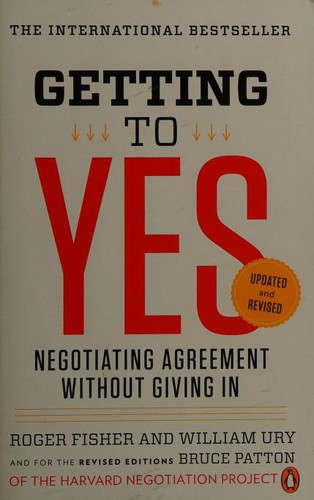
Getting to Yes emerged from the Harvard Negotiation Project in the late 1970s and laid out a method its authors called principled negotiation.
Roger Fisher and William Ury · 1981 · 3h 15m
Full summary and key takeaways →The 12 questions
- 1.
Fisher and Ury say most people negotiate positions rather than interests. Think of a recent disagreement — what was your stated position, and what was the underlying interest?
- 2.
What's a negotiation in your life where you've accepted a bad deal because you didn't know your BATNA? What would a stronger alternative have looked like?
- 3.
The book separates the people from the problem. Is there a relationship in your life where those two things have gotten tangled together in ways that make the problem harder to solve?
- 4.
Inventing options for mutual gain requires separating brainstorming from deciding. Where in your work or personal life do you collapse those two steps and end up with worse outcomes?
- 5.
Objective criteria give both sides cover to move without losing face. What external standards — market data, precedent, expert opinion — could you bring to a negotiation you're currently in?
- 6.
The BATNA concept suggests that power in a negotiation comes from your alternatives, not from the table itself. How much time do you spend improving your alternatives before negotiating?
- 7.
Fisher and Ury argue that a soft negotiator trying to preserve a relationship often damages it more by caving than a principled one would by holding firm. Do you recognize that pattern in yourself?
- 8.
Think of a negotiation where you won the position but damaged the relationship. Was the win worth it?
- 9.
The book was written partly for international diplomacy and labor disputes. Does the framework translate cleanly to the kinds of negotiations you actually face day to day?
- 10.
When someone uses a hardball tactic — a very low anchor, a threat, artificial urgency — what is your instinctive response? Does it help or hurt you?
- 11.
Getting to Yes assumes some degree of mutual rationality. What do you do when the other side isn't negotiating in good faith at all?
- 12.
The book distinguishes between a good negotiator and a pushover. Where does firmness tip into stubbornness for you, and how do you know when you've crossed that line?
How to run the discussion
- Pick six to eight, not all of them. An hour of real discussion covers fewer questions than anyone expects, and racing the list is what makes a book club feel like homework.
- Open with what people noticed, not what they concluded. Asking for a verdict first hardens opinions before anyone has heard each other.
- Let the disagreement run. The questions below that split a room are the ones worth the time; the ones everyone answers the same way can be skipped.
- Ask the quiet person a specific question. A direct, narrow question is far easier to answer than an open invitation to contribute.
Themes worth steering toward
If the conversation stalls, these are the threads that usually restart it.
Common questions
What are good book club questions for Getting to Yes: Negotiating Agreement Without Giving In?
Here are 12 book club questions for Getting to Yes: Negotiating Agreement Without Giving In by Roger Fisher and William Ury, ordered to open easily and end somewhere worth arguing about. The strongest openers ask what each reader noticed rather than what they concluded, and the discussion usually turns on negotiation, conflict resolution, communication.
How long should a book club discussion of Getting to Yes: Negotiating Agreement Without Giving In last?
Most groups run 60 to 90 minutes of actual discussion. That is roughly six to eight questions, not all of them, so pick the ones that suit your group rather than working down the list in order.
What are the main themes in Getting to Yes: Negotiating Agreement Without Giving In?
Negotiation, Conflict resolution, Communication, Interests vs. positions, Decision-making. Those are the threads most likely to divide a room, which makes them the useful places to steer a discussion that has gone quiet.
Picking the next one? See books like Getting to Yes: Negotiating Agreement Without Giving In or questions for other book club picks.
