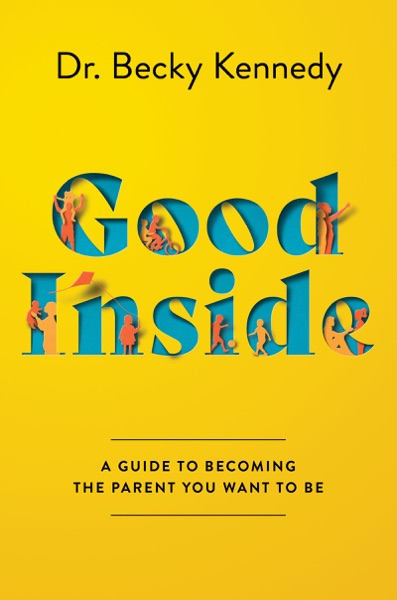
Good Inside: A Guide to Becoming the Parent You Want to Be by Becky Kennedy is a 2022 psychology book about parenting, child development, emotional regulation. Children are good inside: difficult behaviors signal unmet needs or underdeveloped skills, not bad character. This framing changes what intervention is needed.
Summary
Good Inside is clinical psychologist Becky Kennedy's guide to a parenting philosophy built around one central premise: children are fundamentally good inside, and difficult behaviors are not character flaws or manipulation but signals of unmet needs or underdeveloped skills. Kennedy, known online as "Dr. Becky" to millions of Instagram and podcast followers, wrote the book to translate her framework into a practical guide for parents dealing with tantrums, defiance, sibling conflict, and other everyday challenges that traditional discipline approaches handle poorly.
The book's foundational distinction is between a child's behavior and a child's character. Kennedy argues that when a parent responds to bad behavior with punishment or shame, they solve the immediate problem by attacking the child's sense of self — which produces compliance in the short run and disconnection, anxiety, or rebellion in the longer run. The alternative is to hold firm on boundaries while staying connected to the child's experience. This sounds paradoxical but is the book's central skill: the parent can simultaneously say "I'm not going to let you hit your sister" and "I understand you're really frustrated." Both things are true, and the child needs to experience both.
Kennedy introduces the concept of the "two-things-are-true" framework as a tool for holding this tension without collapsing into either permissiveness or authoritarian control. She also provides scripts — actual language to use in difficult moments — which is where the book is most practically useful and where it most diverges from typical parenting psychology books, which tend to stay at the level of principle. The scripts cover situations from meltdowns and bedtime resistance to sibling rivalry, fears, and the aftermath of parental explosions.
The book is most useful for parents who find punitive approaches unsatisfying or ineffective but feel at a loss for what to do instead. Kennedy is honest about the cost of the approach: it requires more emotional regulation from the parent than punitive responses do, and she spends considerable space on how parents manage their own reactivity as a precondition for parenting differently. The framework is grounded in attachment theory and developmental psychology, and the book explains the science clearly enough to make the approach legible rather than just appealing.
Talk to Good Inside: A Guide to Becoming the Parent You Want to Be like its author wrote you back.
Get the ideas that fit your life — not generic summaries.
- Chat with the book
- Audiobook-style main ideas
- Adapts to your life and goals
- Helps you take action
Key takeaways
- 1.
Children are good inside: difficult behaviors signal unmet needs or underdeveloped skills, not bad character. This framing changes what intervention is needed.
- 2.
Behavior and character are separable. A parent can hold a firm limit on behavior while staying connected to the child's inner experience. Both are necessary and neither cancels the other.
- 3.
The 'two-things-are-true' framework helps parents hold limit-setting and empathy simultaneously: 'I won't let you hit, and I can see you're really upset.'
- 4.
Shame is a poor teaching tool. When children feel bad about themselves, they become less capable of learning or changing, not more. Connection enables the growth that shame prevents.
- 5.
Children need to feel felt before they can regulate. Trying to teach lessons or set consequences in the middle of a meltdown is ineffective; the dysregulated nervous system is not learning.
- 6.
Parental regulation comes first. A parent's own emotional state is contagious; managing your own reactivity is not a luxury but a precondition for the kind of parenting the book describes.
- 7.
Boundaries and connection are not opposites. The most effective parenting combines clear, consistent limits with deep attunement to the child's emotional experience.
- 8.
Repair matters more than perfection. Parents will lose their temper and make mistakes; the ability to return, acknowledge what happened, and reconnect is what builds secure attachment over time.
Discussion questions
Use these on your own, with a book club, or as chat starters in Superbook. Book club version, ready to copy or print →
- 1.
Kennedy's premise is that children are good inside and difficult behavior is a signal, not a character flaw. How does this framing change what you do in the moment of conflict with a child?
- 2.
The 'two-things-are-true' approach requires holding a limit and an empathy statement at the same time. Which part is harder for you — the limit or the empathy?
- 3.
Kennedy argues that shame is ineffective as a teaching tool and damages the relationship. Where do you see shame used as a parenting strategy, intentionally or not?
- 4.
The book spends significant space on parental regulation — managing your own reactivity as a parent. What are the situations that most reliably trigger your own escalation?
- 5.
Repair — acknowledging a parenting mistake and reconnecting — is presented as more important than perfection. How comfortable are you with modeling fallibility to children?
- 6.
Kennedy's framework is grounded in attachment theory and developmental psychology. Does the scientific grounding change how you receive the practical advice?
- 7.
The book provides actual scripts for difficult moments. Do you find scripted language helpful or does it feel artificial? What happens when the script doesn't fit the situation?
- 8.
The argument that boundaries and connection reinforce each other contradicts many parents' intuition that they are in tension. Has your own experience supported or challenged this claim?
- 9.
Kennedy's approach requires more emotional energy from the parent in the short run. What would need to change in a typical family day for this approach to be sustainable?
- 10.
The book focuses on parent-child relationships but the framework applies to other authority relationships. Where else could 'children are good inside' apply — with employees, students, or partners?
- 11.
Kennedy is transparent that she is not a perfect parent and that her children still melt down. How does this honesty affect how you receive her advice compared to authors who present themselves as having solved parenting?
- 12.
What is one specific change in how you respond to difficult child behavior that the book suggests, and how plausible does it seem to you in practice?
Themes
Frequently asked questions
-
What is the core idea of Good Inside?
Children are fundamentally good and capable, and their difficult behaviors are signals of underdeveloped skills or unmet needs rather than evidence of bad character. Parenting from this premise changes the goal from compliance to building the inner resources children need to regulate themselves.
-
Is Good Inside based on research or just parenting philosophy?
It is grounded in attachment theory and developmental psychology, which Kennedy references throughout, though the book is primarily practical rather than academic. The underlying framework draws on Bowlby, Siegel's interpersonal neurobiology, and decades of research on what predicts secure attachment in children.
-
Is this approach just permissive parenting?
No. Kennedy is explicit that boundaries are essential and non-negotiable. The difference from punitive approaches is that limits are maintained without shame or threats, and the child's emotional experience is acknowledged even when the behavior is not permitted. The goal is connection and limit-setting simultaneously, not one instead of the other.
-
How does this book compare to other parenting books like The Whole-Brain Child?
Both draw on attachment and developmental neuroscience and emphasize connection over punishment. Kennedy's book is more script-heavy and focused on specific difficult scenarios, while The Whole-Brain Child spends more time on the neuroscience of child development. They complement each other well.
-
Who should read Good Inside?
Parents who find themselves resorting to threats, punishments, or yelling and feeling dissatisfied with the results, or who want an approach grounded in developmental science. It is most practically useful for parents of children between roughly ages two and twelve, though the framework applies more broadly.