Business · Book club
Hooked: How to Build Habit-Forming Products book club questions
Here are 12 book club questions for Hooked: How to Build Habit-Forming Products by Nir Eyal, ordered to open easily and end somewhere worth arguing about. Copy them, print them, or bring them up one at a time.
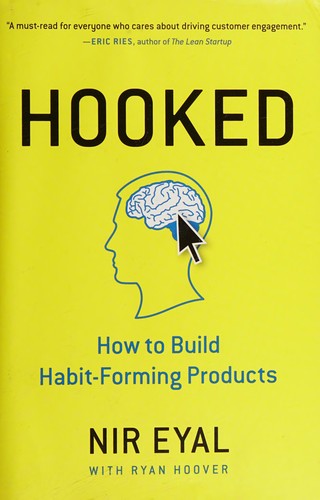
Hooked is Nir Eyal's framework for designing products that people return to without external prompting.
Nir Eyal · 2014 · 3h 45m
Full summary and key takeaways →The 12 questions
- 1.
Eyal argues that internal triggers are more powerful than external ones. What internal state does your most-used app exploit, and is that a problem?
- 2.
The variable reward mechanism is borrowed from slot machine research. Does knowing that make you more or less likely to change how you use social media?
- 3.
Think of a product you've quit using. Did it fail on trigger, action, reward, or investment — or somewhere else in the loop?
- 4.
The investment phase argues that adding data to a product increases switching costs. Where in your own digital life are you locked in because of accumulated investment?
- 5.
Eyal draws a line between facilitators (products that genuinely help users) and dealers (products that exploit them). Where would you place the apps you use most?
- 6.
If you were designing a habit-forming product for something genuinely beneficial — exercise, language learning, a health behavior — which phase of the Hook Model would be hardest to execute honestly?
- 7.
The book was written for product designers and founders. Does reading it from a user's perspective change anything about how you interact with technology?
- 8.
Eyal says the most powerful internal trigger is anxiety. Can you identify a specific moment in your day when an app reliably captures you at an anxious moment?
- 9.
The ethics chapter is brief. Does the manipulation matrix Eyal proposes feel like an adequate framework for deciding whether to build a particular product?
- 10.
Variable rewards of the tribe depend on social validation. How much of your own engagement with social platforms is driven by checking whether your posts performed?
- 11.
The book assumes that habit formation in products is inherently a tool — neutral until pointed at something. Do you agree with that framing?
- 12.
Which products in your life have successfully attached to an existing routine rather than trying to create a new one? Was the attachment deliberate or accidental?
How to run the discussion
- Pick six to eight, not all of them. An hour of real discussion covers fewer questions than anyone expects, and racing the list is what makes a book club feel like homework.
- Open with what people noticed, not what they concluded. Asking for a verdict first hardens opinions before anyone has heard each other.
- Let the disagreement run. The questions below that split a room are the ones worth the time; the ones everyone answers the same way can be skipped.
- Ask the quiet person a specific question. A direct, narrow question is far easier to answer than an open invitation to contribute.
Themes worth steering toward
If the conversation stalls, these are the threads that usually restart it.
Common questions
What are good book club questions for Hooked: How to Build Habit-Forming Products?
Here are 12 book club questions for Hooked: How to Build Habit-Forming Products by Nir Eyal, ordered to open easily and end somewhere worth arguing about. The strongest openers ask what each reader noticed rather than what they concluded, and the discussion usually turns on habit formation, product design, behavioral psychology.
How long should a book club discussion of Hooked: How to Build Habit-Forming Products last?
Most groups run 60 to 90 minutes of actual discussion. That is roughly six to eight questions, not all of them, so pick the ones that suit your group rather than working down the list in order.
What are the main themes in Hooked: How to Build Habit-Forming Products?
Habit formation, Product design, Behavioral psychology, Persuasion, User engagement. Those are the threads most likely to divide a room, which makes them the useful places to steer a discussion that has gone quiet.
Picking the next one? See books like Hooked: How to Build Habit-Forming Products or questions for other book club picks.
