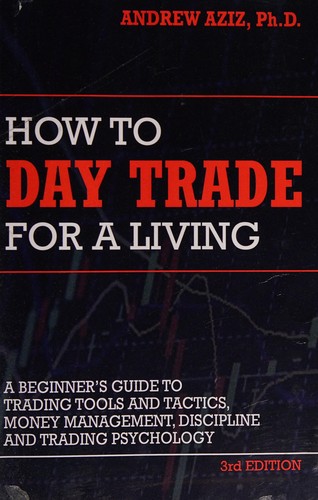
How to Day Trade for a Living by Andrew Aziz is a 2015 business book about day trading, stock markets, risk management. Day trading requires strict rules and predefined setups. Improvising in real-time leads to emotional decisions and losses.
Summary
How to Day Trade for a Living is Andrew Aziz's introduction to active stock trading for people who want to treat it as a craft rather than a gamble. Aziz worked as a chemical engineer before becoming a full-time trader, and the book reflects that background: it is systematic and procedure-oriented rather than motivational. The central premise is that retail traders can compete profitably in short-term equity markets if they develop a strict set of rules, limit themselves to a handful of proven setups, and manage risk with precision.
The bulk of the book walks through the practical mechanics: how to choose a broker and set up a direct-access trading platform, how to read Level 2 quotes and time-and-sales data, and how to use technical indicators like moving averages, VWAP, and relative strength to identify entries and exits. Aziz identifies specific chart patterns — the opening range breakout, the ABCD pattern, the bull flag — and explains what each one signals and how to trade it consistently. He is explicit that learning these patterns is not enough; discipline in execution is what separates traders who survive from those who blow up their accounts.
Risk management gets more attention than most trading books give it. Aziz argues that the first job of a day trader is not to make money but to protect capital. He describes sizing positions relative to account equity, setting hard stop-losses before entering any trade, and keeping a trading journal to identify patterns in both wins and losses. The concept of risk-to-reward ratio is threaded through every strategy: never take a trade where the potential gain does not meaningfully outweigh the potential loss.
The honest limitation of the book is that day trading is genuinely difficult and the failure rate among retail traders is high. Aziz does not hide this. He recommends starting with a simulator, paper-trading for months before risking real money, and being prepared for a long learning curve. The book is most useful as an orientation to the vocabulary, tools, and discipline of short-term trading — not a guarantee of results, but a serious map of the terrain.
Talk to How to Day Trade for a Living like its author wrote you back.
Get the ideas that fit your life — not generic summaries.
- Chat with the book
- Audiobook-style main ideas
- Adapts to your life and goals
- Helps you take action
Key takeaways
- 1.
Day trading requires strict rules and predefined setups. Improvising in real-time leads to emotional decisions and losses.
- 2.
The primary job of a new trader is to protect capital, not to make money. Losses compound just as gains do.
- 3.
VWAP — the volume-weighted average price — is one of the most reliable intraday reference points for identifying support, resistance, and trend direction.
- 4.
Position sizing must be tied to account equity and the distance to the stop-loss. Risking more than 1-2% of capital on any single trade is how accounts get wiped.
- 5.
The first hour after the open carries the most volume, volatility, and opportunity. Many experienced traders do the bulk of their work in that window.
- 6.
A trading journal is not optional. Without systematic review of past trades, the same errors repeat indefinitely.
- 7.
Paper trading is undervalued. Spending months simulating trades before risking real capital dramatically shortens the real-money learning curve.
- 8.
Chart patterns like the bull flag and ABCD are only useful when combined with broader market context — sector strength, news catalysts, and overall market direction.
Discussion questions
Use these on your own, with a book club, or as chat starters in Superbook. Book club version, ready to copy or print →
- 1.
Aziz says the failure rate among retail day traders is very high. What does he believe separates the minority who succeed from the majority who don't?
- 2.
What is the role of discipline versus skill in day trading according to this book? Can one compensate for the other?
- 3.
Aziz recommends paper trading for months before risking real money. How realistic is that for someone eager to start, and what are the limits of simulated trading?
- 4.
The book emphasizes risk-to-reward ratios. Think of a decision you made recently — in work or life — where that framework might have helped. Did you apply it consciously?
- 5.
Aziz argues that most retail traders lose because of psychology, not lack of knowledge. What psychological traps does he identify, and which seem most dangerous?
- 6.
The VWAP and Level 2 data tools described in the book were once only available to professional traders. Has democratization of these tools leveled the playing field, or simply added more noise?
- 7.
How does Aziz's advice about limiting yourself to a few specific setups cut against the instinct to stay flexible and opportunistic?
- 8.
What does the trading journal serve beyond simple record-keeping, and why do so many traders skip it despite knowing its value?
- 9.
Aziz treats day trading as a business with repeatable processes. What does applying that frame change about how someone approaches learning it?
- 10.
The first hour of market open is described as the most important. What does that imply about the relationship between volatility and opportunity?
- 11.
How does Aziz's engineering background shape the way he presents trading strategies, and is that framing useful or limiting?
- 12.
If day trading requires this much discipline, preparation, and ongoing study, what does it actually mean to 'live' from it in practice?
Themes
Frequently asked questions
-
Is How to Day Trade for a Living worth reading?
For someone genuinely curious about active trading, yes. Aziz is honest about the difficulty and failure rates, gives concrete tools, and covers risk management seriously. It is not a get-rich-quick pitch. For anyone hoping to supplement income casually, the time and capital requirements described make the case for index funds instead.
-
How long does it take to read this book?
Around four to five hours. The chapters are structured as reference material as much as linear reading, so many traders return to the strategy sections repeatedly once they start practicing.
-
What is the main argument of How to Day Trade for a Living?
That day trading is a learnable skill — not a lottery — if approached with structured setups, rigorous risk management, and patient practice. Aziz argues that most traders fail because of poor discipline and psychology, not lack of information.
-
Who should read this book?
Anyone seriously considering day trading as a profession or side practice. It is also useful for longer-term investors who want to understand how short-term traders think about price action, volume, and market microstructure.
-
What's the most important concept in the book?
Risk management via hard stop-losses and position sizing. Aziz returns to this throughout: the trade that wipes out your account eliminates all the small wins that preceded it. Protecting capital is the first discipline, and everything else follows.