Psychology · Book club
Influence: The Psychology of Persuasion book club questions
Here are 12 book club questions for Influence: The Psychology of Persuasion by Robert B. Cialdini, ordered to open easily and end somewhere worth arguing about. Copy them, print them, or bring them up one at a time.
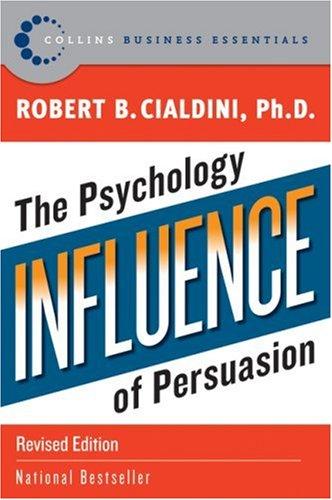
Influence is Robert Cialdini's account of why people say yes, and how that agreement is manufactured.
Robert B. Cialdini · 1984 · 6h 15m
Full summary and key takeaways →The 12 questions
- 1.
Cialdini argues these principles exploit shortcuts that normally serve us well. Can you think of a recent decision where one of the six principles led you to a genuinely good outcome?
- 2.
Which of the six principles do you think you are most susceptible to, and why?
- 3.
The foot-in-the-door technique uses small commitments to build toward larger ones. Where in your own life have you been moved in a direction you didn't intend by a series of small yeses?
- 4.
Social proof is most powerful under uncertainty. What area of your life right now is most shaped by what the people around you are doing rather than by your own reasoning?
- 5.
Cialdini spent years studying compliance professionals. Does knowing the mechanics of persuasion actually change how you respond to it, or does the automatic reaction still fire?
- 6.
The reciprocity principle creates obligation from uninvited gifts. How do you personally decide when to accept something for free and when to decline because the obligation isn't worth it?
- 7.
Authority shortcuts work even when the authority is costumed rather than real. What credentials or signals of authority do you find hardest to question in practice?
- 8.
The liking principle means physical attractiveness and perceived similarity increase compliance. Is there a professional context in your life where you've seen this play out in ways that concerned you?
- 9.
Scarcity framing — limited time, limited supply — is used constantly in retail, media, and politics. Where outside of shopping do you notice this principle being used most aggressively?
- 10.
Cialdini is writing a defense manual as much as an explanation. Has reading or knowing about these principles actually made you harder to persuade, or just more cynical?
- 11.
The 2021 edition adds unity — shared identity — as a seventh principle. What groups or identities do marketers and politicians use most effectively to trigger compliance in you specifically?
- 12.
If you were designing a process — hiring, fundraising, product launches — and wanted to use these principles ethically, where would you draw the line between persuasion and manipulation?
How to run the discussion
- Pick six to eight, not all of them. An hour of real discussion covers fewer questions than anyone expects, and racing the list is what makes a book club feel like homework.
- Open with what people noticed, not what they concluded. Asking for a verdict first hardens opinions before anyone has heard each other.
- Let the disagreement run. The questions below that split a room are the ones worth the time; the ones everyone answers the same way can be skipped.
- Ask the quiet person a specific question. A direct, narrow question is far easier to answer than an open invitation to contribute.
Themes worth steering toward
If the conversation stalls, these are the threads that usually restart it.
Common questions
What are good book club questions for Influence: The Psychology of Persuasion?
Here are 12 book club questions for Influence: The Psychology of Persuasion by Robert B. Cialdini, ordered to open easily and end somewhere worth arguing about. The strongest openers ask what each reader noticed rather than what they concluded, and the discussion usually turns on persuasion, social influence, decision-making.
How long should a book club discussion of Influence: The Psychology of Persuasion last?
Most groups run 60 to 90 minutes of actual discussion. That is roughly six to eight questions, not all of them, so pick the ones that suit your group rather than working down the list in order.
What are the main themes in Influence: The Psychology of Persuasion?
Persuasion, Social influence, Decision-making, Compliance, Behavioral psychology. Those are the threads most likely to divide a room, which makes them the useful places to steer a discussion that has gone quiet.
Picking the next one? See books like Influence: The Psychology of Persuasion or questions for other book club picks.
