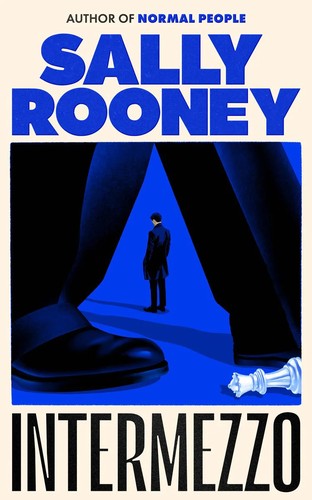
Intermezzo by Sally Rooney is a 2024 literary fiction book about grief and mourning, brotherhood, age-gap relationships. The novel uses alternating styles — stream-of-consciousness for Peter, more contained third-person for Ivan — as a formal argument about how differently siblings can experience the same loss.
Summary
Intermezzo is Sally Rooney's fourth novel, following two brothers in Dublin in the months after their father's death. Peter Korellis is a thirty-two-year-old barrister who has never recovered from a breakup with his college girlfriend Sylvia, now his closest friend and still partially his lover, while also sleeping with and falling in love with Naomi, a twenty-three-year-old in a difficult situation. Ivan Korellis is twenty-two, a chess prodigy who begins a relationship with Margaret, a thirty-six-year-old woman recently widowed, that neither of them knows how to categorize. The novel alternates between the brothers with different narrative techniques and watches both relationships form, falter, and press against the question of what people owe each other.
The title is a chess term — the intermezzo or zwischenzug, an in-between move that disrupts an expected sequence. Rooney uses it to describe the moment the novel occupies: between a death and whatever comes after it, between one kind of life and the next. Grief is not the book's explicit subject but it saturates everything — the brothers' inability to speak to each other, Peter's drug use, Ivan's sudden willingness to risk something real. Both men are trying to feel something that doesn't hurt.
Rooney's style has evolved. The Peter sections use long, stream-of-consciousness sentences and avoid quotation marks, giving his interiority an anxious, unbroken quality. The Ivan sections are more traditionally rendered, quieter, and let the chess scenes carry a surprising amount of emotional freight. The contrast in technique is deliberate and reflects the two men's different relationships to their own minds.
This is Rooney's most emotionally ambitious novel and probably her most divisive. Readers who found Normal People or Beautiful World, Where Are You too schematic or too sociologically tidy will find Intermezzo less neat — the moral questions are genuinely unresolved and the characters are harder to map onto positions. Those looking for the precise social observation of her earlier work will find it, but freighted with more grief than before.
Talk to Intermezzo like its author wrote you back.
Get the ideas that fit your life — not generic summaries.
- Chat with the book
- Audiobook-style main ideas
- Adapts to your life and goals
- Helps you take action
Key takeaways
- 1.
The novel uses alternating styles — stream-of-consciousness for Peter, more contained third-person for Ivan — as a formal argument about how differently siblings can experience the same loss.
- 2.
Rooney treats age-gap relationships not as scandals to be adjudicated but as relationships with their own specific difficulties, which she examines without editorial comment.
- 3.
Grief in the novel operates structurally: the brothers can't communicate because grief has disrupted the usual circuits, and the novel watches them trying to reroute.
- 4.
Chess is used seriously — not as metaphor but as the specific mental world Ivan inhabits, which turns out to be a useful mirror for how he approaches everything else.
- 5.
Peter's drug use and his tangled double-relationship are treated as symptoms of something rather than as character flaws, which is a more complicated position than the novel makes it look.
- 6.
The title's chess meaning — an unexpected in-between move — frames the entire novel as a period of disruption between two more stable states, which both liberates and limits the characters.
- 7.
Rooney is unusually attentive to economic reality: what everyone earns, what they can afford, what financial precarity does to romantic possibility.
- 8.
Brotherhood as a relationship form — requiring nothing to be said and everything to be maintained through action — is the novel's unexpectedly tender center.
Discussion questions
Use these on your own, with a book club, or as chat starters in Superbook. Book club version, ready to copy or print →
- 1.
Rooney writes Peter's sections in an unbroken stream-of-consciousness and Ivan's sections in more traditional prose. Did that formal distinction feel meaningful to you, or like an affectation?
- 2.
Peter's relationship with Naomi is complicated by his ongoing emotional entanglement with Sylvia. Do you think Naomi understands what she's in, and does the novel treat her fairly?
- 3.
Ivan and Margaret's age-gap relationship is treated with unusual seriousness — neither romanticized nor condemned. Did you find Rooney's handling of it convincing?
- 4.
The brothers barely talk for most of the novel. What does their silence say about how grief operates between men, specifically, in Rooney's telling?
- 5.
Chess appears throughout as a genuine technical world — not just as metaphor. Did the chess scenes work for you? What do they reveal about Ivan that other scenes can't?
- 6.
The novel ends without resolving all of its threads. Which unresolved thread felt most uncomfortable to leave open?
- 7.
Compared to Normal People and Beautiful World, Where Are You, does Intermezzo feel like a maturation of Rooney's concerns, or a departure from them?
- 8.
Peter is likable despite doing things that are, on inspection, not especially admirable. How does Rooney pull that off — what techniques make him sympathetic?
- 9.
Margaret is a widow whose grief runs alongside Ivan's grief for his father. What does the novel do with the parallel, and does it connect them or use them separately?
- 10.
Sylvia — Peter's college girlfriend, now his friend and occasional lover — is one of the novel's most carefully drawn characters. What does Rooney seem to understand about that specific kind of relationship?
- 11.
The novel's class consciousness is present but quieter than in Rooney's earlier work. Do you think it recedes or is it still doing the same structural work?
- 12.
What is the novel's thesis about grief — if it has one — and do you agree with it?
Themes
Frequently asked questions
-
Is Intermezzo Rooney's best novel?
Opinion is divided. Many critics consider it her most ambitious and formally interesting work; some readers who loved Normal People found Intermezzo less emotionally immediate. It's more complicated than her earlier books and takes longer to settle.
-
Do I need to have read Rooney's earlier novels first?
No. Intermezzo is entirely standalone. Prior Rooney reading will give you a sense of her concerns and style, but nothing in the earlier books is required to follow this one.
-
What's the chess about?
Ivan is a competitive chess player, and the chess scenes are rendered with genuine technical specificity — not as metaphor but as the actual mental world he lives in. The title itself is a chess term for a disruptive in-between move. It's used to frame the novel's temporal position: between a death and whatever comes after.
-
Is Intermezzo hard to read?
Peter's chapters use long, flowing, unpunctuated dialogue and interior monologue that requires some adjustment. Ivan's chapters are more conventionally paced. The difficulty is real but not extreme — closer to Mrs. Dalloway-lite than to actual experimental fiction.
-
Who might not enjoy Intermezzo?
Readers who want clear moral verdicts on the characters' choices, or who found Rooney's earlier novels too focused on interiority over plot. The novel's main movement is emotional rather than narrative, and it's content to leave things unresolved.
Similar books
Educated: A Memoir
Tara Westover
Born a Crime: Stories from a South African Childhood
Trevor Noah
A Heartbreaking Work of Staggering Genius
Dave Eggers
Angela's Ashes
Frank McCourt
