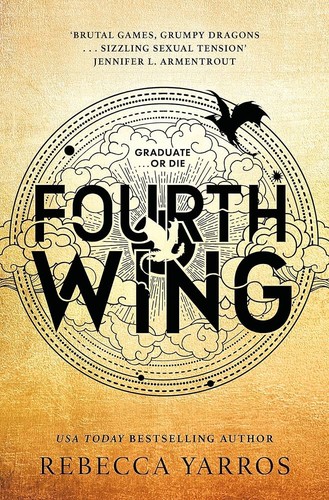
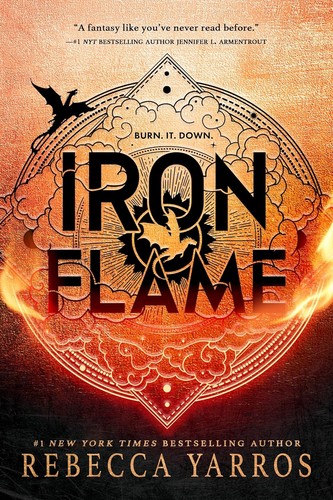
Iron Flame by Rebecca Yarros is a 2023 fantasy book about betrayal and trust, war and its costs, secrets between intimates. The novel extends Fourth Wing's central argument: institutions don't protect their members from the truth because they need those members to function within the lie.
Summary
Iron Flame picks up in the immediate aftermath of Fourth Wing's reveal, with Violet Sorrengail now knowing what the war is actually about and what her mother has been hiding. The second year at Basgiath War College begins with everything structurally changed: the alliances that made the first year navigable are destabilized, the lies the institution has built itself on are cracking, and Violet's relationship with Xaden is strained by the magnitude of what was withheld from her. This is the book where the consequences of the first novel's choices arrive.
Yarros is working at a larger scale here — the novel is longer, the geopolitical machinery is more explicit, and the secondary characters get more room. The resistance storyline that was background in Fourth Wing moves to the foreground, raising questions about what obligation looks like when the institution you're inside is fundamentally corrupt. Violet must decide not just whether to trust Xaden but whether the structures she's been trained to defend deserve defending. The romance continues with higher emotional stakes and more explicit conflict; the fantasy plot requires actual strategic thinking.
The book has the structural problem of all second-volume sequels: it must complicate without resolving, develop without concluding, and sustain tension through a story that by design cannot pay off yet. Yarros handles this more successfully than most, largely because the central question — what do you do when the truth is worse than you imagined and the people you love are implicated in it — is genuinely interesting and doesn't require a series conclusion to matter. The prose remains propulsive rather than literary, the pacing is thriller-inflected.
Iron Flame will lose readers who came for the romance and don't want to do the fantasy work, and it will reward readers who sensed the first book's world had more in it than a love story. The ending is again unresolved, again frustrating, again sufficient to send readers immediately to the next book. As fantasy sequels go, it earns its length.
Talk to Iron Flame like its author wrote you back.
Get the ideas that fit your life — not generic summaries.
- Chat with the book
- Audiobook-style main ideas
- Adapts to your life and goals
- Helps you take action
Key takeaways
- 1.
The novel extends Fourth Wing's central argument: institutions don't protect their members from the truth because they need those members to function within the lie.
- 2.
Xaden's arc in this volume is about the cost of being a person who carries secrets he believes are protective — and what happens when the person he's protecting rejects that framing.
- 3.
Violet's power continues to develop in ways that exceed the institution's ability to contain or explain her, which becomes its own kind of problem.
- 4.
The resistance storyline forces the question of when loyalty to a cause justifies deception of the people you're supposedly protecting.
- 5.
Secondary characters like Rhiannon and Liam are given enough space to become people rather than plot functions, which raises the stakes when the story turns on them.
- 6.
The bond between rider and dragon deepens as a model for the human relationships: trust that is earned, tested, and not guaranteed.
- 7.
Iron Flame is interested in what it costs to know the truth in a society organized around a lie — not just politically, but personally and psychologically.
- 8.
The ending is engineered to produce a specific emotional response; Yarros understands that readers of long fantasy series have a particular relationship with devastating final chapters.
Discussion questions
Use these on your own, with a book club, or as chat starters in Superbook. Book club version, ready to copy or print →
- 1.
Xaden continues to withhold information from Violet in this volume, again for reasons he frames as protective. By the end, has the novel moved its position on whether he was right to?
- 2.
The institution at Basgiath turns out to be even more comprehensively dishonest than Fourth Wing suggested. At what point does complicity become unavoidable for the characters inside it?
- 3.
Violet's power in this book is explicitly destabilizing to the existing order. How does the novel handle the ethics of power that is both necessary and dangerous?
- 4.
The resistance characters are shown to have made morally complex choices. Does Iron Flame ask you to sympathize with them, condemn them, or hold both at once?
- 5.
Which secondary character's storyline in this volume mattered most to you, and did the book give it enough space?
- 6.
The romance in Iron Flame is more fraught and less fun than in Fourth Wing. Is that a strength of the series or a cost of committing to consequences?
- 7.
The novel raises the question of whether there is a right way to fight for a just cause inside a corrupt institution. Does it give you enough to formulate an answer?
- 8.
Yarros writes explicitly about the physical and psychological costs of war on the cadets. How does that shift the tone from what might otherwise be a more escapist fantasy?
- 9.
The ending has been described as brutal even by the standards of fantasy sequels. Was it earned, or does it feel like manipulation?
- 10.
Iron Flame is significantly longer than Fourth Wing. Did the length feel justified by the story being told, or were there places you felt the padding?
- 11.
If you read both books back to back, how did your trust in Xaden change between the two volumes? What specifically caused those shifts?
- 12.
The series is structured around secrets being revealed in stages. Does knowing that more revelations are coming change how you read the books as they exist now?
Themes
Frequently asked questions
-
Can I read Iron Flame without reading Fourth Wing first?
No. Iron Flame begins immediately after Fourth Wing ends and assumes you know everything that was revealed in that book. Reading them out of order would destroy most of the first book's carefully managed surprises.
-
Is Iron Flame better or worse than Fourth Wing?
Longer, more complex, and more demanding. Readers who wanted more world and more consequences tend to prefer it. Readers who came for the romance-with-dragons energy of the first book sometimes find the second's scale and darkness less fun. Neither reading is wrong.
-
What is Iron Flame about, without spoiling Fourth Wing?
The sequel to a military fantasy about dragon-riding cadets; it follows the characters after a major revelation and forces them to decide what they're willing to do about what they now know.
-
Who shouldn't read Iron Flame?
Anyone who finished Fourth Wing feeling lukewarm about the world-building. The second book doubles down on fantasy infrastructure, political intrigue, and moral complexity. The romance is still there, but it's harder won.
-
Is there a third book in the series?
Yes, Onyx Storm was published in January 2025 as the third book in the Empyrean series.