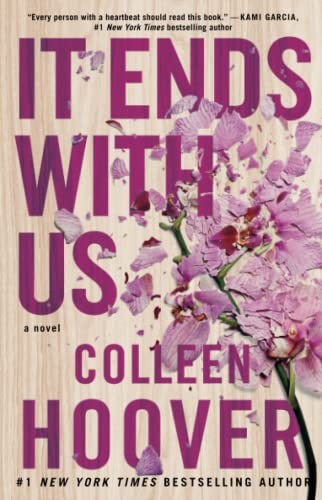
It Ends with Us by Colleen Hoover is a 2016 contemporary fiction book about domestic abuse, cycles of violence, first love. Recognizing abuse and escaping it are completely different tasks — Lily's awareness of the cycle doesn't protect her from it, which is the most honest thing the book does.
Summary
Lily Bloom moves to Boston after her father's death and opens the flower shop she always dreamed of. She meets Ryle Kincaid on a rooftop, a neurosurgeon who is charming, intense, and candid about not wanting a relationship. What follows is a romance novel that, about halfway through, pivots into something far heavier than its cover suggests.
The book is about the gap between what love looks and feels like from inside and what it looks like from the outside. Lily knows the shape of abuse — she watched her mother endure it from her father for years. The novel's central tension is how a person with that knowledge can still find themselves in the same story, how the cycle repeats not out of stupidity but because the person inside a loving relationship experiences it as love, and the violence arrives as the exception, not the rule. Woven through the present timeline is Lily's childhood diary, letters to Ellen DeGeneres that document her relationship with Atlas Corrigan, a homeless teenager she hid in her basement. That first love keeps returning, complicating everything.
What makes Hoover's book land differently from a lot of domestic-abuse fiction is that it refuses to make Ryle a cartoon villain. He is also genuinely the man Lily loves. The novel holds both things simultaneously, and that dual reality is what makes the final act hit hard. The structure — the diary letters as counterpoint to the present, the slow accumulation of red flags that Lily notices and then explains away — is more carefully constructed than Hoover's other work.
Readers who came expecting a straightforward romance will find this more complicated. The ending does not provide a neat moral lesson; it provides a cost. This book earned its word-of-mouth reputation through BookTok not because it is comforting but because it is upsetting in ways that feel real. Those who have experienced or witnessed abusive relationships often report the recognition as uncomfortable and accurate. Readers who want light beach reads should look elsewhere; those willing to sit with discomfort will find something genuinely affecting.
Talk to It Ends with Us like its author wrote you back.
Get the ideas that fit your life — not generic summaries.
- Chat with the book
- Audiobook-style main ideas
- Adapts to your life and goals
- Helps you take action
Key takeaways
- 1.
Recognizing abuse and escaping it are completely different tasks — Lily's awareness of the cycle doesn't protect her from it, which is the most honest thing the book does.
- 2.
The violence in the book is never cartoonish; each incident is preceded by tenderness, which is exactly how it works in real abusive relationships.
- 3.
Lily's childhood letters function as both backstory and moral compass — Atlas represents the version of love that didn't come with conditions.
- 4.
The novel argues that loving someone genuinely is not sufficient reason to stay when that love is also destructive.
- 5.
Generational patterns of abuse are shown as self-perpetuating not through malice but through the warped definition of love that grows up around them.
- 6.
Lily's decision at the end is framed as strength, not failure — a reframing that many readers find either necessary or too tidy depending on their own history.
- 7.
The book treats the question 'why didn't she just leave?' as the wrong question, dramatizing the actual reasons people stay instead of dismissing them.
- 8.
Hoover gives Ryle a coherent inner life and backstory; his violence has an origin story, which doesn't excuse it but forces the reader to hold complexity.
Discussion questions
Use these on your own, with a book club, or as chat starters in Superbook. Book club version, ready to copy or print →
- 1.
Lily knows the history of her mother's marriage before she ever meets Ryle — does the novel suggest that knowledge protected her at all, or does it argue the cycle is bigger than individual awareness?
- 2.
At what point in the book did you first notice the warning signs? Did you notice them before Lily did, or did you explain them away as she did?
- 3.
Ryle's backstory involving his brother is offered as partial explanation for his behavior. Does it change how you read him? Should it?
- 4.
The childhood diary sections give Atlas an almost mythological quality in Lily's memory. Is that idealization part of why the present-day situation is so hard for her to see clearly?
- 5.
Lily's mother asks her not to judge. How do you read that scene — as a mother protecting herself, or as something the novel is critical of?
- 6.
The title refers to stopping a cycle. Do you think the ending actually ends anything, or does it just move the story to the next generation?
- 7.
Hoover writes Ryle so that the reader also understands why Lily loves him. Did that make the violent scenes harder to read or more honest?
- 8.
This book became enormous on BookTok, largely among young women. What do you think it gave readers that more sanitized romance fiction doesn't?
- 9.
Compare Lily's final decision to her mother's choice. What's different between them beyond the obvious plot circumstances?
- 10.
The novel is told entirely from Lily's first-person perspective. What would the book be if Ryle or Atlas narrated a section?
- 11.
Is Atlas a realistic character or does he function more as a symbol? Does it matter?
- 12.
The book club question most people avoid: did the ending feel earned, or did it feel like the author rescuing the protagonist rather than the protagonist rescuing herself?
Themes
Frequently asked questions
-
Is It Ends with Us appropriate for sensitive readers?
No — it contains depictions of domestic violence that are portrayed with realistic emotional context. Readers with personal history of abuse should be aware the book treats this material seriously and without softening.
-
Is there a sequel to It Ends with Us?
Yes — It Starts with Us (2022) continues Lily's story and was published after significant fan demand. It centers on Lily's life after the events of the first book.
-
Why did this book become so popular on BookTok?
Readers responded to its emotional honesty about abusive relationships in a genre that usually avoids the subject. Many reported it made them think differently about family members or their own past experiences. The twist from romance to something harder was also widely shared as a genuine surprise.
-
Who should not read this book?
Readers looking for a light romance, or those for whom depictions of partner violence would be harmful. It's also not a book that provides clean resolution — if you need to leave a story feeling fixed, this one won't do that.
-
Is the movie adaptation worth watching?
The 2024 film adaptation with Blake Lively and Justin Baldoni received mixed reviews and was controversial for reasons related to the film's marketing and the actors' public dispute. The book is widely considered more effective.