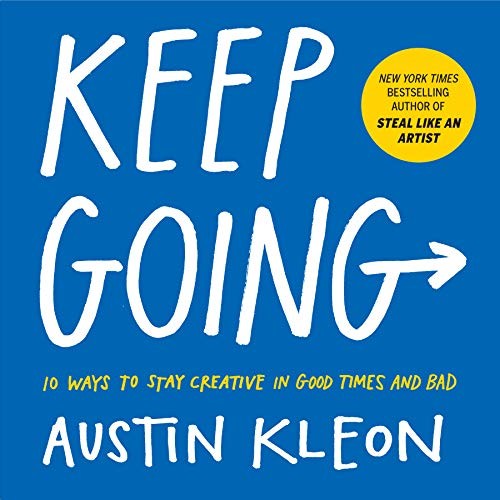
Keep Going by Austin Kleon is a 2019 self-help book about creativity, creative practice, resilience. Sustainability in creative work comes from daily practice tied to process, not to results. The goal is to show up, not to produce a masterpiece.
Summary
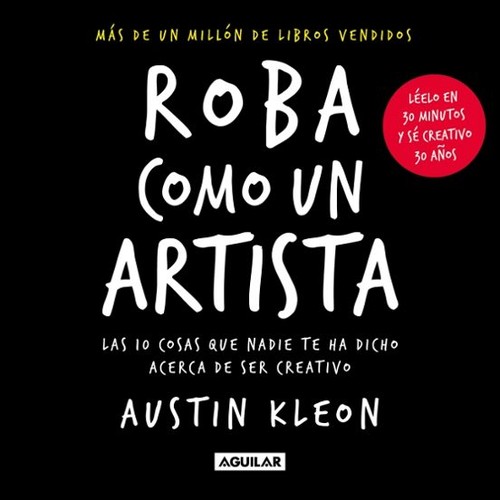
Keep Going is Austin Kleon's third book in his series on creative practice, following Steal Like an Artist and Show Your Work. Where the earlier books focused on finding creative influence and sharing work publicly, this one addresses the harder problem: what to do when the initial enthusiasm has faded and creative work becomes a daily act of will rather than a rush of inspiration. Kleon describes the book as ten ways to stay creative in good times and bad, and it reads as a set of personal rules he has developed for sustaining a decades-long creative practice.
The book is physically unusual — short, heavily illustrated, filled with Kleon's own visual notes and collages. It is designed to be absorbed in a single sitting and returned to when motivation falters. Each chapter makes a discrete argument: keep a daily log ("the bliss station"), protect your attention ("disconnect from the chaos"), distinguish the process from the product ("the creative life is not linear"), and allow yourself to be a beginner in something outside your main discipline. The arguments are not new, but Kleon's particular combinations and framings are often striking.
Several ideas stand out. His argument for "forget the decade, live in the day" challenges creative workers who orient their entire practice around long-term projects and legacy, at the cost of the daily enjoyment that actually sustains work over years. His chapter on anxiety and news consumption is bracingly practical: the kind of attention required to monitor the news cycle constantly is inimical to the kind of attention required to make things. And his chapter on the importance of rest and play is one of the more honest treatments of creative burnout in the popular literature.
Keep Going is not a comprehensive manual for creative productivity. It is closer to a set of values with illustrations. Some readers will find it too aphoristic, too light on mechanism. But for people in the middle of a creative project who have lost momentum, or who feel their creative energy contracting under the pressure of career ambitions, the book functions as something more useful than instruction: it functions as permission.
Talk to Keep Going like its author wrote you back.
Get the ideas that fit your life — not generic summaries.
- Chat with the book
- Audiobook-style main ideas
- Adapts to your life and goals
- Helps you take action
Key takeaways
- 1.
Sustainability in creative work comes from daily practice tied to process, not to results. The goal is to show up, not to produce a masterpiece.
- 2.
Attention is the raw material of creativity. Protecting it from the pull of news, social media, and ambient anxiety is a creative act, not just a productivity tactic.
- 3.
A 'bliss station' — a defined time and space for undistracted creative work — is more important than inspiration. Inspiration finds people who are already at work.
- 4.
Disconnecting from the reception of past work is necessary for producing new work. What the audience thought of the last thing is irrelevant to making the next one.
- 5.
Being a beginner at something outside your main creative discipline restores a sense of play and wonder that professional expertise tends to erode.
- 6.
The creative life is non-linear. Apparent detours, failures, and fallow periods are part of the process, not interruptions to it.
- 7.
Working on something you cannot monetize or optimize for audience is creatively restorative. Hobbies are not frivolous; they are maintenance.
Discussion questions
Use these on your own, with a book club, or as chat starters in Superbook. Book club version, ready to copy or print →
- 1.
Kleon argues that daily practice matters more than inspiration. What does your daily creative practice look like, and is it something you protect or something you do when other things allow?
- 2.
What's your relationship to news and social media during periods of creative work? Have you noticed a correlation between attention to the feed and creative output?
- 3.
Is there a project you've been avoiding returning to because of how the last one was received? What would it mean to disconnect from that reception and start fresh?
- 4.
Kleon recommends keeping a daily log — not a diary of events but a record of ideas, images, and fragments. Do you keep anything like that? What would change if you did?
- 5.
What's the last thing you did as a pure beginner, for no professional reason and with no external audience? How did it feel?
- 6.
Kleon distinguishes 'the calendar year' from 'the decade' — the long arc of a creative career. Do you have a sense of what your decade looks like? Does it clarify or obscure what you're doing day to day?
- 7.
Where in your creative life are you confusing the difficulty of the work with a sign that the work is wrong?
- 8.
Kleon talks about the creative life being non-linear and includes failure, fallow periods, and detours as part of the process. Can you identify a detour in your own creative history that turned out to matter?
- 9.
What creative activity do you do purely for yourself, with no external audience or professional application?
- 10.
The book is written for people already doing creative work. If you're not actively making something, what's in the way of starting a low-stakes daily practice?
- 11.
Which of Kleon's ten guidelines resonated most? Which one felt like a rebuke?
Themes
Frequently asked questions
-
Do I need to read Steal Like an Artist before Keep Going?
No. Each book in Kleon's trilogy stands on its own. Keep Going has a different focus — sustaining a long-term practice rather than finding influence or sharing work — and can be read independently. Some readers find it the most useful of the three precisely because it addresses what happens after the initial creative excitement fades.
-
Is Keep Going only useful for professional artists?
No. The advice applies to anyone engaged in creative work in any form — writing, design, programming, cooking — whether professional or not. Kleon explicitly frames the book for people who feel their creative energy is contracting, regardless of career stage or medium.
-
How long does it take to read Keep Going?
About two hours, possibly less. It is short, visually designed, and readable in one sitting. Many readers report returning to specific chapters when motivation drops rather than rereading it cover to cover.
-
What is the most actionable idea in Keep Going?
The bliss station: a defined daily time and place for undistracted creative work, protected from professional obligations and external reception. It sounds simple but most people don't have one, and the absence is felt as a vague creative restlessness rather than a solvable structural problem.
-
Is this book suitable for people dealing with creative burnout?
Yes, and this may be its primary audience. Kleon wrote it during a period of feeling overwhelmed by the demands of public creative work, and several chapters address creative anxiety and the corrosive effect of external validation directly. It won't solve clinical burnout, but as a perspective shift it is well-suited to that moment.