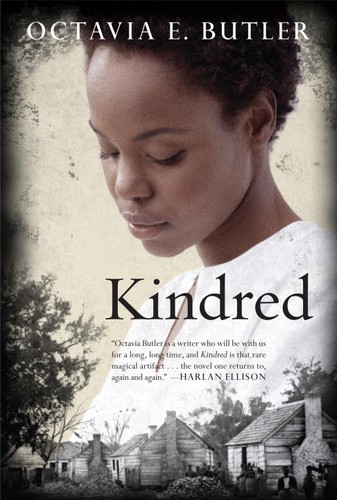
Kindred by Octavia E. Butler is a 1979 science fiction book about slavery and dehumanization, survival and complicity, power and dependency. Slavery's durability came not only from violence but from the dependency and attachment it engineered — Butler shows how those bonds developed and why they were so hard to break.
Summary
Dana, a Black woman living in California in 1976, is suddenly and involuntarily transported to the antebellum South. The mechanism is not explained — she is simply pulled through time whenever a white boy named Rufus, her ancestor, is in mortal danger, and she is returned to the present only when she herself is near death. Over the course of the novel, Dana makes several trips spanning decades, watching Rufus grow from a child into the slaveholder who will one day father her ancestor — and navigating the full horror of plantation slavery from within it.
Kindred is structured as a survival story, but its real subject is the psychology of slavery — how it was maintained, how it got inside people, how the enslaved found ways to preserve selfhood under conditions designed to obliterate it. Butler is meticulous about the mechanisms: the violence that enforces compliance, the small advantages that create hierarchy among the enslaved, the dependency that develops between enslaved people and the owners they protect to protect themselves. Dana's 1976 consciousness doesn't immunize her from these mechanisms — she finds herself making accommodations she would have found unimaginable, and the novel watches her do it with unflinching honesty.
What makes Kindred formally unusual is its genre ambiguity. The time-travel device is purely science-fictional, but the novel refuses the genre's conventions — there is no explanation, no technology, no way to control or escape the mechanism. The result sits between genres: it has the emotional logic of literary fiction, the premise of science fiction, and the historical detail of a narrative like Twelve Years a Slave. Butler herself resisted the "science fiction" label for this book; she called it a "grim fantasy."
This is a book for readers who want to understand, viscerally rather than abstractly, how slavery worked as a psychological and social system — not just its brutality but its logic, and why that logic was so durable. It is not comfortable. Butler is not interested in making slavery legible in ways that make the reader feel morally safe. The ending is deliberately unresolved in ways that will stay with you.
Talk to Kindred like its author wrote you back.
Get the ideas that fit your life — not generic summaries.
- Chat with the book
- Audiobook-style main ideas
- Adapts to your life and goals
- Helps you take action
Key takeaways
- 1.
Slavery's durability came not only from violence but from the dependency and attachment it engineered — Butler shows how those bonds developed and why they were so hard to break.
- 2.
Dana's modern consciousness doesn't protect her from the system; within weeks she is making survival accommodations that she would have judged as complicity from the outside.
- 3.
Rufus is neither a simple villain nor a sympathetic figure — he is a product of the system he was born into, and the novel insists on holding both his genuine attachments and his violence simultaneously.
- 4.
The time-travel mechanism externalizes what historical fiction often keeps abstract: the pull of the past on the present, the way Black Americans are still tethered to slavery's consequences.
- 5.
Kevin, Dana's white husband, experiences the same plantation differently — the novel uses their divergent experiences to show how race determines which parts of a system you see.
- 6.
Literacy is a form of power in the novel; teaching enslaved people to read is simultaneously an act of love and a political act, and the novel treats it as both.
- 7.
The ending is not cathartic — it removes a threat but leaves Dana marked, diminished, not restored. That incompleteness is the point.
- 8.
Butler wrote Kindred partly as a response to her generation's dismissiveness toward enslaved people's choices: the novel asks what you would do, and then makes you find out.
Discussion questions
Use these on your own, with a book club, or as chat starters in Superbook. Book club version, ready to copy or print →
- 1.
Dana knows she must keep Rufus alive until he fathers her ancestor, or she will cease to exist. Does that necessity make her a collaborator in his violence? How does the novel hold that question?
- 2.
Kevin experiences the antebellum South differently from Dana — as a white man, some of its brutality is simply invisible to him. Does the novel treat their different experiences with equal weight?
- 3.
Butler has said she wrote the novel partly in response to younger Black people in the 1970s who said they would have fought back or died rather than submit to slavery. How does Kindred answer that claim?
- 4.
Rufus's relationship with Dana is part genuine attachment, part ownership. Can those things coexist in a person? Does the novel think they can?
- 5.
The time-travel mechanism is never explained. What does the lack of explanation do for the novel? What would change if Dana had a machine she could control?
- 6.
Alice, an enslaved woman whom Rufus rapes repeatedly, is in some ways Dana's mirror. What does the novel do with the contrast between their situations?
- 7.
Dana becomes dependent on Rufus for protection just as enslaved people on real plantations became dependent on their owners. How does experiencing that dependency change her?
- 8.
Kevin stays in the past for five years before Dana can retrieve him. What does the novel suggest happened to him in that time, and what does it mean for their relationship?
- 9.
The novel was published in 1979. Does its account of antebellum slavery feel different to read now than it might have then? What has changed in how we talk about this history?
- 10.
Kindred ends with Dana having lost something she cannot get back. What is the novel saying with that ending?
- 11.
How does Kindred compare to Beloved as a treatment of slavery's legacy? What does each book do that the other doesn't?
- 12.
Butler described Kindred as a 'grim fantasy' rather than science fiction. What does the label you use change about how you read it?
Themes
Frequently asked questions
-
Is Kindred science fiction or historical fiction?
Butler called it 'a grim fantasy' and resisted the science fiction label. It uses a science fiction premise — time travel — but refuses the genre's explanatory conventions. The historical detail is serious and researched. Most bookstores shelve it in science fiction; most literature courses teach it as American literature.
-
Is Kindred worth reading?
Yes, strongly. It remains one of the most viscerally effective explorations of how slavery worked as a psychological system, and the time-travel device makes that exploration available to readers who would find straight historical fiction harder to enter. It is not a comfortable book, but its discomfort is the point.
-
How does Kindred compare to Beloved?
Beloved is more stylistically ambitious and more focused on memory and haunting; Kindred is more plot-driven and more interested in the moment-to-moment psychology of survival. Both are essential. Kindred is generally considered more accessible as an entry point.
-
Who shouldn't read Kindred?
Readers who need resolution and catharsis from their fiction. The ending is deliberately unrestorative. Readers who want the violence of slavery kept at historical distance will also find this difficult — Butler's method requires you to be inside the experience rather than reading about it.
-
Is there a graphic novel or adaptation?
A graphic novel adaptation illustrated by John Jennings and Damian Duffy was published in 2017 and received significant praise for preserving the novel's emotional impact in visual form.
Similar books
Beloved
Toni Morrison

Twelve Years a Slave
Solomon Northup
The New Jim Crow: Mass Incarceration in the Age of Colorblindness
Michelle Alexander
Man's Search for Meaning
Viktor E. Frankl
