Psychology · Book club
Learned Optimism: How to Change Your Mind and Your Life book club questions
Here are 11 book club questions for Learned Optimism: How to Change Your Mind and Your Life by Martin E. P. Seligman, ordered to open easily and end somewhere worth arguing about. Copy them, print them, or bring them up one at a time.
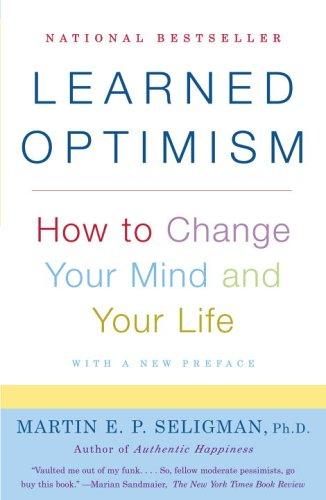
Martin Seligman's research career began with learned helplessness — the discovery that animals and humans who experience uncontrollable events generalize the uncontrollability to subsequent situations where control is actually possible, becoming passive even when action would help.
Martin E. P. Seligman · 1991 · 4h 40m
Full summary and key takeaways →The 11 questions
- 1.
Seligman describes your explanatory style as a relatively stable characteristic. Can you identify your own default style for explaining bad events — permanent or temporary, pervasive or specific?
- 2.
The learned helplessness concept emerged from animal experiments where dogs stopped trying to escape shocks they had previously learned were uncontrollable. Where in your life have you stopped trying in a situation where effort would actually help?
- 3.
He acknowledges that pessimists are often more accurate. Can you identify a domain in your life where optimism has led you to underestimate a real risk?
- 4.
The cognitive restructuring exercises involve disputing pessimistic automatic thoughts. Have you practiced anything like this, formally or informally? What happened?
- 5.
Seligman argues that children can be taught optimistic explanatory style and that this reduces depression. What would it mean to make that a serious educational priority?
- 6.
The distinction between when to use optimism and when to trust pessimism is one of the book's most nuanced contributions. Can you think of a current decision in your life where that distinction matters?
- 7.
He argues that chronic explanatory style is partly heritable and partly formed by early experience, particularly parental explanatory style. What do you notice about your own parents' style and your own?
- 8.
Learned Optimism was published in 1991, predating the positive psychology movement Seligman later founded. How does the earlier, more clinical book feel different from the later prescriptive work?
- 9.
The book includes self-assessments. Did you find the assessments in the book useful, or do you trust your intuitions about your own explanatory style more?
- 10.
Seligman acknowledges that some pessimism is protective and accurate. How do you decide which of your negative thoughts to dispute and which to take seriously?
- 11.
If you were designing a school curriculum to build resilience, what would you include based on this book's framework?
How to run the discussion
- Pick six to eight, not all of them. An hour of real discussion covers fewer questions than anyone expects, and racing the list is what makes a book club feel like homework.
- Open with what people noticed, not what they concluded. Asking for a verdict first hardens opinions before anyone has heard each other.
- Let the disagreement run. The questions below that split a room are the ones worth the time; the ones everyone answers the same way can be skipped.
- Ask the quiet person a specific question. A direct, narrow question is far easier to answer than an open invitation to contribute.
Themes worth steering toward
If the conversation stalls, these are the threads that usually restart it.
Common questions
What are good book club questions for Learned Optimism: How to Change Your Mind and Your Life?
Here are 11 book club questions for Learned Optimism: How to Change Your Mind and Your Life by Martin E. P. Seligman, ordered to open easily and end somewhere worth arguing about. The strongest openers ask what each reader noticed rather than what they concluded, and the discussion usually turns on optimism, explanatory style, depression.
How long should a book club discussion of Learned Optimism: How to Change Your Mind and Your Life last?
Most groups run 60 to 90 minutes of actual discussion. That is roughly six to eight questions, not all of them, so pick the ones that suit your group rather than working down the list in order.
What are the main themes in Learned Optimism: How to Change Your Mind and Your Life?
Optimism, Explanatory style, Depression, Resilience, Cognitive therapy. Those are the threads most likely to divide a room, which makes them the useful places to steer a discussion that has gone quiet.
Picking the next one? See books like Learned Optimism: How to Change Your Mind and Your Life or questions for other book club picks.
