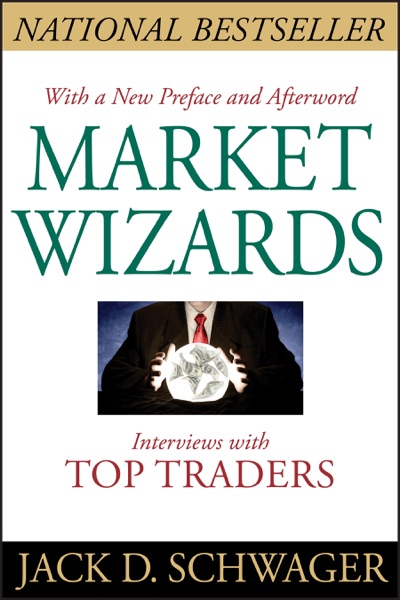
Market Wizards by Jack D. Schwager is a 1989 business book about trading, risk management, psychology of investing. Capital preservation is the primary objective. Every successful trader in the book prioritizes not losing money over making money — not as a platitude but as the operational foundation of all other decisions.
Summary
Market Wizards is Jack Schwager's collection of interviews with some of the most successful traders of the 1970s and 1980s — Michael Marcus, Bruce Kovner, Richard Dennis, Paul Tudor Jones, and others who generated extraordinary returns over extended periods in futures, currencies, and equities. Schwager, a financial writer and trader himself, conducted the interviews with enough expertise to push past platitudes and elicit genuinely specific accounts of how these traders actually think, what they got wrong early on, and what habits and principles eventually produced their results.
The most striking finding across the interviews is that these traders share a small number of core principles despite using wildly different methods — technical analysis, fundamental analysis, trend following, contrarian positions, macro bets. Almost all of them emphasize cutting losses ruthlessly before they compound, protecting capital as the primary goal rather than maximizing gains, sizing positions to survive extended losing streaks, and treating trading as a probabilistic enterprise where any single trade is irrelevant relative to the long-run edge. The divergence in method is wide; the convergence in risk management is nearly complete.
Several of the interviews are landmarks in trading literature. Paul Tudor Jones's account of his methods and his rules for capital protection is frequently excerpted. Richard Dennis's interview is memorable partly because Dennis's "Turtle Traders" experiment — training ordinary people to trade like professionals — is one of the most famous experiments in behavioral finance. Michael Marcus's account of his early career, including his catastrophic early losses and how he rebuilt, is one of the more honest confessions in the genre.
For non-traders, the book's interest lies in the psychology of performance under uncertainty. The traders Schwager interviews have developed unusually clear frameworks for managing decision-making in conditions of incomplete information, emotional pressure, and financial consequence. The habits they describe — pre-defining risk before entry, avoiding hope as a trading strategy, respecting the market over personal conviction — have applications beyond finance. The book is most useful read as a study of expert judgment in high-stakes, probabilistic environments.
Talk to Market Wizards like its author wrote you back.
Get the ideas that fit your life — not generic summaries.
- Chat with the book
- Audiobook-style main ideas
- Adapts to your life and goals
- Helps you take action
Key takeaways
- 1.
Capital preservation is the primary objective. Every successful trader in the book prioritizes not losing money over making money — not as a platitude but as the operational foundation of all other decisions.
- 2.
Cut losses early and let winners run. This asymmetry — small losses, large gains — is the mathematical foundation of profitable trading across almost all methods discussed.
- 3.
Position sizing is as important as entry and exit. Many traders with correct market views still lose money because they size positions too large to survive the volatility that precedes being right.
- 4.
The market is almost always right. Holding a losing position because you believe the market is wrong is a form of arrogance that the best traders learn to abandon early.
- 5.
Trading psychology determines outcomes as much as strategy. The ability to take a loss without it affecting the next trade, and to hold a winner without cutting it prematurely, is a trainable skill.
- 6.
Richard Dennis's Turtle Traders experiment suggested that at least some trading ability could be taught — that rules and discipline could produce traders where none existed before.
- 7.
The best traders are highly risk-averse, not risk-seeking. They make money by identifying high-probability setups and limiting exposure when uncertainty is high, not by taking large risks.
- 8.
Every successful trader Schwager interviews has been through significant losses, often early in their career. The losses were formative rather than disqualifying — they produced the discipline that later produced the returns.
Discussion questions
Use these on your own, with a book club, or as chat starters in Superbook. Book club version, ready to copy or print →
- 1.
The traders in this book use very different methods but share nearly identical risk management principles. What does that convergence tell you about where the real edge in trading comes from?
- 2.
Paul Tudor Jones describes rituals and physical cues that maintain his mental state during trading. Do you use similar techniques in your own high-stakes decision-making?
- 3.
Richard Dennis believed trading could be taught to ordinary people through rules. Do you think discipline and rule-following can substitute for natural talent in performance domains?
- 4.
The principle of cutting losses and letting winners run is easy to state and hard to follow. What psychological forces make it so difficult to execute in practice?
- 5.
Most of the traders describe learning through catastrophic early losses. Is there a lesson here about the role of painful experience in developing genuine expertise?
- 6.
These traders made their fortunes in the 1970s and 1980s. How much of their edge was specific to that era's markets, and how much transferred to later decades?
- 7.
The book's traders are almost all men operating in an era before algorithmic trading dominated. How do you think the insights generalize to today's markets and to women in finance?
- 8.
Capital preservation as the primary objective sounds conservative for people generating extraordinary returns. How does conservatism about downside coexist with the aggression required for large gains?
- 9.
Several traders describe their thinking as probabilistic rather than predictive — they don't try to be right, they try to have a positive expected value. How do you apply probabilistic thinking in your own work?
- 10.
Schwager's follow-up interviews over decades showed that some of these traders' methods stopped working as markets changed. What does that suggest about the durability of any particular trading edge?
- 11.
The emotional discipline described in these interviews — taking losses without self-recrimination, holding gains without premature exits — is difficult by design. What makes it so, and what practices seem to help?
Themes
Frequently asked questions
-
Is Market Wizards worth reading for non-traders?
Yes, especially for the psychology of decision-making under uncertainty. The principles these traders articulate — cutting losses, sizing bets to survive being wrong, separating the quality of a decision from its outcome — apply in any domain where you must act on incomplete information with real consequences.
-
How long is Market Wizards?
Around 330 pages. At average reading pace, roughly six hours. Each chapter is a separate interview and can be read independently. Most readers find two or three interviews particularly resonant and return to those later.
-
What is the main lesson of Market Wizards?
Risk management is the foundation of consistent performance. The traders in the book use different methods but all share a near-obsessive focus on protecting capital, sizing positions conservatively, and treating each trade as one data point in a long series rather than a life-or-death decision.
-
Which interview in Market Wizards is most worth reading?
Paul Tudor Jones is the most frequently cited. His rules for capital protection, his account of the 1987 crash (which he predicted and profited from), and his psychological framework are exceptionally clear. Richard Dennis on the Turtle Traders experiment is a close second.
-
Is the advice still applicable to modern markets?
The risk management principles are as valid as ever. The specific trading methods — some based on reading physical commodity floors, some on phone conversations with brokers — are obviously dated. Readers should take the psychology and principles seriously and hold the specific mechanics loosely.
Similar books
Reminiscences of a Stock Operator
Edwin Lefèvre
Thinking in Bets: Making Smarter Decisions When You Don't Have All the Facts
Annie Duke
The Big Short: Inside the Doomsday Machine
Michael Lewis
Liar's Poker
Michael Lewis
