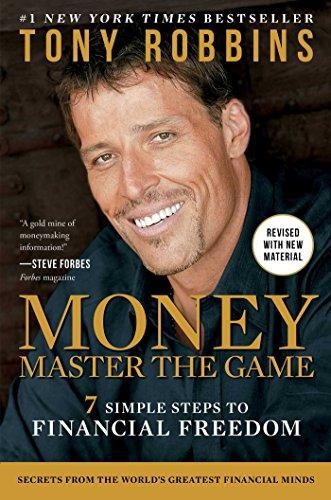
Money: Master the Game by Tony Robbins is a 2014 economics book about personal finance, investing, financial freedom. Compounding works exponentially, but fees compound equally — a 1-2% annual fee over 30 years can consume a third of your potential returns.
Summary
Money: Master the Game is Tony Robbins's attempt to distill financial wisdom from interviews with fifty of the world's most successful investors — including Ray Dalio, Warren Buffett, Jack Bogle, and Paul Tudor Jones — into a practical guide for ordinary people. The core argument is that the financial services industry is structurally misaligned with individual investors, and that understanding a small number of fundamental principles can help most people accumulate enough wealth to achieve what Robbins calls financial freedom.
The book is organized around seven steps. It begins with the psychology of commitment and moves through foundational concepts: the math of fees and compounding, the importance of tax-advantaged accounts, and the case for low-cost index funds over actively managed alternatives. The centerpiece is an extended discussion of asset allocation, particularly Ray Dalio's All Weather Portfolio — a diversified allocation across stocks, bonds, gold, and commodities designed to perform across different economic environments. Robbins argues that getting asset allocation right is more important than security selection, a position consistent with the academic evidence he cites.
The book's final sections turn to lifestyle: what financial freedom actually means in practice, how to calculate your own freedom number, and how to protect wealth once accumulated. Robbins interviews a range of investors at different wealth levels and repeatedly emphasizes that the goal is not to become a billionaire but to reach a point where work becomes optional.
The chief weakness is length. At nearly 700 pages, the book repeats itself considerably, and the celebrity interview format means quality is uneven. Some chapters deliver genuine insight; others feel like extended testimonials. The financial concepts themselves are mostly sound and consistent with evidence-based investing literature, but readers who have already encountered index fund investing, fee minimization, and diversification will find little that is technically new. For someone starting from scratch with no financial framework, it is comprehensive if exhausting.
Talk to Money: Master the Game like its author wrote you back.
Get the ideas that fit your life — not generic summaries.
- Chat with the book
- Audiobook-style main ideas
- Adapts to your life and goals
- Helps you take action
Key takeaways
- 1.
Compounding works exponentially, but fees compound equally — a 1-2% annual fee over 30 years can consume a third of your potential returns.
- 2.
Asset allocation, not stock picking, drives the majority of investment returns over time. Getting the allocation right matters more than individual security selection.
- 3.
Ray Dalio's All Weather Portfolio allocates across economic seasons — growth, recession, inflation, deflation — to reduce volatility without sacrificing long-term returns.
- 4.
Index funds consistently outperform the majority of actively managed funds after fees over long periods. This is not a prediction but an observed historical pattern.
- 5.
Tax-advantaged accounts — 401(k), IRA, Roth IRA — are among the highest-leverage financial tools available to ordinary investors and should be maximized before other investments.
- 6.
Financial freedom has a specific number: the amount of passive income that covers your essential and desired lifestyle. Calculating that number is the first concrete step.
- 7.
The financial services industry profits primarily from fees and complexity. Simplicity, low cost, and diversification are systematically underserved by that industry.
- 8.
Rebalancing — selling what has appreciated and buying what has lagged — is the mechanical discipline that keeps an allocation on target and forces buy-low behavior.
Discussion questions
Use these on your own, with a book club, or as chat starters in Superbook. Book club version, ready to copy or print →
- 1.
Robbins argues fees are the silent killer of long-term returns. Have you ever calculated the total fee impact on your own investments over a 20- or 30-year horizon?
- 2.
What is your actual financial freedom number — the passive income that would make work optional — and how did you arrive at it?
- 3.
Dalio's All Weather Portfolio prioritizes stability across economic seasons over maximum returns in any one season. How does that tradeoff fit your own temperament as an investor?
- 4.
Robbins interviews both billionaires and people who achieved freedom on modest incomes. Which interviews in the book were most instructive, and why?
- 5.
The book argues most people hand their financial future to advisors without understanding the incentive structures those advisors operate under. How do you currently vet financial advice?
- 6.
Robbins repeatedly emphasizes the psychology of scarcity versus abundance. How much of your financial behavior is driven by fear rather than a clear plan?
- 7.
Index investing is presented as the obvious answer. What are the strongest arguments against it, and do they apply to your situation?
- 8.
The book distinguishes between being financially secure, financially vital, financially independent, and financially free. Which stage are you at, and what would it take to move to the next?
- 9.
Robbins argues that the hardest part of investing is doing nothing during market crashes. Have you ever sold during a downturn? What drove that decision?
- 10.
How much of your total investment cost do you actually know? Expense ratios, advisor fees, fund trading costs, taxes — have you summed them?
- 11.
Robbins spends considerable time on what financial freedom means beyond money. What would you actually do differently if work were optional tomorrow?
- 12.
The book is very long. What's the chapter or interview you found most credible, and which felt most like padding or salesmanship?
Themes
Frequently asked questions
-
Is Money: Master the Game worth reading?
For someone with no investing framework, yes — the core financial concepts are accurate and useful. For readers already familiar with index fund investing and asset allocation, the book is long relative to its new information. The Ray Dalio All Weather discussion and the fee compounding sections are the strongest parts.
-
How long does Money: Master the Game take to read?
It is nearly 700 pages and takes most readers ten to fourteen hours. The length is the most common complaint. The financial content could be conveyed in a third the space; the remainder is interviews, motivational framing, and repetition.
-
What is the All Weather Portfolio?
Ray Dalio's asset allocation designed to hold up across all economic environments — inflationary, deflationary, growth, and recession. The allocation Robbins presents is roughly 30% stocks, 40% long-term bonds, 15% intermediate bonds, 7.5% gold, and 7.5% commodities. It prioritizes stability over maximum return.
-
Does Robbins have any financial conflicts of interest in this book?
He promotes certain financial products and advisors, which critics noted at publication. Readers should evaluate recommendations critically. The independent investing concepts — low-cost index funds, fee awareness, diversification — are consistent with mainstream evidence-based finance regardless of the promotional content.
-
Who should not read Money: Master the Game?
Readers who have already built a solid financial foundation and understand index investing, tax-advantaged accounts, and asset allocation will find little new. The book is most valuable as an entry point for people starting from zero financial knowledge.