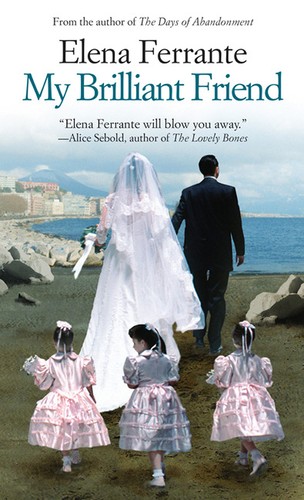
My Brilliant Friend by Elena Ferrante is a 2011 literary fiction book about female friendship and rivalry, class and education as escape, violence and patriarchy. Ferrante depicts female friendship as a relationship that can be both the primary emotional bond of a life and a site of ongoing rivalry, without either of those things canceling the other out.
Summary
My Brilliant Friend is the first volume of Elena Ferrante's Neapolitan Novels, following Elena Greco and Lila Cerullo from their childhood in a poor Naples neighborhood in the 1950s into early adolescence. Elena narrates in retrospect, from old age, after Lila has inexplicably erased herself from the world. The novel is essentially Elena's attempt to understand a lifelong friendship — and rivalry — that shaped everything about who she became.
The book is saturated with violence. Violence in the neighborhood is ordinary, structural: husbands beat wives, fathers beat children, men beat other men over territorial and economic slights. The neighborhood is a closed system with its own economy, hierarchies, and rules, and Ferrante renders it with ferocious specificity. Into this world she places two exceptional girls who both recognize each other's intelligence and cannot stop measuring themselves against each other. Lila is dazzling, mercurial, capable of intuitive leaps that leave Elena winded. Elena is steadier, more dutiful, and has the devastating self-awareness to know that she has always, in some part of herself, wanted to become Lila.
What makes the Neapolitan Novels different from most female-friendship narratives is Ferrante's refusal to sentimentalize or stabilize the relationship. Elena's love for Lila is real and so is her resentment. The friendship is competitive and generous simultaneously. Neither woman is idealized. Ferrante tracks the precise way that proximity to someone more brilliant than you can both elevate and diminish — how a friendship can be the thing that saves you and the thing that makes you doubt whether you have a self apart from the comparison.
This is one of those novels where the first volume is not complete in itself — it ends mid-story in a way that demands the sequel. Readers who bounce off the slow, dense first hundred pages (the childhood section is demanding) are advised to persist. The novel is not for readers who want likable characters or tidy emotional resolution; it is for readers willing to spend time in a world that is uncomfortable, specific, and alive in ways literary fiction rarely manages.
Talk to My Brilliant Friend like its author wrote you back.
Get the ideas that fit your life — not generic summaries.
- Chat with the book
- Audiobook-style main ideas
- Adapts to your life and goals
- Helps you take action
Key takeaways
- 1.
Ferrante depicts female friendship as a relationship that can be both the primary emotional bond of a life and a site of ongoing rivalry, without either of those things canceling the other out.
- 2.
The neighborhood operates as a character — the rione's claustrophobic economy of violence, reputation, and limited escape routes is the novel's true antagonist.
- 3.
Education in the novel functions as the only plausible exit from the neighborhood, and the decision about who gets it (boys, not girls) is depicted as the fundamental injustice that shapes both women's lives.
- 4.
Lila is rendered from Elena's perspective, which means she is always slightly mysterious — we see her effects more than her interior, which makes her simultaneously more and less real than Elena.
- 5.
Ferrante is precise about how class shapes aspiration: the girls can imagine escaping the neighborhood but not its values, and the novel tracks the ways those values persist even in people who intellectually reject them.
- 6.
The novel's violence is not gratuitous: it functions as a constant reminder of the material conditions that constrain these characters and what it actually costs to step outside them.
- 7.
Elena's self-deprecation is complex — she is both genuinely insecure and using modesty as a form of social navigation, and Ferrante keeps both readings available simultaneously.
- 8.
The novel ends in a place that makes sense only if you read it as the beginning of a longer argument — standalone it is frustratingly incomplete, which is part of the point.
Discussion questions
Use these on your own, with a book club, or as chat starters in Superbook. Book club version, ready to copy or print →
- 1.
Elena describes Lila as brilliant throughout, but we mostly see Lila's brilliance through Elena's perception. Is Lila actually more exceptional than Elena, or is Elena's story about Lila a way of explaining her own choices?
- 2.
The neighborhood is depicted as brutal but also as a community with real bonds and pleasures. Does Ferrante romanticize it, or is she being honest about what leaving actually costs?
- 3.
Education is the escape valve for the girls, but the novel shows it closing for Lila while opening for Elena. Is Lila's marriage a choice or a surrender? Does the novel answer this?
- 4.
How does violence function in the neighborhood's social order? Is it primarily about economics, gender, or something else?
- 5.
Elena's narration is retrospective — she knows how things turn out, including that Lila will eventually vanish. Does knowing this change how you read the friendship in this first volume?
- 6.
Ferrante never writes about Lila from the inside. Is this a technical limitation or a deliberate statement about the limits of Elena's knowledge of her friend?
- 7.
The Solara brothers represent a specific kind of threatening masculinity in the novel. How do they function differently from the older generation's violence?
- 8.
My Brilliant Friend is sometimes described as a novel about Naples as much as about its characters. Did you feel the city as a presence? How much does place determine destiny in this world?
- 9.
Elena and Lila's mothers are almost entirely unsympathetic figures. Is this a flaw in the novel, or does Ferrante have something specific to say about what poverty and confinement do to women over time?
- 10.
The novel ends inconclusively. Did that frustrate you or make you want to read on? Is that a fair way to end a first volume?
- 11.
If you had to characterize the friendship at the end of this volume — is it primarily love, rivalry, or something else? What's the right word for it?
- 12.
Ferrante's identity is famously unknown. Does not knowing who wrote the novel change how you read it? Does the author's anonymity feel like a gimmick or something more interesting?
Themes
Frequently asked questions
-
Do I need to read all four Neapolitan Novels?
My Brilliant Friend does not work as a standalone — it ends mid-story. The quartet is effectively one long novel published in four volumes. If you read the first, plan for all four. The total is roughly 1,700 pages and most readers find it compulsive once the first hundred pages have established the world.
-
Is My Brilliant Friend hard to read?
The opening childhood section is demanding because Ferrante introduces a large cast of neighborhood families simultaneously. Many readers recommend powering through the first fifty pages and letting the characters sort themselves out. After that the novel becomes very difficult to put down.
-
Who is Elena Ferrante really?
Unknown, officially. There have been claims and investigations, including a 2016 journalistic report suggesting a Roman translator, but Ferrante has never confirmed an identity and the debate continues. The mystery is real and the author appears to prefer it that way.
-
Is the HBO series worth watching?
The series is highly regarded — the casting is exceptional and it captures the neighborhood's texture well. It works as a companion to the novels rather than a substitute; the books' interior life is irreplaceable.
-
Who shouldn't read My Brilliant Friend?
Readers who find novels requiring attention to large casts and slow narrative accumulation frustrating, or who want likable protagonists making sensible choices. The novel earns its length but demands patience, particularly in the first third.
Similar books
The Woman Warrior: Memoirs of a Girlhood Among Ghosts
Maxine Hong Kingston
Angela's Ashes
Frank McCourt
Born a Crime: Stories from a South African Childhood
Trevor Noah
Between the World and Me
Ta-Nehisi Coates
