No Filter: The Inside Story of Instagram by Sarah Frier is a 2020 business book about social media, startup culture, acquisition. Instagram's founders built the product around curation and beauty, a deliberate aesthetic choice that differentiated it from Facebook's utility-driven design philosophy.
Summary
No Filter is Sarah Frier's account of Instagram's founding, its acquisition by Facebook, and the decade-long tension between Instagram's founders and Mark Zuckerberg over what the product should become. Frier, a Bloomberg technology reporter, had extraordinary access to the central figures and the narrative is rich in specific detail: the dinner conversations, the strategic disagreements, and the moment-by-moment decisions that shaped one of the world's most influential products.
The core story is a study in what happens when a product with a distinct vision is absorbed by a company with a very different one. Kevin Systrom and Mike Krieger built Instagram around a carefully curated aesthetic experience — high-quality photography, a chronological feed, an advertising model tethered to beauty rather than behavioral targeting. Facebook bought Instagram in 2012 for a billion dollars partly to neutralize a competitor and partly for its engagement data. What followed was a decade of quiet conflict over whether Instagram would remain what it had been or become a more effective growth and advertising engine for Facebook.
Frier documents how Zuckerberg's priorities — aggressive growth metrics, cross-platform integration, advertising volume — gradually reshaped Instagram despite Systrom's resistance. Features were copied from Snapchat (Stories), growth was optimized at the expense of content quality, and the algorithmic feed replaced the chronological one over Systrom's objections. Systrom and Krieger ultimately resigned in 2018 in what Frier characterizes as a confrontation over autonomy.
Beyond the internal politics, the book raises important questions about Instagram's cultural consequences — the normalization of idealized self-presentation, the mental health effects on teenagers, the weaponization of social proof by brands and influencers. Frier is careful not to overstate Instagram's individual responsibility for these effects, but she doesn't ignore them either. The result is one of the more complete portraits of how a beloved consumer product was built, acquired, and complicated.
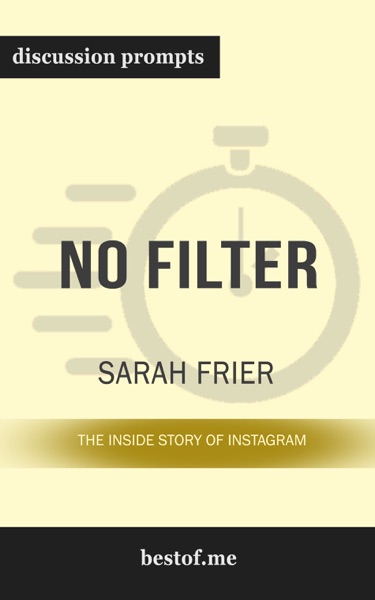
Talk to No Filter: The Inside Story of Instagram like its author wrote you back.
Get the ideas that fit your life — not generic summaries.
- Chat with the book
- Audiobook-style main ideas
- Adapts to your life and goals
- Helps you take action
Key takeaways
- 1.
Instagram's founders built the product around curation and beauty, a deliberate aesthetic choice that differentiated it from Facebook's utility-driven design philosophy.
- 2.
Facebook's acquisition of Instagram for $1 billion in 2012 was Zuckerberg's recognition that a mobile-native photo product was a competitive threat he could not build fast enough.
- 3.
The post-acquisition decade showed how a parent company's incentive structures — growth at all costs, advertising revenue per user — can gradually reshape a product over its founders' objections.
- 4.
The algorithmic feed, replacing the chronological one, was one of the most significant product decisions in Instagram's history — increasing engagement while fundamentally changing what users saw.
- 5.
Stories, copied directly from Snapchat, proved that shameless feature imitation is a viable competitive strategy when executed well and distributed at scale.
- 6.
The influencer economy Instagram created was not designed or anticipated by its founders. It emerged from user behavior and platform incentives interacting in ways no one fully controlled.
- 7.
Systrom and Krieger's resignation illustrated the structural tension in acqui-hire arrangements: the acquiring company wants the product but also wants control over strategy.
- 8.
Instagram's effect on teenage mental health and the normalization of idealized self-presentation became visible in research years after the product design decisions that caused them.
Discussion questions
Use these on your own, with a book club, or as chat starters in Superbook. Book club version, ready to copy or print →
- 1.
Systrom and Krieger tried to preserve Instagram's aesthetic identity after the Facebook acquisition. Was that a realistic goal once the acquisition closed?
- 2.
At what point, if any, does a product's cultural influence become the responsibility of its creators to manage?
- 3.
Frier documents the algorithmic feed transition as a pivotal decision. Should Instagram have kept the chronological feed?
- 4.
Stories was a feature Snapchat invented and Instagram cloned. How should we think about competitive imitation in consumer technology?
- 5.
The influencer economy grew from Instagram's platform without being designed for it. What does that tell us about the relationship between product design and emergent user behavior?
- 6.
Zuckerberg's competitive instincts are a major theme in the book. Is his style of competition — acquire or copy — a rational strategy or something more personal?
- 7.
How much responsibility does Instagram bear for the mental health effects documented in research on teenage girls? How much is on parents, educators, or society?
- 8.
Frier presents Systrom sympathetically. Are there ways his leadership contributed to the tensions she describes?
- 9.
What would Instagram look like today if Systrom had retained full control over product strategy after the acquisition?
- 10.
Instagram's advertising model was built around beauty and aspiration. Facebook's was built around behavioral targeting and social proof. Which do you think is more durable?
- 11.
How does Instagram's story differ from WhatsApp's, the other major Facebook acquisition? What explains the different outcomes?
- 12.
Does the pattern Frier describes — large platform acquires smaller, better product and gradually assimilates it — suggest anything about how acquisition should be regulated?
Themes
Frequently asked questions
-
Is No Filter worth reading?
Yes. Frier's access and reporting are exceptional, and the book is one of the most detailed accounts of what happens to a consumer product after a major acquisition. It works as business narrative, cultural history, and a case study in corporate governance simultaneously.
-
How long does it take to read No Filter?
Around five to six hours at average reading pace. The narrative is chronological and moves quickly, with chapters organized around specific periods and decisions.
-
What is No Filter mainly about?
The founding of Instagram, its acquisition by Facebook, and the decade-long conflict between Instagram's founders and Mark Zuckerberg over the product's direction and values — ending with Systrom and Krieger's resignation in 2018.
-
Did Instagram's founders resent the acquisition?
Frier's account suggests they initially accepted it willingly but grew increasingly frustrated as Facebook's growth priorities overrode their product vision. The resignation came after years of escalating tension over autonomy, metrics, and competitive strategy.
-
What is No Filter's most important finding?
That the cultural consequences of Instagram — influencer culture, the normalization of edited self-presentation, the mental health effects on teenagers — were largely byproducts of product decisions made for business rather than cultural reasons, and were not seriously examined until the harm was already widespread.
Similar books
Super Pumped: The Battle for Uber
Mike Isaac
The Everything Store: Jeff Bezos and the Age of Amazon
Brad Stone

Bad Blood: Secrets and Lies in a Silicon Valley Startup
John Carreyrou
Creativity, Inc.: Overcoming the Unseen Forces That Stand in the Way of True Inspiration
Ed Catmull and Amy Wallace
