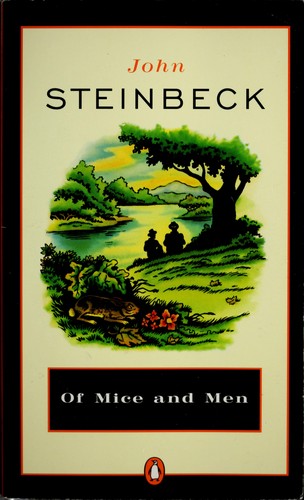
Of Mice and Men by John Steinbeck is a 1937 literary fiction book about dreams and their failure, loneliness, friendship. The dream of the farm is not naive — it is the one thing that makes the world of migratory labor survivable, and Steinbeck understands this even as he dismantles it.
Summary
Of Mice and Men is a short novel — really a novella — published in 1937, two years before The Grapes of Wrath, and it covers much of the same Depression-era California ground in concentrated form. George Milton and Lennie Small are migrant ranch workers who travel together, which is itself unusual in this world. George is small, sharp, and protective; Lennie is physically enormous, mentally disabled, and capable of great violence without intent. They share a dream: save enough money to buy a small farm, grow their own food, keep rabbits. The dream is what keeps them going.
The novel is structured almost like a play — a few scenes, a small cast, a tight timeframe — and Steinbeck originally conceived it for theatrical adaptation. Everything that happens is compressed and deliberate. The ranch they arrive at has its own constellation of lonely people: Candy, the old swamper who fears being discarded when he's no longer useful; Crooks, the Black stable hand who lives apart from the others; Curley, the boss's aggressive son; and Curley's wife, who has no name, only a role. She is lonely and restless and dangerous, not because she is malicious but because she is a human being trapped in a situation that gives her no outlet.
The novel moves toward its ending with the inevitability of tragedy — you can feel it building from the first scene, when we learn what Lennie has already done before the story begins. Steinbeck doesn't withhold the outcome; he makes it inescapable. The final scene between George and Lennie, conducted in a deliberate echo of the novel's opening, is one of the most quietly devastating things in American fiction. Mercy and loss are held in the same gesture.
At 100-odd pages it reads in two hours, but the brevity is deceptive. The compressed form means every detail pulls weight. The mice, the puppy, Candy's dog — each is a station in an argument about what it costs to be tender in a brutal world. It is the most frequently banned book in American schools and the most frequently taught. Both reactions make sense.
Talk to Of Mice and Men like its author wrote you back.
Get the ideas that fit your life — not generic summaries.
- Chat with the book
- Audiobook-style main ideas
- Adapts to your life and goals
- Helps you take action
Key takeaways
- 1.
The dream of the farm is not naive — it is the one thing that makes the world of migratory labor survivable, and Steinbeck understands this even as he dismantles it.
- 2.
Lennie's violence is never malicious. He kills things by holding them too tight. This is a precise psychological portrait, not a convenient plot device.
- 3.
Loneliness is the novel's real subject. Every character except George and Lennie is isolated — Crooks by race, Candy by age and fear, Curley's wife by gender and marriage.
- 4.
Curley's wife has no name in the novel. This is deliberate, and the novel knows it. Her anonymity is part of what Steinbeck is documenting about her situation.
- 5.
The parallel between Candy's dog and Lennie is not subtle, but it is devastating. Candy's failure to shoot his own dog is a rehearsal for what George must do.
- 6.
George and Lennie's relationship is the only genuine human bond in the novel. That it ends as it does says something precise about whether such bonds can survive in this world.
- 7.
The ending is an act of mercy, not cruelty. Whether the mercy is for Lennie, for George, or for both is the question the novel leaves open.
- 8.
The best-laid plans of mice and men go oft awry — the Burns line that names the novel frames human aspiration as a universal condition, not a failure of intelligence or effort.
Discussion questions
Use these on your own, with a book club, or as chat starters in Superbook. Book club version, ready to copy or print →
- 1.
George has been carrying Lennie for years, at real cost to himself. Is their relationship mutual, or is George giving far more than he receives?
- 2.
The novel ends with George shooting Lennie. Is this a mercy killing, a murder, a sacrifice, or something that requires a different word entirely?
- 3.
Crooks tells Lennie that everyone who doesn't have someone to talk to 'goes nuts.' Is Crooks right? What does the novel say about the relationship between loneliness and sanity?
- 4.
Curley's wife is portrayed sympathetically — she has dreams, she is trapped — but she also says something vicious to Crooks. How do you hold both of those things at once?
- 5.
The farm dream is almost certainly impossible. Does George believe in it, or is it a story he tells Lennie? Does the distinction matter?
- 6.
Candy offers his life savings to be part of the dream. What does that tell us about what the dream represents beyond its literal content?
- 7.
Compare Candy's failure to shoot his dog with George's decision at the end. Is there a moral distinction, or is Steinbeck making them equivalent?
- 8.
The novel was written to be staged as a play. Does reading it feel different from other novels? Does its theatrical structure limit or concentrate its effect?
- 9.
Of Mice and Men is one of the most frequently challenged books in schools. On what grounds? Do you find those grounds convincing?
- 10.
The Burns epigraph frames failure as a universal condition. Does that universality let the novel off the hook politically — making structural conditions feel like fate?
- 11.
At what points in your own life have you held a dream the way George and Lennie hold theirs — as something necessary to function, regardless of its likelihood?
- 12.
Steinbeck gives Lennie's mental disability no clinical label and no explanation. Is that a strength of the portrayal, or does it flatten a complex condition into a plot mechanism?
Themes
Frequently asked questions
-
Is Of Mice and Men appropriate for high school readers?
It is widely taught at that level and is generally accessible — short, clearly plotted, emotionally direct. Some schools and parents have objected to racial slurs and to the ending. The challenges it poses are emotional and ethical rather than literary, which makes it both useful for teaching and occasionally uncomfortable.
-
How long is Of Mice and Men?
About 105 pages — a novella. Most readers finish it in a single sitting of two hours or so.
-
What happens at the end?
George shoots Lennie before Curley and his men can reach him. Lennie has killed Curley's wife accidentally. George shoots him while telling him the dream of the farm, so the last thing Lennie hears is the story that has sustained them both. This is not a spoiler the novel conceals — the ending is visible from early on.
-
Why is it called Of Mice and Men?
From Robert Burns's poem 'To a Mouse' — 'The best-laid schemes o' mice an' men / Gang aft agley' (go oft awry). The title frames the characters' failure as an instance of universal human aspiration undone by circumstance.
-
Is there a film adaptation?
Two notable ones: a 1939 version directed by Lewis Milestone and a 1992 version directed by and starring Gary Sinise as George, with John Malkovich as Lennie. The 1992 version is generally considered the better film.