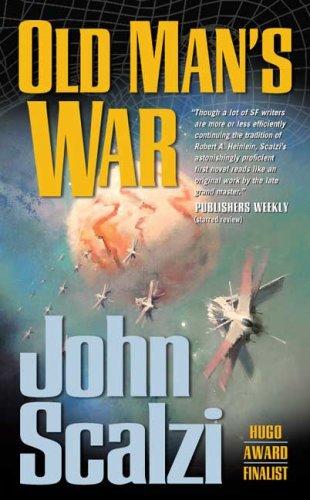
Old Man's War by John Scalzi is a 2005 science fiction book about identity and embodiment, war and mortality, aging and renewal. The premise forces the question most military fiction avoids: if you are given a new body to fight, are you the same person who signed up? Scalzi makes that question plot-relevant, not just philosophical.
Summary
John Perry is 75 years old when he enlists in the Colonial Defense Forces. The deal is simple: the CDF gives old people new, enhanced bodies to fight humanity's interstellar wars; in exchange, soldiers serve two years in combat. Nobody who has done it comes back to explain exactly what the new body involves. Perry signs up on the day he visits his wife's grave, which tells you something about where he is in life. The premise is cheerfully high-concept, but Scalzi means it seriously: what happens to who you are when the body carrying you is completely replaced?
The book is a military science fiction novel in the Heinlein tradition — fast, funny, propulsive, full of characters who talk in the sardonic shorthand of soldiers who've seen too much. But underneath the action sequences is a genuine philosophical question about continuity of self. Perry is Perry in his new body, mostly. Except when he isn't. The novel tracks the widening gap between who he was at 75 and who combat is making him into, and it takes that gap more seriously than the genre usually does.
Scalzi's voice is one of the most readable in contemporary science fiction: accessible without being shallow, funny without undercutting the stakes. He acknowledges his debts to Heinlein's Starship Troopers and Haldeman's The Forever War openly, and Old Man's War earns a place alongside them without being imitative. The alien species are inventive, the action is cleanly staged, and the book moves at a pace that makes 350 pages feel like 200.
This is science fiction for people who are slightly wary of science fiction — low on jargon, high on character. It's also one of the few military SF novels that treats the colonialism implicit in the genre with at least some honest discomfort, even if it doesn't fully reckon with it. The first book in a series, it stands alone cleanly.
Talk to Old Man's War like its author wrote you back.
Get the ideas that fit your life — not generic summaries.
- Chat with the book
- Audiobook-style main ideas
- Adapts to your life and goals
- Helps you take action
Key takeaways
- 1.
The premise forces the question most military fiction avoids: if you are given a new body to fight, are you the same person who signed up? Scalzi makes that question plot-relevant, not just philosophical.
- 2.
Perry's 75-year-old perspective gives the book emotional weight that most military SF lacks — he's not an eager recruit, he's a man with nothing left to lose, which is its own kind of character study.
- 3.
The novel sits in the Heinlein tradition but doesn't romanticize military service the way Starship Troopers does. Combat is effective and brutal, not glorious.
- 4.
The alien species are genuinely inventive — creatures competing for resources across limited habitable worlds, with no shared basis for communication or mercy. Scalzi doesn't make them metaphors; they are simply what they are.
- 5.
The book quietly acknowledges that interstellar colonialism raises questions about who decides which planets are available for conquest, and those questions don't have clean answers.
- 6.
The relationship between Perry and the Ghost Brigades — cloned soldiers built from the DNA of dead volunteers — raises questions about whether personhood can be created, not just born.
- 7.
Scalzi's readable, conversational prose is a deliberate choice: the genre has a tendency toward density, and Old Man's War makes a case for accessibility as a value, not a compromise.
- 8.
The ending is earned but bittersweet — Perry gets something back and loses something at the same time. The novel resists the clean triumphalism most military SF settles for.
Discussion questions
Use these on your own, with a book club, or as chat starters in Superbook. Book club version, ready to copy or print →
- 1.
Perry is given a new, enhanced body to fight. He says he's still the same person. By the end of the novel, do you believe him? Does the narrative?
- 2.
The CDF doesn't tell recruits what the new body involves until after they've signed up. Is that informed consent? Does Perry think it matters?
- 3.
Old Man's War is in direct dialogue with Starship Troopers and The Forever War. If you've read those, where does Scalzi's novel land relative to them in its politics about war?
- 4.
The novel's aliens are not metaphors or mirrors for humanity — they're just competing organisms. Does that make the violence easier or harder to sit with?
- 5.
Perry visits his wife's grave on the day he enlists. What does that scene tell us about why he's really doing this? Is it grief, or something else?
- 6.
The Ghost Brigades are people built from dead soldiers' DNA, without those people's memories. Are they those people? Does the novel take a position?
- 7.
Old Man's War doesn't seriously interrogate whether humanity should be colonizing other planets. Is that a flaw, or is it the right scope for this book?
- 8.
Perry becomes a better soldier as the novel progresses. What does he lose in becoming one? Does Scalzi want us to notice that cost?
- 9.
The book is fast and funny. Does that voice serve the serious themes, or does it let the reader off the hook too easily?
- 10.
If you were 75 with nothing left to lose, would you sign up for what Perry signs up for?
- 11.
What would it take for a military SF novel to take colonialism seriously? Does Old Man's War get there, or does it stop short?
- 12.
The series continues in The Ghost Brigades. Does Old Man's War feel complete, or does it leave questions you need the sequel to answer?
Themes
Frequently asked questions
-
Is Old Man's War worth reading?
Yes, especially as an entry point to military science fiction or if you want smart genre fiction that moves quickly. It's one of the most readable SF novels of the 2000s. If you like Scalzi's voice in the first chapter, you'll finish the book.
-
Do I need to have read Starship Troopers first?
No. Scalzi acknowledges his debt to Heinlein openly, but Old Man's War stands entirely on its own. Knowing the earlier book adds context but isn't required.
-
Is Old Man's War hard science fiction?
No. The science is handwavy by design — the point isn't the technology, it's the human experience of using it. Readers looking for rigorous extrapolation will need to look elsewhere, but that's not the book's project.
-
Who shouldn't read Old Man's War?
Readers looking for a deep anti-war examination will find it frustratingly light. The book doesn't fully interrogate the ethics of interstellar colonialism. If those questions need to be at the center, this isn't the right novel.
-
Is there a movie or adaptation?
As of 2024, a film adaptation has been in development at Netflix for several years, but no release has been announced. Scalzi has been involved in the process.