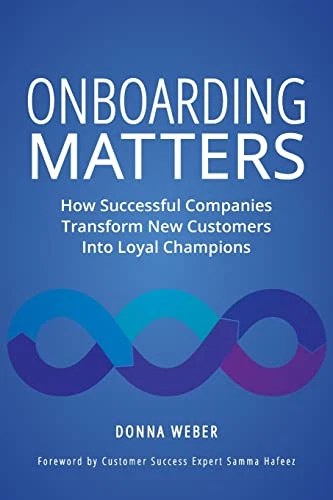
Onboarding Matters by Donna Weber is a 2021 business book about customer success, onboarding, customer experience. Onboarding is not a one-time event but an ongoing process that continues until the customer is consistently realizing value from the product.
Summary
Onboarding Matters is Donna Weber's practical guide to customer onboarding for software companies, written from the perspective of a customer success consultant who has seen the same patterns fail repeatedly across B2B SaaS. Weber's central argument is that onboarding is not a support function or a one-time technical exercise — it is the foundation on which customer lifetime value is built or lost, and most companies treat it as an afterthought.
The book introduces the Orchestrated Onboarding framework, which breaks onboarding into three phases: welcome and kickoff, adoption, and optimization. Each phase has specific goals, handoffs, and success criteria. Weber spends significant time on the kickoff — the first structured meeting with a new customer — arguing that most companies let this moment be informal and unstructured when it should be deliberate and outcome-focused. A well-run kickoff aligns customer goals with product capabilities, sets realistic timelines, and establishes the accountability structure that will govern the rest of the relationship.
Weber is also direct about the organizational dysfunction that makes onboarding fail. Sales teams often overpromise. Implementation and customer success teams are under-resourced and poorly integrated. The handoff from sales to post-sales is frequently a moment of confusion and dropped context. Fixing onboarding often means fixing cross-functional communication, which is harder than fixing a playbook.
The book is aimed squarely at customer success professionals in B2B SaaS companies, and its applicability outside that context is limited. The frameworks are practical and the examples are drawn from real consulting work, which makes them useful if you recognize your own situation. Readers looking for a theory of customer experience rather than a how-to guide for SaaS onboarding will find it narrower than expected.
Talk to Onboarding Matters like its author wrote you back.
Get the ideas that fit your life — not generic summaries.
- Chat with the book
- Audiobook-style main ideas
- Adapts to your life and goals
- Helps you take action
Key takeaways
- 1.
Onboarding is not a one-time event but an ongoing process that continues until the customer is consistently realizing value from the product.
- 2.
The kickoff meeting is the highest-leverage moment in the customer relationship and deserves more preparation than most teams give it.
- 3.
Customer churn that appears at renewal is often rooted in a failed onboarding months earlier. By the time customers say they're leaving, the outcome was largely determined.
- 4.
The handoff from sales to customer success is one of the most common points of failure. Without structured context transfer, the customer experience resets to zero.
- 5.
Orchestrated onboarding requires a cross-functional playbook that aligns sales, implementation, product, and customer success around a shared definition of success.
- 6.
Time-to-value is the most important early metric in a customer relationship. The longer it takes for a customer to see results, the more the relationship erodes.
- 7.
Internal champions matter: onboarding works better when both the vendor and the customer have identified who is responsible for driving adoption internally.
Discussion questions
Use these on your own, with a book club, or as chat starters in Superbook. Book club version, ready to copy or print →
- 1.
Weber argues that churn decisions are made early in the customer relationship, long before renewal. Does that match what you've observed in companies you know?
- 2.
Think of a software product you or your organization adopted. What did the onboarding experience get right, and where did it fail to connect the product to your specific goals?
- 3.
The handoff from sales to implementation is described as a common failure point. What information actually needs to transfer, and what gets lost in most companies?
- 4.
Weber's framework is built for B2B SaaS. How would you adapt the orchestrated onboarding concept to a different industry or a consumer product?
- 5.
Most customer success teams are under-resourced relative to sales. What does that resource imbalance signal about how organizations actually value long-term retention?
- 6.
Time-to-value is the key early metric Weber emphasizes. How would you define and measure time-to-value for a product you work on or use?
- 7.
What does it look like when a customer internal champion is genuinely effective? What's missing when there isn't one?
- 8.
Sales teams often overpromise during the deal cycle. What incentive structures create that pattern, and who is responsible for correcting it?
- 9.
Weber suggests onboarding should be owned by a specific role or team. In your organization, who actually owns the new customer experience end-to-end?
- 10.
The book focuses on B2B SaaS. What's fundamentally different about onboarding in a relationship-heavy professional services context versus a product-led growth model?
- 11.
If you were redesigning the onboarding experience for a product you know, what would you change first and why?
Themes
Frequently asked questions
-
Who should read Onboarding Matters?
Customer success managers, onboarding specialists, and SaaS founders who want to reduce churn and improve early customer experience. It's less useful for people outside B2B SaaS or those looking for a conceptual treatment of customer experience rather than a practical playbook.
-
What is the Orchestrated Onboarding framework?
A three-phase structure covering welcome and kickoff, adoption, and optimization. Each phase has defined goals, handoffs, and success criteria designed to move a new customer from contract signing to consistent value realization in a structured, accountable way.
-
Is Onboarding Matters only for SaaS companies?
Primarily yes. The frameworks assume recurring revenue, a distinct implementation phase, and cross-functional teams that don't always exist outside software businesses. Some concepts like time-to-value and internal champion identification translate broadly, but the specifics are SaaS-first.
-
How long does it take to read Onboarding Matters?
Around three and a half to four hours. It is a practical rather than a literary book — dense with frameworks and examples — so readers who want to implement the ideas may spend additional time with specific chapters.
-
What's the most actionable idea in the book?
Redesigning the kickoff meeting. Most onboarding starts loosely. Weber's kickoff template — with explicit agenda, defined success criteria, and accountability assignments — is something most teams can apply immediately without waiting for a broader onboarding overhaul.