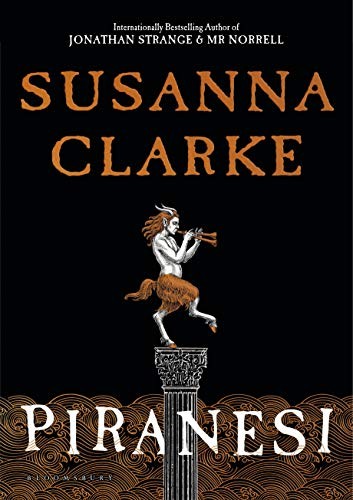
Piranesi by Susanna Clarke is a 2020 fantasy book about memory and identity, wonder and isolation, gaslighting and manipulation. The House is both setting and character — Clarke's achievement is making a non-human space feel fully inhabited and specific, with its own weather, ecology, and emotional logic.
Summary
Piranesi is structured as the journal of a man who calls himself Piranesi, living in a House that contains the world: a vast and apparently infinite series of halls filled with marble statues, where the tides come in twice a day and the skies are visible through the upper floors. Piranesi has no memory of how he arrived, no knowledge of what his name was before, and no sense that anything is wrong. He feeds himself on fish and dried seaweed, tracks the behavior of the tides, names the statues, and buries the dead he occasionally discovers. His only human contact is with a man he calls the Other, who visits twice a week to discuss their shared interest in a mythological theory about ancient knowledge embedded in the House.
The novel is structured as a mystery, and readers will solve it at a different pace than Piranesi does — part of the pleasure and the horror is watching a man systematically dismantled come back together, without knowing he was dismantled, without knowing that the damage is ongoing. What initially reads as world-building — the description of the House, its halls, its statues, its tides — gradually reveals itself as a portrait of captivity and psychological manipulation, and the shift from wonder to dread is managed with exceptional precision.
Clarke's prose is spare and formal, rendered in journal entries that reveal character not through interior monologue but through what Piranesi notices and what he doesn't. The novel is very short — under 300 pages — and gains power from its compression. It won the Women's Prize for Fiction in 2021, and the consensus is that Clarke has done something rare: written a fantasy novel that works as literary fiction without sacrificing the pleasures of either genre. Readers who loved Jonathan Strange and Mr Norrell will find a completely different approach to a different set of concerns, but will recognize the same capacity for imagining worlds from the inside.
This is not a difficult novel — it's accessible and propulsive — but it is an unusual one. It requires surrendering to a perspective that is unreliable not because its narrator is dishonest but because he is genuinely missing information about himself. Readers who enjoy psychological suspense in unusual containers, who like the literary novel of a person rediscovering who they are, and who don't need conventional fantasy world-building will find it one of the most satisfying novels of recent years.
Talk to Piranesi like its author wrote you back.
Get the ideas that fit your life — not generic summaries.
- Chat with the book
- Audiobook-style main ideas
- Adapts to your life and goals
- Helps you take action
Key takeaways
- 1.
The House is both setting and character — Clarke's achievement is making a non-human space feel fully inhabited and specific, with its own weather, ecology, and emotional logic.
- 2.
The gap between what Piranesi knows and what the reader gradually suspects is managed with unusual care — the novel rewards re-reading the early sections after finishing.
- 3.
Memory is not just information. Losing it is losing selfhood, and Piranesi's recovery is not just cognitive but existential — a reconstruction of who he is, not just what happened.
- 4.
Gaslighting as a systematic practice is examined through the extreme case of a man whose entire reality has been constructed by someone else. The novel makes the dynamics of psychological manipulation viscerally clear.
- 5.
Wonder is a moral condition in the novel — Piranesi's capacity for gratitude and attention to beauty is both his greatest vulnerability and his greatest resource.
- 6.
The uncanny house has a long literary tradition, from gothic fiction through Borges to Clarke's own Jonathan Strange. Piranesi works within that tradition while doing something genuinely new.
- 7.
The journal form is not decorative. The specific constraint — we only know what Piranesi notices and chooses to record — is what makes the mystery work and what makes his character coherent.
- 8.
By the end, the question of whether the House is real or not is deliberately left open. Clarke is more interested in what inhabiting it did to Piranesi than in resolving its ontology.
Discussion questions
Use these on your own, with a book club, or as chat starters in Superbook. Book club version, ready to copy or print →
- 1.
The novel reveals its central mystery gradually — do you think Clarke intended readers to solve it before Piranesi does, or is that a side effect of the form?
- 2.
Piranesi's wonder at the House — his genuine gratitude and love for it — persists even after he learns what has been done to him. What does the novel say about the relationship between captivity and beauty?
- 3.
The Other is the novel's villain, but his motives are complex. Did you find him sympathetic? Does the novel ask you to?
- 4.
Piranesi has been stripped of his past self and, arguably, his past self had significant flaws. Does the novel endorse his new self as an improvement, or is that reading too neat?
- 5.
The House defies physics and has no clear explanation by the novel's end. Is the ambiguity about its nature satisfying or frustrating?
- 6.
Clarke uses the journal form to limit information — we can only know what Piranesi chooses to record. Did you trust his narration, or were you reading against it?
- 7.
The novel is very short. Did the compression feel like a constraint or a strength? Is there anything the novel needed more of?
- 8.
Compare Piranesi to Jonathan Strange and Mr Norrell. Both are fantasy novels, but they are doing very different things. What remains consistent between them?
- 9.
The statues in the House are described with great care. What function do they serve — as world-building, as symbol, as something else?
- 10.
Piranesi's character is defined in part by his genuine kindness toward the dead he discovers. What does the novel do with that quality — is it simply admirable, or does it serve a structural purpose?
- 11.
The novel won the Women's Prize for Fiction. Is that category relevant to how you read it, or does the prize categorization feel beside the point?
Themes
Frequently asked questions
-
Is Piranesi worth reading?
Yes, by almost any measure. It is one of the most original novels of the past decade — short, strange, beautifully controlled, and genuinely moving. Even readers who don't usually read fantasy will find it accessible. It reads in a single sitting and rewards re-reading.
-
Do I need to read Jonathan Strange and Mr Norrell first?
No. Piranesi is completely standalone. The two novels share an author but nothing else — different world, different form, different scale. Jonathan Strange is a 1000-page Victorian doorstop; Piranesi is a tight 272 pages.
-
Is Piranesi a mystery novel?
Effectively, yes — it's structured as a mystery and generates the specific pleasures of watching a puzzle resolve. But it's also a psychological novel about manipulation and recovered identity, and a fantasy novel with genuine world-building. It works in all three registers.
-
Is Piranesi a hard read?
No. The prose is formal but clear, the journal form is accessible, and the novel moves quickly. Some readers find the opening disorienting — you're dropped into a world without explanation — but the disorientation is intentional and pays off.
-
Who shouldn't read Piranesi?
Readers who need full rational explanation for their fantasy premises — the House is never fully explained and the novel doesn't apologize for that. Also readers who find extremely self-contained worlds claustrophobic, since the novel barely leaves its single location.