Psychology · Book club
Pre-Suasion: A Revolutionary Way to Influence and Persuade book club questions
Here are 11 book club questions for Pre-Suasion: A Revolutionary Way to Influence and Persuade by Robert B. Cialdini, ordered to open easily and end somewhere worth arguing about. Copy them, print them, or bring them up one at a time.
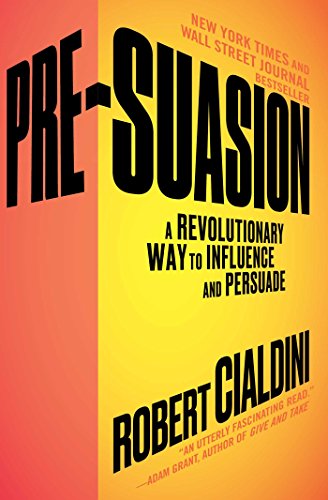
Robert Cialdini spent decades studying the principles of persuasion that animate Influence, his 1984 masterwork.
Robert B. Cialdini · 2016 · 5h 0m
Full summary and key takeaways →The 11 questions
- 1.
Cialdini argues that the moment before a message matters as much as the message itself. Can you think of a case where you have experienced this — where the setup shaped how you received information?
- 2.
The attention-causation link means that focusing on a factor makes it seem more causally important. Where do you see this operating in media, politics, or organizational communication?
- 3.
Priming research has had replication problems. How do you weigh those replication challenges against the common-sense observation that context shapes judgment?
- 4.
He proposes a seventh principle of influence: unity, or shared identity. How is belonging to the same group different in its influence from simply liking someone?
- 5.
The book opens frame — what is presented first — shapes the entire subsequent evaluation. Can you think of a negotiation, presentation, or conversation where you have deliberately managed the opening frame?
- 6.
Cialdini ends the book arguing that manipulative use of influence principles damages both relationships and the influence practitioner's long-term capacity. Is that claim convincing?
- 7.
How does pre-suasion relate to what designers, marketers, and architects already do in managing environments and attention flows?
- 8.
The book argues that channeled attention produces focused conviction. What is the ethical line between legitimate persuasion and manufactured conviction?
- 9.
He describes pre-suasion as working on both the audience and the communicator — attending to a reason for a position also strengthens that position in the holder's own mind. What does that imply for how you prepare for important conversations?
- 10.
What is the most valuable pre-suasive move you have observed someone else make, and what made it effective?
- 11.
If you were going to apply one idea from this book to a high-stakes communication in your own life, what would it be?
How to run the discussion
- Pick six to eight, not all of them. An hour of real discussion covers fewer questions than anyone expects, and racing the list is what makes a book club feel like homework.
- Open with what people noticed, not what they concluded. Asking for a verdict first hardens opinions before anyone has heard each other.
- Let the disagreement run. The questions below that split a room are the ones worth the time; the ones everyone answers the same way can be skipped.
- Ask the quiet person a specific question. A direct, narrow question is far easier to answer than an open invitation to contribute.
Themes worth steering toward
If the conversation stalls, these are the threads that usually restart it.
Common questions
What are good book club questions for Pre-Suasion: A Revolutionary Way to Influence and Persuade?
Here are 11 book club questions for Pre-Suasion: A Revolutionary Way to Influence and Persuade by Robert B. Cialdini, ordered to open easily and end somewhere worth arguing about. The strongest openers ask what each reader noticed rather than what they concluded, and the discussion usually turns on persuasion, attention, priming.
How long should a book club discussion of Pre-Suasion: A Revolutionary Way to Influence and Persuade last?
Most groups run 60 to 90 minutes of actual discussion. That is roughly six to eight questions, not all of them, so pick the ones that suit your group rather than working down the list in order.
What are the main themes in Pre-Suasion: A Revolutionary Way to Influence and Persuade?
Persuasion, Attention, Priming, Influence, Communication. Those are the threads most likely to divide a room, which makes them the useful places to steer a discussion that has gone quiet.
Picking the next one? See books like Pre-Suasion: A Revolutionary Way to Influence and Persuade or questions for other book club picks.
